
Start by locking a vision with the bride, then poll dates and budgets before you book anything. Pick lodging first, build the itinerary around two to three anchor events per day, and collect a deposit from every attendee before final payments come due. Guests typically split the bride's travel and lodging costs while she covers her airfare, and a shared planning hub keeps everyone honest about who owes what.
TL;DR:
- Lock in accommodations early since popular properties sell out months ahead, especially for destination trips, and confirm reserved activities before plans change.
- Keep the schedule simple with two to three anchor events each day, spaced with buffer time, and avoid overly tight or packed itineraries to prevent exhaustion.
- Use anonymous polls to set the budget around the group's comfortable minimum and choose a splitting method that suits the financial makeup, such as even, pay-your-own-way, or hybrid.
- Build the trip around a clear, shared itinerary with detailed confirmation info, addresses, and what to bring, shared in a single document for easy access.
- Incorporate flexibility and a contingency budget of 5-10% to handle unexpected issues, with a designated point person for real-time changes and communication.
- ✓Collaborative date voting with DateSync
- ✓AI-powered itinerary generation
- ✓Shared expense management with SplitEase
Table of Contents
- What Does the Bride Actually Want From This Trip?
- How Do You Budget and Split Costs Fairly?
- How Far in Advance Should You Plan a Bachelorette Trip?
- Which Destination and Lodging Fit Your Group?
- How Do You Build a Bachelorette Itinerary That Doesn't Exhaust Everyone?
- What Does a Sample 3-Day Bachelorette Itinerary Look Like?
- How Can a Planning Platform Simplify Bachelorette Logistics?
- How Do You Handle Dietary Restrictions and Activity Preferences?
- What's the Backup Plan If Something Goes Wrong?
- Do You Need Permits or Should You Worry About Noise Rules?
- How Should You Handle Airfare, Rentals, and Ground Transportation?
- Planner Perspective: The Mistake That Wrecks Most Trips
- Ready to Plan Without the Group Chat Chaos?
- Sources
- FAQ
What Does the Bride Actually Want From This Trip?
Every bachelorette trip falls apart at the same point: someone assumes what the bride wants instead of asking. Before you touch a calendar or a spreadsheet, get her answers to three questions.
- What's the vibe? Beach lounge chairs, a city bar crawl, or a cabin with cards and wine?
- What's the one must-include moment? A spa day, a specific restaurant, a concert tied to the trip dates?
- What's an absolute no? Certain activities, certain guests, certain price points?
Guest count changes everything downstream. A group of six fits a three-bedroom rental with room to spare. A group of fourteen needs a bigger property, a second vehicle, and a longer runway for group dinner reservations. Decide early whether moms, sisters-in-law, or plus-ones are coming, since a mixed-generation group usually means a tamer itinerary and different lodging needs than an all-friends weekend.
Once the guest list is roughly set, run a quick anonymous date poll instead of a group chat vote. A tool like DateSync lets everyone mark availability without the back-and-forth of ten people replying "works for me" out of order.
How Do You Budget and Split Costs Fairly?
Money is where most bachelorette trips quietly go wrong, usually because nobody says the real number out loud until it's too late to change plans. Fix that with an anonymous budget poll early, then plan around the lowest comfortable figure someone submitted, not the average.
From there, pick a splitting method that matches your group:
- Even split: everyone pays the same flat amount, simplest for groups with similar income and no plus-ones.
- Pay-your-own-way: each person covers their own flights, meals, and activities, with only shared costs like the rental split evenly. Works well for larger or financially mixed groups.
- Hybrid: a fixed core amount covers lodging and one anchor event, and everything else is opt-in. This lets budget-sensitive attendees join the heart of the trip without paying for extras they'd skip anyway.
Collect a deposit at booking. A $100 to $200 per-person deposit is common and cuts your cancellation risk if someone backs out. Set the final payment 2 to 3 weeks before departure, when the group's actual attendance is locked.
Pro Tip: Track every expense in one shared tool from day one instead of collecting receipts in a shoebox. A running tally makes the final settlement a five-minute task instead of a week of "wait, who paid for what?"
Weekend trips for domestic destinations commonly run $300 to $700 per person all in, while flight-heavy destination weekends often land between $700 and $1,500 once airfare enters the math.
How Far in Advance Should You Plan a Bachelorette Trip?
Lock lodging first. Vacation rentals and boutique hotels near popular dates get booked out months ahead, and losing your top pick usually cascades into losing your preferred neighborhood too. Once the property's confirmed, move on group dinner reservations and any timed activity, ropes courses, boat charters, or ticketed shows tend to sell out fastest.
For larger or destination-heavy groups, start the conversation about six months out, collect RSVPs 2 to 3 months before departure, and let attendees book their own flights once dates are firm.
- Book now: lodging, dinner reservations, ticketed or capacity-limited activities.
- Book later: casual daytime plans, pool time, anything that doesn't require a reservation.
- Staggered arrivals are normal. Build the schedule so late arrivals and early departures still catch at least one anchor event.
- Deposits reduce your exposure if someone cancels close to the trip, since that money is already committed toward the group total.
Which Destination and Lodging Fit Your Group?
Match the destination to three things: how far people are willing to travel, what it costs to get there, and whether the vibe actually fits what the bride asked for. A four-hour drive radius keeps costs down and skips airport logistics entirely, which matters more than people expect once you're coordinating ten travel schedules.
- Resort: built-in activities and food, higher price per night, least logistics for the planner.
- City weekend: more nightlife and restaurant variety, but higher per-meal costs and more decisions to make.
- Vacation rental: cheapest per person for larger groups, and everyone's under one roof, though someone has to handle check-in logistics and house rules.
Inside the rental or hotel block, price rooms in tiers rather than assigning them by seniority. Letting attendees choose and pay for their tier (master suite versus a shared room with bunks) avoids the resentment that comes from someone else deciding who gets the good room.
Before you book, check rideshare availability, parking situation, and posted quiet hours. A property with a strict 10 p.m. noise cutoff changes your Saturday night plans more than any activity choice will.
How Do You Build a Bachelorette Itinerary That Doesn't Exhaust Everyone?
The itinerary is where planners either nail it or burn out trying. The fix is simpler than most guides make it sound: build each day around two to three confirmed "anchor" events, add buffer time between them, and leave evenings loose.
An anchor is anything with a reservation attached, a dinner, a spa slot, a boat tour. Two to three anchors per day is the sweet spot; more than that turns a relaxing weekend into a checklist nobody enjoys. Buffer time between anchors covers the inevitable slow mornings, wardrobe changes, and the person who's always fifteen minutes behind the group.
- Arrival night: light plans only, dinner and drinks, nothing that requires being anywhere at 7 a.m.
- Main day: your two to three anchors, spaced with buffer, plus one flexible evening block.
- Recovery day: brunch, checkout, maybe one low-key activity before people scatter to flights.
Prebook anything timed or capacity-limited: dinner reservations, tours, classes. Leave pool time, shopping, and casual hangouts unplanned, since those fill themselves in naturally.
Pro Tip: Treat the itinerary as a reference document, not a minute-by-minute schedule. Share it as one scannable link two weeks before the trip so the maid of honor isn't fielding "where do we need to be?" texts all weekend.
Include addresses, reservation confirmation numbers, and what to bring for each anchor event. A shared doc beats a group chat every time, since nobody has to scroll back through a hundred messages to find the dinner reservation time.
What Does a Sample 3-Day Bachelorette Itinerary Look Like?
Here's a template built around the anchor and buffer approach that you can adapt to nearly any destination.
| Day | Time Window | Plan |
|---|---|---|
| Friday | afternoon block | Arrivals, check in, settle into rooms |
| Friday | evening block | Anchor: welcome dinner reservation |
| Saturday | morning block | Anchor: main activity (spa, tour, class) |
| Saturday | early afternoon block | Buffer: lunch, pool, rest |
| Saturday | evening to late night | Anchor: night out, dinner and going out |
| Sunday | morning slot | Recovery brunch, pack up |
| Sunday | late morning onward | Checkout, staggered departures |
Round out the shared doc with a quick checklist so nothing gets left behind:
- Confirmation numbers for lodging, dinners, and activities
- Chargers, medications, and any costume or themed items
- Emergency contact and nearest urgent care or pharmacy
- Who's paying for what, and where receipts get logged
How Can a Planning Platform Simplify Bachelorette Logistics?
Most of this workflow gets easier with one tool instead of five. DateSync handles the availability poll, an AI-powered itinerary builder turns your anchor list into a shareable schedule, and SplitEase logs expenses as they happen so nobody's reconstructing a Venmo history after the trip. The workflow is straightforward: collect availability, lock lodging, share the itinerary, log expenses as you go. Start on a free plan to test it, or consider an upgrade if you just need it for this one weekend.
How Do You Handle Dietary Restrictions and Activity Preferences?
Ask about dietary needs and physical limitations in the same message where you collect the date poll, not after the reservations are made. It's far easier to pick a restaurant that accommodates a gluten allergy before you book than to call and change a party of twelve the week of the trip.
A short intake question works better than expecting people to volunteer this information: "Any allergies, dietary restrictions, or physical limitations we should plan around?" Send it once, privately if needed, since some guests are more comfortable sharing medical details one-on-one than in a group chat.
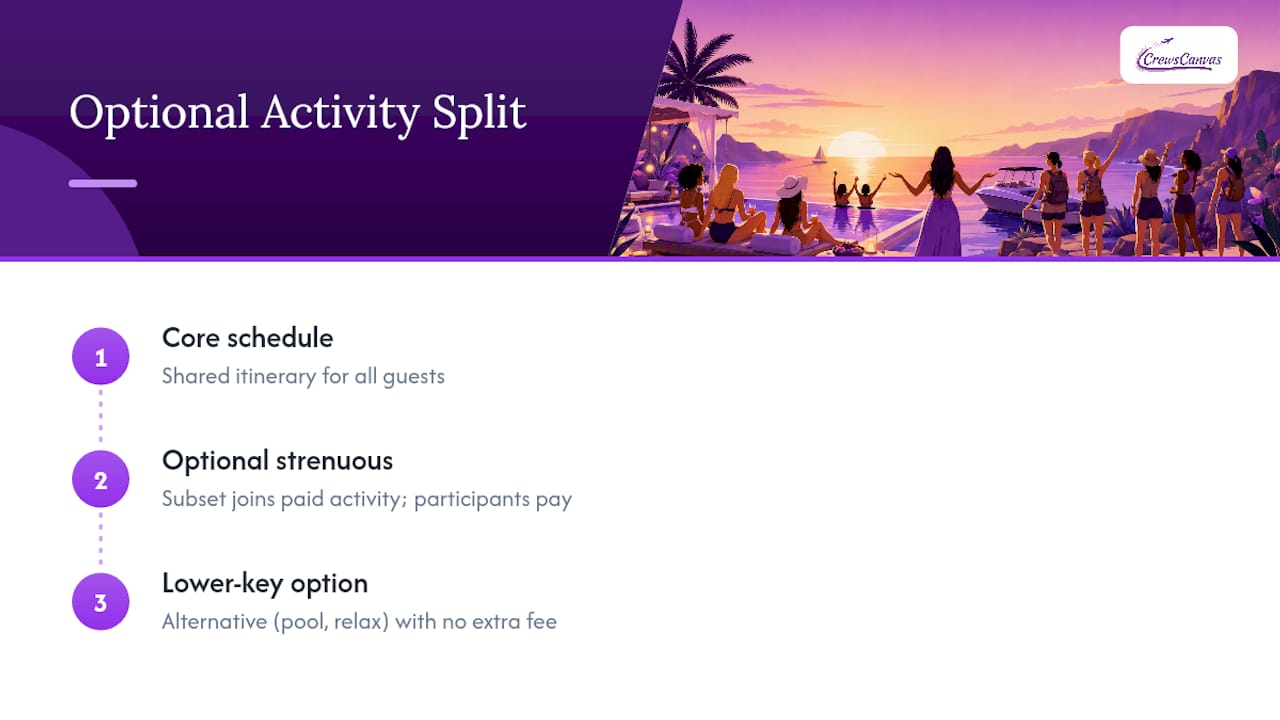
For activities, the same logic applies. Not everyone wants to do a hike or a boat excursion, and forcing full participation usually creates the one guest who spends the anchor event complaining instead of enjoying it. Build in one optional activity block where a subset of the group can skip the strenuous plan for something lower-key, a pool afternoon instead of the zip line, for instance. This is also where the hybrid budget-splitting method pays off: guests who opt out of a pricier activity simply don't pay into it.
When booking group dinners, tell the restaurant your dietary counts in advance rather than hoping the server can accommodate on the spot. Most restaurants handling groups of eight or more need at least 24 hours' notice for allergy-specific meal prep.

What's the Backup Plan If Something Goes Wrong?
Weather cancels the boat tour. Someone gets sick and misses the flight. The rental's water heater breaks the morning of. None of these are rare, and none of them should derail the whole weekend if you've planned for the possibility.
Build slack into the schedule rather than filling every hour, since a fully booked itinerary has no room to absorb a delay. That's part of why the buffer time between anchor events matters as much as the anchors themselves.
For lodging and big-ticket activities, check the cancellation policy before you book and favor providers with flexible or partially refundable terms, even if they cost a little more upfront.
Keep a small contingency line in the shared budget, roughly 5 to 10% of the total, to cover last-minute substitutions without a scramble to collect more money from the group. If someone has to drop out last minute, decide in advance whether their deposit is refundable, transferable to a future trip cost, or absorbed by the group, and put that policy in writing when you first collect payments.
Designate one person, usually the maid of honor or a co-planner, as the point of contact for real-time changes. Splitting that responsibility across three people during an actual emergency just creates confusion about who's calling the rental company.
Do You Need Permits or Should You Worry About Noise Rules?
Most bachelorette activities need no special permit, but a few common ones do. Public parks, beaches, and some private event spaces often require a reservation or day-use permit for groups above a certain size, and many cities require permits for anything involving alcohol in a public space, a park picnic with a keg, for instance.
Vacation rentals are the bigger risk area. Many cities and homeowner associations enforce quiet hours, typically somewhere between 10 p.m. and 8 a.m., and some short-term rental platforms include noise-monitoring devices with automatic fines for violations. Read the house rules before booking, not after you've already planned a late-night hot tub party.
If your itinerary includes anything unusual, a party bus, a large group photo shoot at a public landmark, a rented venue space, call ahead and ask directly whether a permit is required. Local visitor bureaus and city clerk offices can usually answer this in one phone call, and it's a much better use of five minutes than finding out mid-trip that you're not allowed to be where you are.
How Should You Handle Airfare, Rentals, and Ground Transportation?
Flights are almost always each person's own responsibility once the trip dates are locked, both because coordinating group airfare rarely saves money and because attendees are traveling from different cities. Send the confirmed dates as early as possible so people can book before prices climb.
For ground transportation, decide early whether you're renting a vehicle, using rideshare apps, or hiring a private shuttle for the group. A single 12-passenger van rental often costs less per person than a dozen separate rideshare trips, especially in destinations where rideshare pricing surges during weekend nights.
If the group is landing at different times, arrange one shared airport pickup option rather than everyone booking individual rides. A group like those driving in from Cleveland, Columbus, or Detroit for a regional weekend trip might skip flights entirely and split gas and a rental car instead, which is often the cheapest transportation option for groups within driving distance.
Check whether your lodging includes parking before assuming everyone can bring a car. Downtown properties in particular sometimes charge steep daily parking fees that aren't obvious until you're already checked in.
Planner Perspective: The Mistake That Wrecks Most Trips
The biggest mistake isn't picking the wrong destination. It's over-scheduling every hour and glossing over the real budget number until deposits are already due. Stick to two or three anchors a day, leave buffer room, and get the money conversation done honestly before anyone books flights. Do that, and the rest of the weekend takes care of itself.
— CrewsCanvas
Ready to Plan Without the Group Chat Chaos?
CrewsCanvas replaces the group chat and spreadsheet combo with one shared hub, so nobody has to scroll through 200 messages to find the dinner reservation time.
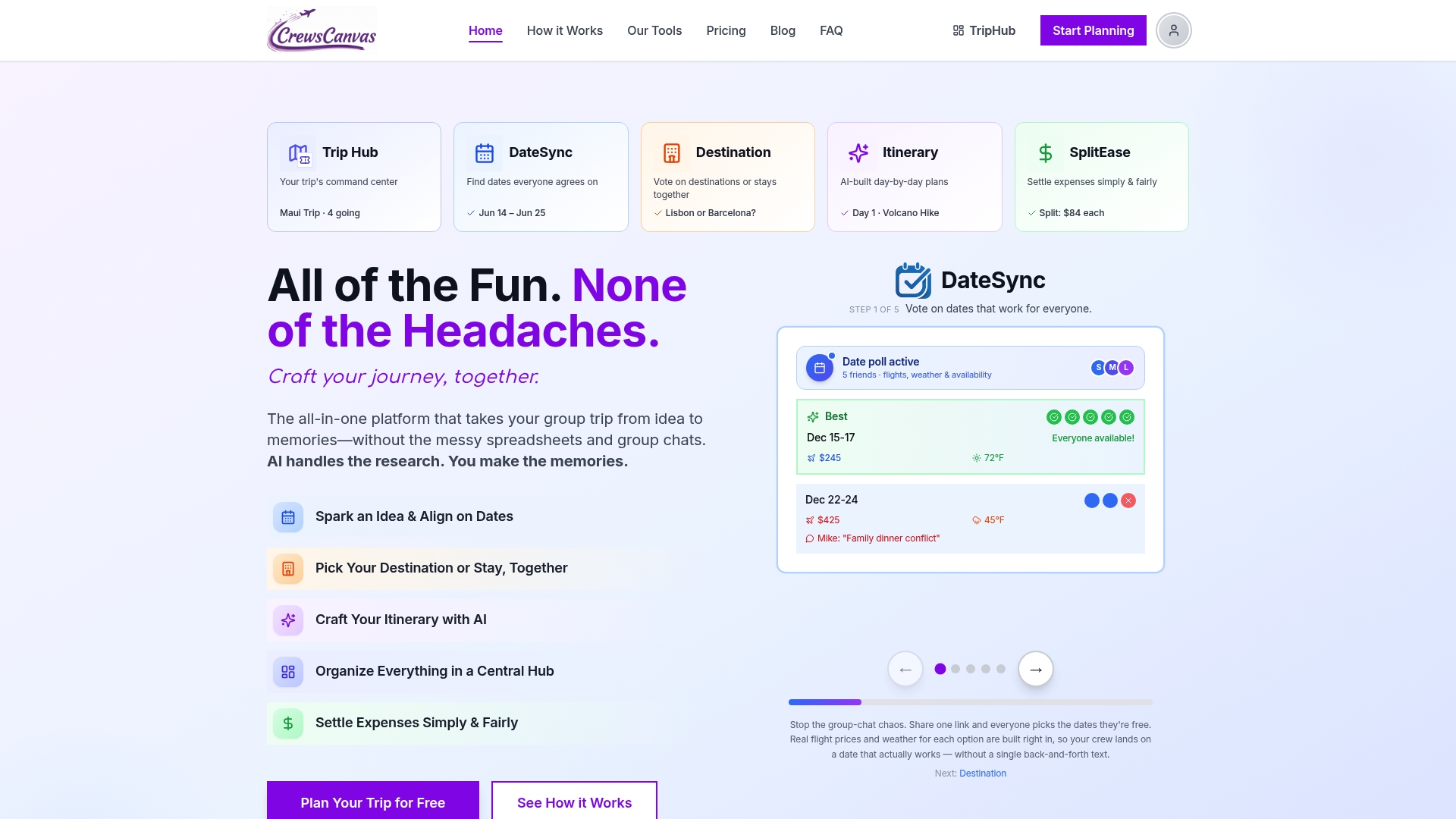
Everyone can vote on dates through a date polling tool, an AI itinerary builder can turn your anchor list into a shareable schedule in minutes, and expense logging features help make settling up at the end of the trip quick and easy. Nobody needs to download an app or create an account to participate, they just use the shared link. The Free plan covers small groups, and if you only need this for one weekend, One-Trip Pro unlocks the full toolkit for $14.99 as a one-time payment. Head to the pricing page and pick the option that fits your group size, then start your date poll today.
Sources
The budget ranges and splitting norms in this guide come from Nearlywed Magazine's cost-splitting breakdown, the PartyTab budget guide, and RipTrip's budget breakdown. The itinerary structure follows the anchor-and-buffer framework outlined by Bachelorette Party Depot, and the planning timeline draws on Zola's bachelorette checklist.
- How to Split Costs on a Bachelorette Trip (Without the Awkwardness) - Nearlywed Magazine
- Bachelorette party itinerary: How to build the perfect weekend
- Bachelorette Party Budget Breakdown | RipTrip
FAQ
What Is a Normal Budget for a Bachelorette Trip?
Domestic weekend trips commonly run $300 to $700 per person all in, covering lodging, meals, and one or two anchor activities. Destination trips involving flights often climb to $700 to $1,500 per person once airfare is factored in.
How Far in Advance Should You Plan a Bachelorette Trip?
For larger or destination-heavy groups, start planning around six months out, locking lodging first since it books up fastest. Smaller local trips can come together in as little as six to eight weeks.
How Many Days Should a Bachelorette Trip Be?
Three days, typically a Friday through Sunday weekend, is the most common length and gives room for an arrival night, one main day of anchor activities, and a recovery day before travel home. Longer trips work for destination-heavy groups but require more lead time for flights and lodging.
What Should You Do on a Bachelorette Trip?
Structure each day around two to three confirmed anchor events, a dinner reservation, a spa appointment, a group activity, with buffer time in between and evenings left flexible. A platform like this can turn an anchor list into a shareable itinerary automatically through an AI planner.