
Agree on a budget and travel dates before anyone mentions a destination, collect a deposit within a week of picking dates, assign one lead organizer, choose a trip style that fits the group's patience for logistics, and build the schedule around a few shared anchor points instead of a packed itinerary. Do that, and you skip the 200-message group chat spiral entirely. Use a shared workspace like CrewsCanvas to keep dates, bookings, and money in one place instead of scattered across five apps.
TL;DR:
- Setting a clear budget upfront, including core costs, shared experiences, individual spending, and a buffer, prevents cost-related conflicts during the trip.
- Proposing three specific date windows and requiring a firm commitment within a week ensures group consensus without prolonging planning delays.
- Choosing a trip style that matches the group's coordination tolerance, such as resorts or cruises for less effort, reduces logistical stress and frustration.
- Assigning defined roles like lead organizer, finances, and activities helps distribute workload and identify potential troublemakers early in the planning process.
- Using centralized tools for polling, shared itineraries, expense tracking, and documentation streamlines coordination and minimizes fragmented communication.
- ✓Vote on dates with DateSync
- ✓Generate a smart itinerary with AI
- ✓Manage shared costs with SplitEase
Table of Contents
- Set a realistic group budget and payment rules
- How to pick dates your whole group will commit to
- Choosing a trip style that matches your group's patience for logistics
- Who should organize what, and how to spot a problem trip member early
- Building an itinerary with anchor points, not a minute-by-minute schedule
- How to manage shared costs so no one feels shorted
- Which tools and apps actually help, and where AI plans fall short
- Pre-trip logistics: the checklist to run in the final weeks
- Keeping the peace: etiquette rules and a simple way to handle conflict
- How CrewsCanvas maps to every step of this process
- A planner's perspective: what actually breaks friends trips
- Ready to plan your next trip without the spreadsheet chaos
- Sources
- FAQ
Set a realistic group budget and payment rules
Money problems sink more friends trips than bad weather ever will. The fix isn't a bigger budget. It's agreeing on scope before anyone starts pricing flights.
Start with the full per-person cost, not just the headline number. A "$800 trip" that ignores baggage fees, airport transfers, tips, and one splurge dinner turns into a $1,200 trip by day two, and that gap is exactly where resentment builds. Travel guides consistently recommend a budget-first approach that locks in a spending range before anyone falls in love with a destination the group can't actually afford.
Your budget conversation should cover:
- Core travel costs: flights, lodging, ground transportation, and baggage fees.
- Shared experiences: excursions, group meals, and any splurge activity everyone opts into.
- Individual spending: souvenirs, drinks, and side activities people cover on their own.
- Travel protection: whether the group buys individual policies or skips it.
- A buffer: 10 to 15% on top of the estimate for the thing nobody planned for.
Once the range is set, eliminate destinations that don't fit. This is the step most groups skip, and it's why they end up locked into a trip half the group secretly can't afford.
Deposits are where budgeting turns into commitment. A reasonable ask is a modest percentage of the estimated per-person cost, due within a week of the date being locked in, and clearly labeled as nonrefundable unless the whole trip cancels. Vague language here creates disputes later, so spell it out in the group chat: "Deposit of $150 due by March 3rd, nonrefundable after that date, covers your share of the house deposit."
For the payment flow itself, you generally have two options. Everyone pays their own share directly to vendors, which works for flights and independent bookings but gets messy fast for shared costs like a rental house. Or one person collects a shared kitty and pays vendors on the group's behalf, which is simpler operationally but puts pressure and risk on that one person. Most successful trips use a hybrid: individual bookings for flights, a shared kitty for house/car/group meals. A tool like CrewsCanvas can split those shared costs automatically instead of someone manually tracking a spreadsheet of who owes what.
How to pick dates your whole group will commit to
Date-picking kills more trips at the planning stage than any other single step. Here's a process that actually converges instead of dragging on for six weeks.
- Propose three date windows, not open-ended options. Ask "which of these three weekends works" instead of "when are you all free," which invites twelve different answers and zero consensus.
- Run a structured vote with a hard close date. A simple poll, whether through a shared spreadsheet or a tool like CrewsCanvas's DateSync, narrows things fast when everyone can see the tally in real time instead of guessing from scattered texts.
- Give the vote five to seven days, then close it. Longer windows don't produce more responses. They just delay the decision.
- Set a commitment deadline separate from the vote. Voting on a date and committing money to it are different actions. Give people 48 to 72 hours after the winning date is announced to confirm with a deposit.
- Handle stragglers with a clear rule stated in advance. Anyone who misses the deadline goes on a waitlist, and their spot opens up if a confirmed person needs to fill it.
Groups with parents, shift workers, or people in different time zones need extra lead time. Propose windows six to eight weeks out rather than two, and expect that at least one person's ideal weekend won't survive the vote. That's normal. The goal isn't unanimous enthusiasm. It's a date most people can actually make.
Choosing a trip style that matches your group's patience for logistics
Not every group needs the same kind of trip, and picking a format that fights your group's natural tendencies is a common planning mistake. A high-energy group of eight forcing themselves into a slow beach week will be just as unhappy as a low-key group of four white-knuckling through a packed multi-city itinerary.
Match the format to the group:
- City trips offer flexibility and lots of independent activity options, but require more coordination around restaurant reservations and transit.
- Beach or resort trips simplify logistics dramatically since meals, activities, and lodging are often bundled in one location.
- Cruises hand off most of the planning burden entirely, which works well for larger or less coordination-savvy groups. A cruise decision platform can help narrow ship and itinerary choices if this format fits your group.
- Active or adventure trips need more advance booking (permits, gear rentals, guides) and work best with smaller, similarly-fit groups.
- Multi-destination road trips offer the most freedom but multiply logistics with every stop, and rarely suit groups larger than five or six.
Group size changes everything about which format works. A trip built for six friends often falls apart at twelve, not because of personality conflicts but because restaurant reservations, transport, and lodging all get exponentially harder to coordinate. If your group exceeds eight or nine people, consider splitting into subgroups for some activities while keeping two or three anchor points where everyone reunites. Packaged options like resorts and cruises reduce this friction the most since most logistics are handled by a single vendor rather than assembled piece by piece.
Who should organize what, and how to spot a problem trip member early
Every group trip needs assigned ownership, or everything defaults to whoever is most anxious about logistics. That person burns out by week three of planning, and the resentment shows up on day one of the actual trip.
Split the workload across defined roles:
- Lead organizer: owns the timeline, sends reminders, and makes final calls when the group can't decide.
- Finance lead: collects deposits, tracks who's paid, and handles the shared kitty.
- Activities lead: researches and books excursions, restaurants, and anchor-point events.
- Bookings verifier: double-checks reservation confirmations, opening hours, and cancellation policies before anyone relies on them.
- Emergency contact: holds copies of everyone's travel documents and insurance info, and is the point person if something goes wrong on the trip.
Decision-making also needs a rule before it needs a decision. Writing this down before the first disagreement prevents the disagreement from becoming personal.
Vetting matters more than most groups admit, especially when a trip includes friends-of-friends who aren't well known to everyone. Watch for chronic unresponsiveness to planning messages, reluctance to commit money even after agreeing to dates, and vague answers about logistics they've claimed to handle. None of these are dealbreakers alone, but two or more together are worth a direct conversation before the deposit stage. For larger or looser-knit groups, safety practices like meeting new travel companions in low-stakes public settings first are worth building into the pre-trip process.

A short "expectations" message posted early sets the tone for everyone:
Pro Tip: Post the expectations message before the date poll, not after. People commit more honestly when they know the rules going in, rather than discovering them after they've already said yes.
Building an itinerary with anchor points, not a minute-by-minute schedule
The itineraries that actually survive contact with a group of six adults share one trait: they're built around a small number of fixed commitments, with everything else left loose. Overscheduling is one of the most common reasons friends trips turn stressful, according to Condé Nast Traveler's group travel guide, which recommends anchoring the day around one or two shared events rather than filling every hour.
Here's how to structure it:
- Pick one to two anchor points per day. A shared dinner reservation, a group excursion, or a planned activity everyone's expected to attend. More than that, and you're scheduling a group of adults like a summer camp, which breeds quiet resentment fast.
- Label everything else as optional. If half the group wants to sleep in and the other half wants a sunrise hike, both should be visible on the shared itinerary with an RSVP option, not treated as a scheduling conflict that needs resolving.
- Build in real buffer time between anchors. If a reservation is at 7:00 PM, don't schedule the prior activity to end at 6:45. One delayed Uber shouldn't cascade into a missed reservation for eight people.
- Account for group size in every time estimate. A restaurant that seats a table of four in fifteen minutes might take twenty-five minutes to seat a table of ten. Pad transitions accordingly.
- Keep the itinerary in one editable, shareable place. A group text with a screenshot of a Google Doc from three weeks ago is not a plan. Everyone needs access to the current version, ideally something they can check from their phone without downloading a new app. CrewsCanvas's itinerary builder keeps anchor points, RSVPs, and edits visible to the whole group in one link.
Protecting minority preferences matters here too. Research on group decision dynamics shows that friend groups often default to whichever preference is loudest, not whichever is most popular, which is exactly why "optional" activities need real visibility instead of getting quietly dropped. If three people want a museum and five want to shop, don't force a vote. Split the group for two hours and reunite at the next anchor point.
Documenting all of this in a shared, exportable format also solves a problem nobody thinks about until they're standing at an airport with spotty WiFi: someone needs offline access to confirmation numbers and addresses, not just a link that requires a live connection.
How to manage shared costs so no one feels shorted
Money handled sloppily during the trip undoes all the budget work you did before it. The goal isn't a perfect system. It's a visible one, where everyone can see what they owe and what's already been paid without asking.
Three models cover most situations:
- Everyone pays their own way for anything individual, like flights and personal spending, which needs zero coordination.
- A shared kitty works best for costs that benefit the whole group equally, like a rental house, a group dinner, or a shared driver.
- Itemized reimbursement fits situations where one person fronts a cost (say, booking the Airbnb on their card) and everyone pays them back their share afterward.
Spreading payments this way keeps any single request from feeling like a shock, and it gives the finance lead a natural checkpoint to flag anyone falling behind.
For tracking spending during the trip itself, receipt photos beat memory every time. Whoever pays for a shared expense snaps a photo of the receipt and logs it immediately, rather than trying to reconstruct four days of spending from memory on the last night. An expense tool with built-in receipt scanning, the kind CrewsCanvas's SplitEase feature is built around, removes the awkward "does anyone remember what we spent at that lunch" conversation entirely by settling balances automatically once the trip wraps.

Cancellations after payment need a rule set in advance, not negotiated in the moment. A common and fair approach: the canceling person forfeits their deposit unless a replacement is found, and any nonrefundable shared costs (like a house deposit) get redistributed across the remaining group unless someone fills the empty spot.
Pro Tip: Settle all shared expenses within 48 hours of getting home. The longer balances sit open, the more likely someone quietly writes off what they're owed instead of asking for it, which breeds resentment even when nobody says anything.
Which tools and apps actually help, and where AI plans fall short
Most friends trips don't fail from lack of effort. They fail from fragmentation, planning details scattered across a group chat, three spreadsheets, and someone's Notes app. A centralized workspace that holds dates, itinerary, and expenses in one place consistently reduces the pre-trip stress that fragmented planning creates.
At minimum, your group needs tools covering:
- Date polling, so the group can vote on windows instead of scrolling forty messages to find the one where someone mentioned their schedule.
- A shared itinerary builder, ideally one that lets non-organizers view and RSVP without creating an account.
- Expense tracking with receipt capture, so nobody has to reconstruct spending from memory.
- Central document storage, for confirmation numbers, addresses, and booking details.
When evaluating any tool, check that guests can access it without mandatory sign-ups, that data exports if you need it offline, and that it works cleanly on mobile, since most trip coordination happens from someone's phone in a parking lot, not at a desk.
AI itinerary tools deserve a specific caution here. They're genuinely useful for ideation, generating a rough first draft of "things to do in three days" faster than any of you could manually. But a 2025 review found that roughly 25% of AI-generated itineraries recommended venues that were permanently closed. AI tools are fast but limited when it comes to real-time details like current hours, availability, or whether a restaurant even still exists.
The fix isn't avoiding AI. It's treating its output as a first draft, never a final plan. Assign your bookings verifier to check every AI-suggested venue against its current hours, reviews, and reservation availability before it goes on the shared itinerary. A quick verification checklist works: confirm the business still operates, confirm hours match the day you're visiting, and confirm a reservation or ticket is actually available if one's required.
Pre-trip logistics: the checklist to run in the final weeks
The final stretch before departure is where small oversights turn into last-minute scrambles. Running a consistent confirmation cadence prevents that.
At 90 days out, confirm major bookings are locked: flights, the primary lodging, and any reservation that requires advance notice for a large group, since many restaurants cap walk-in party sizes well below what a friends trip needs. At 60 days, confirm ground transportation and any activity requiring tickets or permits booked in advance. At 30 days, verify final headcounts with vendors, since restaurant and activity reservations for groups often need updated numbers close to the date. At 7 days, do a final document check.
Your document checklist should cover:
- Copies of IDs and passports, both physical and digital, held by the emergency contact.
- Confirmation numbers for every booking, stored somewhere accessible offline.
- Emergency contact info for everyone in the group, including someone back home.
- Travel protection details, if the group purchased any, including policy numbers and claim procedures.
Travel protection decisions vary by trip cost and destination, but the basic question every group should answer explicitly is whether coverage is individual or shared, and who's responsible for signing up. Leaving it unstated means half the group assumes someone else handled it. A structured confirmation rhythm, similar to the pre-event communication cadence used in large group event planning, keeps everyone's confidence up and prevents the week-before scramble that derails otherwise well-planned trips.
Keeping the peace: etiquette rules and a simple way to handle conflict
Even well-planned trips hit friction. The difference between a friend group that recovers and one that doesn't usually comes down to whether they agreed on ground rules before the trip started.
Post a short etiquette list in the group chat before departure: quiet hours if you're sharing a house, a rough norm for splurge spending so nobody feels pressured into a $200 dinner they can't afford, and a simple check-in expectation if someone splits off for the day.
When actual conflict comes up, a three-step approach handles most situations without dragging the whole group into it:
- Address it privately first. Most friction, someone feeling left out of a decision, a snide comment about spending, resolves with a direct one-on-one conversation before it becomes a group issue.
- Bring in a mediator if it doesn't resolve. A third friend who's not directly involved can often defuse tension neither party can on their own.
- Split into subgroups temporarily if needed. Not every disagreement needs resolving. Sometimes the best move is two hours apart doing different things, then reuniting for the next anchor point.
Organizers should step in when a conflict starts affecting the group's shared plans, like someone refusing to show up to a paid reservation out of spite, but should generally let small personality friction pass on its own. A simple line like "Let's figure this out later, we've got reservations in twenty minutes" buys time and de-escalates without forcing a resolution mid-argument.
How CrewsCanvas maps to every step of this process
Everything above works with a whiteboard and a group chat if your group is disciplined enough. Most aren't, which is exactly the gap CrewsCanvas is built to close by putting the whole process in one shared link nobody has to download an app or create an account to use.
Here's how the pieces map directly to the steps covered above:
- Bookings and shared documents live in TripHub, giving the group one place for confirmation numbers and reservations instead of five separate email chains.
- Deposits and expense tracking run through SplitEase, which handles receipt capture and final settlement so the finance lead isn't manually tallying who owes what.
- Draft itineraries come from CrewsCanvas's AI itinerary planner, built as a starting point for the group to edit, not a finished plan to trust blindly.
A typical flow looks like this: create the trip, run the date poll, set and collect the deposit, generate a draft itinerary, assign someone to verify the AI's suggestions against current hours and availability, then finalize bookings once everyone's confirmed. Every step from this article has a corresponding tool, so nothing gets lost between the group chat and the actual trip.
A planner's perspective: what actually breaks friends trips
Most guides to group travel treat destination choice as the hard part. It isn't. In three seasons of watching friend groups plan trips, the failure point is almost always money and commitment, not where to go. Groups agree on a destination in an afternoon and then spend six weeks failing to agree on who owes what.
Three lessons stand out. First, a deposit collected late is a deposit that will eventually not get collected at all. Waiting until "closer to the trip" to ask for money always produces at least one person who backs out once real dollars are on the line. Second, buffer time isn't optional padding. It's the difference between a group that laughs off a delayed Uber and one that starts sniping at each other by day two. Third, delegation isn't a nice-to-have for the organizer's sanity. It's the only thing standing between one burned-out planner and a trip that actually gets built.
Here's a one-line checklist worth pasting straight into your group chat: agree on budget, vote on dates, collect a deposit within a week, assign roles, build two anchor points a day, and settle expenses within 48 hours of getting home.
Organizer burnout is real and avoidable. The moment planning starts feeling like a second job, hand off a role. Someone in the group wants ownership over something. Let them have it.
— CrewsCanvas
Ready to plan your next trip without the spreadsheet chaos
CrewsCanvas replaces the group chat, the shared spreadsheet, and the separate payment app with one link everyone can use, no downloads and no accounts required for participants. That's the real difference: your friends click a link, vote on dates, and see the budget breakdown, instead of you chasing five people for Venmo confirmations across three different threads.
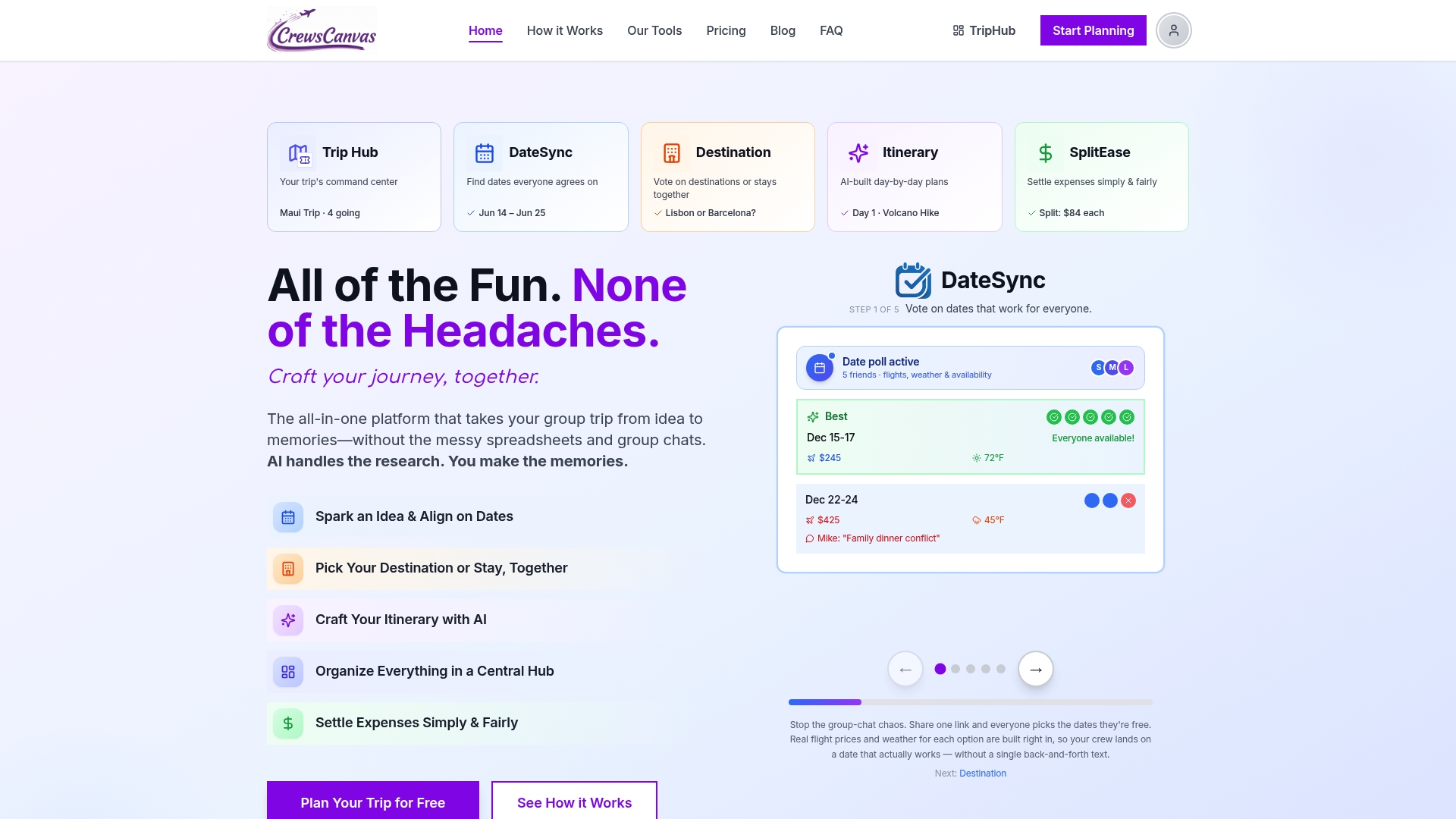
Start by creating a trip and running a date poll through DateSync, then set a small deposit to lock in real commitment before anyone books flights. From there, generate a draft itinerary and assign someone to verify the details, since even a solid AI-drafted plan needs a human checking hours and availability before it goes live. Track shared costs as they happen with SplitEase so settling up after the trip takes minutes, not a week of Venmo requests. CrewsCanvas offers various plans including a free option, a monthly subscription plan, and a one-time payment option for accessing premium features. Compare what fits your group's size and trip frequency on the pricing page, and get the whole group moving on the same plan.
Sources
- Can you trust AI to give you good travel advice? — The Seattle Times
- The complete guide to group travel — Condé Nast Traveler
FAQ
Is there an app to plan a trip with friends?
Yes, several platforms handle group trip planning, including CrewsCanvas, which combines date polling, a shared itinerary builder, and expense tracking in one link that participants can use without creating an account. Look for a tool that doesn't require every friend to download an app or sign up just to vote on a date or view the itinerary.
What are some good trip ideas for a group of friends?
The best trip format depends on your group's size and tolerance for coordination. Beach and resort trips simplify logistics since meals and activities are often bundled, while cruises hand off most planning to a single vendor, which works well for larger or less coordination-heavy groups.
Can I use ChatGPT to plan a trip?
You can use it for ideation and a rough first draft of activities, but treat the output as a starting point, not a finished plan. A 2025 review found that about 25% of AI-generated itineraries recommended venues that were permanently closed, so always verify hours, availability, and reservations before finalizing anything AI suggests.
What are red flags to look for in a travel companion?
Watch for chronic unresponsiveness during planning, reluctance to commit money even after agreeing to dates, and vague or shifting answers about logistics they claimed to handle. None of these alone means trouble, but two or more together are worth a direct conversation before you collect a deposit.
How much should a group trip deposit be?
Spell out clearly whether the deposit is refundable, and set a follow-up payment schedule, such as another 25% at 60 days out and the balance due 30 days before departure.