
Yes, a smooth, affordable group cruise is achievable if you start with three moves: poll dates before booking anything, lock a cabin block early, and assign one person to track payments. Groups that hit the typical minimum cabin threshold generally unlock perks like onboard credit, priority cabin placement, and sometimes a free berth. The sections below walk through the full timeline, real budget math, and the coordination systems that keep 20 people from turning into 200 unread group texts.
TL;DR:
- Booking a group cruise usually requires a minimum of around 8 cabins to unlock perks like onboard credit, priority cabin placement, and sometimes free berths, which vary by cruise line and season.
- Starting planning 12 to 18 months in advance ensures better selection, pricing, and access to group discounts, deposits, and final payment deadlines.
- Real total costs often range from 1.5 to 2.5 times the advertised fare once gratuities, drinks, Wi-Fi, excursions, and travel expenses are included.
- Using a dedicated coordination platform helps track payments, manage reservations, and control expenses, reducing confusion and last-minute surprises.
- An experienced organizer should clearly define responsibilities, set expectations with written documents, and consider professional help for larger groups or complex itineraries.
- ✓Vote on dates with DateSync
- ✓Generate a smart itinerary with AI
- ✓Manage shared costs with SplitEase
Table of Contents
- What Group Cruise Planning Actually Unlocks
- Your Group Cruise Planning Timeline, Month by Month
- What a Group Cruise Really Costs Per Person
- How to Set Up the Booking and Track Every Payment
- Picking the Right Ship, Itinerary, and Cabins for Your Group
- Keeping the Group Together (and Sane) Once You're Onboard
- The Day Before and Day of Embarkation
- Spreadsheets, Group Chats, or a Dedicated Platform?
- The Real Job of a Group Cruise Organizer
- Try CrewsCanvas for Your Next Group Cruise
- Sources
- FAQ
What Group Cruise Planning Actually Unlocks
Booking a cruise as a group is not just about convenience. It changes the price and the perks, sometimes dramatically. Most major cruise lines define a "group" starting at a minimum cabin threshold, often around 8 cabins, though this can vary by cruise line, sailing, and season. Once you cross that line, you are no longer booking individual staterooms. You are negotiating a block, and blocks come with leverage.
The perks scale with size, and they are worth understanding before you promise your group anything. According to Aurora Cruises' group planning guide, typical group benefits include:
- Onboard credit per cabin, often ranging from modest amounts on shorter sailings to substantial sums on longer, pricier voyages.
- Complimentary cabins at scale, commonly granted at roughly one free cabin for every 8 to 16 paid cabins booked.
- Priority cabin placement, which matters enormously if your group wants adjacent rooms on a ship where good real estate disappears fast.
- More flexible deposit structures, since group desks are used to names changing before final payment.
Here is the part organizers skip past: these terms vary by cruise line, by ship, and even by sailing date on the same ship. A Caribbean sailing in peak season will not offer the same complimentary-cabin ratio as a repositioning cruise in shoulder season. Get every perk confirmed in writing from the group sales desk or your agent before you tell your group what to expect. A verbal promise from a phone rep is not a contract, and group perks have a way of shrinking if nobody wrote them down.
Your Group Cruise Planning Timeline, Month by Month
Group cruise planning rewards patience mostly because cabin inventory and pricing both get worse the longer you wait. A workable timeline runs 12 to 18 months out for the best selection and pricing, according to Cruise Ship Tracker's group booking guide. Here is the order that actually works:
- 18 months out: gauge interest. Send a short survey with 2 to 3 possible date ranges and a rough per-person budget estimate. Do not skip the budget number. People say yes to "a cruise" and then balk at the price.
- 15 to 16 months out: pick the sailing. Use the survey results to settle on a ship and date range, then contact group sales or a travel agent to request availability.
- 12 months out: set up the cabin block. This is when you request a group hold, which reserves a set number of cabins at a locked rate without requiring full payment upfront.
- 12 to 9 months out: collect initial deposits. Deposits are typically smaller than the full fare and refundable within cruise line rules, but the deadline is firm. Track who has paid in one shared, visible place.
- 6 to 9 months out: finalize headcount. This is your last realistic point to add cabins to the block at the group rate. After this, new joiners often pay standard pricing.
- 6 months out: book flights and coordinate arrival windows, especially if your group is flying in from different cities.
- 3 to 4 months out: plan shore excursions as a group and independently, since excursion slots fill up on popular itineraries.
- 90 days out: final payment is due. This is non negotiable on almost every cruise line, and missing it can bump a cabin out of the block entirely.
- 30 to 45 days out: confirm documents, cabin assignments, and dining reservations, then send the group a single consolidated packet.
Keep this checklist visible to your whole group, not just in your head. A shared document (or a platform built for it) does more to prevent last minute panic than any number of reminder texts.
What a Group Cruise Really Costs Per Person
The advertised fare is the beginning of the conversation, not the end. Real trip costs for groups often run 1.5 to 2.5 times the headline price once you add the categories cruise lines don't put on the homepage, according to In the Wake's cruise budgeting breakdown.
The math that surprises first-time organizers: a $900 advertised fare can realistically land between $1,350 and $2,250 per person once gratuities, one drink package, Wi‑Fi, and a couple of excursions are added in.
Here's what actually makes up a full group cruise budget:
- Base fare and taxes/port fees, which are usually bundled at booking but worth separating in your budget spreadsheet since taxes and fees are not commissionable and don't shrink with group rates.
- Gratuities, typically charged per person per day and added automatically unless prepaid.
- Drink packages, which sound like a good idea for a group until you calculate that a moderate drinker often breaks even or loses money on them.
- Specialty dining, worth budgeting for if your group wants one nicer meal away from the main dining room.
- Wi‑Fi, priced per device per day on most ships and genuinely expensive for a group trying to stay connected.
- Shore excursions, one of the biggest variable costs and one of the easiest to control.
- Flights, pre-cruise hotel, and transfers, especially if your embarkation port isn't a drivable distance for most of the group.
- Travel insurance, which matters more for groups than solo travelers since one person's cancellation can complicate deposits for everyone.
The savings tactics that actually move the needle: book excursions independently rather than through the ship, since independent operators often run 30 to 50% cheaper for comparable tours. Skip the drink package unless your group genuinely drinks enough to justify it. Mix cabin categories so budget-conscious members take interior cabins while others upgrade to balconies, rather than forcing one price point on everyone. And stagger who books early versus later within the deposit window, since not everyone needs to commit financially on the same day.
How to Set Up the Booking and Track Every Payment
Setting up a group cruise the right way protects you legally and financially, not just logistically. Here's the sequence:
- Contact group sales or a travel agent who handles group bookings specifically, not just individual reservations.
- Request a group hold, which reserves cabins at a fixed rate without requiring immediate full payment from every participant.
- Secure your group ID or group booking number. This is the reference code every group member uses when they call to add their name or make a payment, and it's what ties everyone's individual reservation back to the block.
- Circulate clear booking instructions to your group: the group ID, the deposit deadline, the final payment date, and exactly who to call.
Payment tracking is where most organizers lose sleep. A shared spreadsheet works for small groups, but it breaks down past 15 or 20 people because someone always claims they paid when the tracker says otherwise. Whatever system you use, it needs three things: a visible due date, an automatic reminder, and a paper trail that isn't just your memory.
Rates on group bookings often drop between the time you book and final payment, and Aurora Cruises notes that monitoring for repricing opportunities can produce real savings if you or your agent stay on top of it. This is one of the strongest arguments for working with a travel agent or professional group coordinator: according to Cruisebound's group cruise guide, agents watch for fare drops, request repricing on your behalf, and handle the messy work of cancellations or name changes, usually at no direct cost to you since they're paid by the cruise line.
Pro Tip: Ask your agent or group coordinator to check pricing roughly once a month between booking and final payment. Repricing is common enough that skipping this step often leaves money on the table.
Picking the Right Ship, Itinerary, and Cabins for Your Group
Not every ship fits every group, and this is where organizers waste the most time going back and forth. Start by matching the ship's profile to your group's actual demographics rather than its Instagram appeal.
A bachelor party trip with a dozen 20-somethings wants a ship with nightlife, a pool scene, and an itinerary heavy on beach days rather than history stops. A multigenerational family reunion needs a ship with a genuine kids' program, accessible cabins for anyone with mobility needs, and an itinerary with gentler port days. A friend group planning a milestone birthday trip usually lands somewhere in between: enough activity to stay entertained, enough downtime to actually relax.
Cabin placement deserves its own conversation with your group, not an afterthought. Consider:
- Adjacent or connecting cabins for families with young kids or couples who want doors that open to each other.
- A cluster on the same deck or hallway, even if cabins aren't directly connecting, so people bump into each other naturally.
- Mixed cabin categories so budget doesn't force everyone into the same price point. Interior, ocean view, and balcony cabins can all sit in the same group block.
Dining is worth locking down early too. Most cruise lines will set up a reserved group table or a block of tables in the main dining room if you request it when you set up the booking. For milestone trips, ask about a private event space, since many ships offer small venues for a group dinner or celebration that beats trying to coordinate 20 people around a normal dinner seating.
Keeping the Group Together (and Sane) Once You're Onboard
Group cohesion falls apart on large ships not because people don't want to spend time together, but because there's no default plan for finding each other. Royal Caribbean's group booking guide recommends designating a "home base," a specific bar, deck spot, or lounge where anyone can show up at a set time and find the group without a scavenger hunt.

Pair that home base with a short daily check-in, ten minutes over morning coffee or during the first sea day activity, where you confirm the day's loose plan and who's doing what. This is not a mandatory group activity. It's an information exchange.
For groups larger than 15 or so, appoint sub-group representatives, one person per cabin cluster or friend circle who relays decisions and fields questions. This cuts message noise dramatically, since you're not fielding the same "where are we meeting" text from six different people.
A few coordination habits worth setting before you sail:
- Pick one group chat platform and stick with it. Splitting communication across text, email, and a Facebook group guarantees someone misses something important.
- Check whether your cruise line has an app with messaging that works over the ship's Wi‑Fi, since some can replace texting entirely once onboard.
- Set an emergency contact plan, including cabin numbers, in case someone's phone dies or loses signal.
Pro Tip: Designate your home base on the first sea day, not at departure. Walk the group past it so everyone can find it later without directions.
The Day Before and Day of Embarkation
The final stretch is short, so keep it tight. Fly in at least one day early if your group is coming from out of state. This isn't optional advice. Flight delays are one of the top reasons someone misses embarkation entirely, and a pre-cruise hotel night removes that risk for a fraction of what a missed sailing costs.
- Verify documents. Passports, visas if required, and any vaccine or health forms the cruise line specifies for your itinerary.
- Complete mobile check-in ahead of time; most lines require it 24 to 48 hours before boarding.
- Pack a group leader's kit: medication, a spare phone charger, printed booking confirmations, and a simple sheet with everyone's cabin numbers for quick reference.
Arrive at the terminal within your assigned boarding window rather than at opening, since large groups arriving all at once can create their own bottleneck at security.
Spreadsheets, Group Chats, or a Dedicated Platform?
Spreadsheets and group texts work fine for four people. Past 10, they start failing in predictable ways: date polls get buried under unrelated messages, someone edits the wrong cell in a shared sheet, and expense tracking turns into a running argument about who covered what.
Date polling tools solve the first problem by giving everyone one clear place to vote, instead of scrolling through 40 replies to find out if Saturday works. A shared itinerary that updates in real time solves the second, since everyone sees the same plan instead of five different versions saved to five different phones.
Expense splitting is where things usually get uncomfortable, and it's also where a dedicated system pays off most. Instead of one person fronting the excursion cost and chasing reimbursements over text, a shared expense tracker with receipt logging settles who owes what automatically, without anyone having to bring it up.
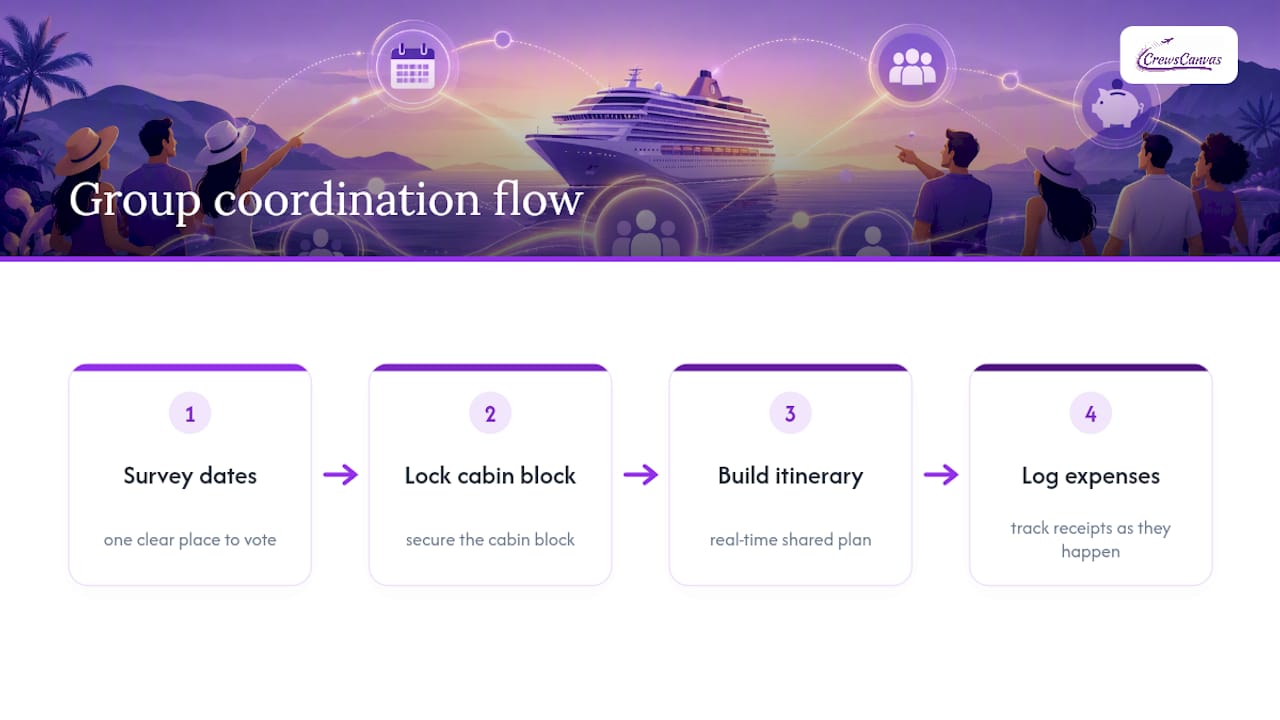
Picture the timeline from earlier in this guide running through a single hub: survey dates, lock the cabin block, build the shared itinerary as excursions get decided, and log every group expense as it happens rather than reconstructing it from memory three weeks later. That's the coordination gap CrewsCanvas's toolkit is built to close.
The Real Job of a Group Cruise Organizer
Every group cruise has one person who ends up answering every question, and if that's you, define the boundaries early or you will burn out before you board. Decide what you are actually responsible for: booking logistics and payment tracking, yes. Being available at 11 PM to settle an argument about excursion times, no.
Write a one-page "what's included" document before you collect a single deposit. State the cabin category options, the payment schedule, what's covered by group perks, and what each person handles independently. This prevents the two most common group cruise disputes: unmet expectations about cost, and confusion about who decided what.
If your group tops 20 people, or if the itinerary involves multiple ports with independent excursions, bringing in a travel agent or paid coordinator often pays for itself in time saved and perks negotiated. You don't have to run everything yourself to be a good organizer. You have to make sure everything gets run.
— CrewsCanvas
Try CrewsCanvas for Your Next Group Cruise
This guide recommends using a shared hub built specifically for the coordination problems discussed, instead of spreadsheets and group chats. A date polling tool lets your group vote on sailing dates instead of guessing from scattered texts, an itinerary builder maps out excursions and free time in one place everyone can see, and an expense-splitting tool helps settle who owes what for shore excursions, group dinners, or shared transfers without anyone having to send an awkward reminder.
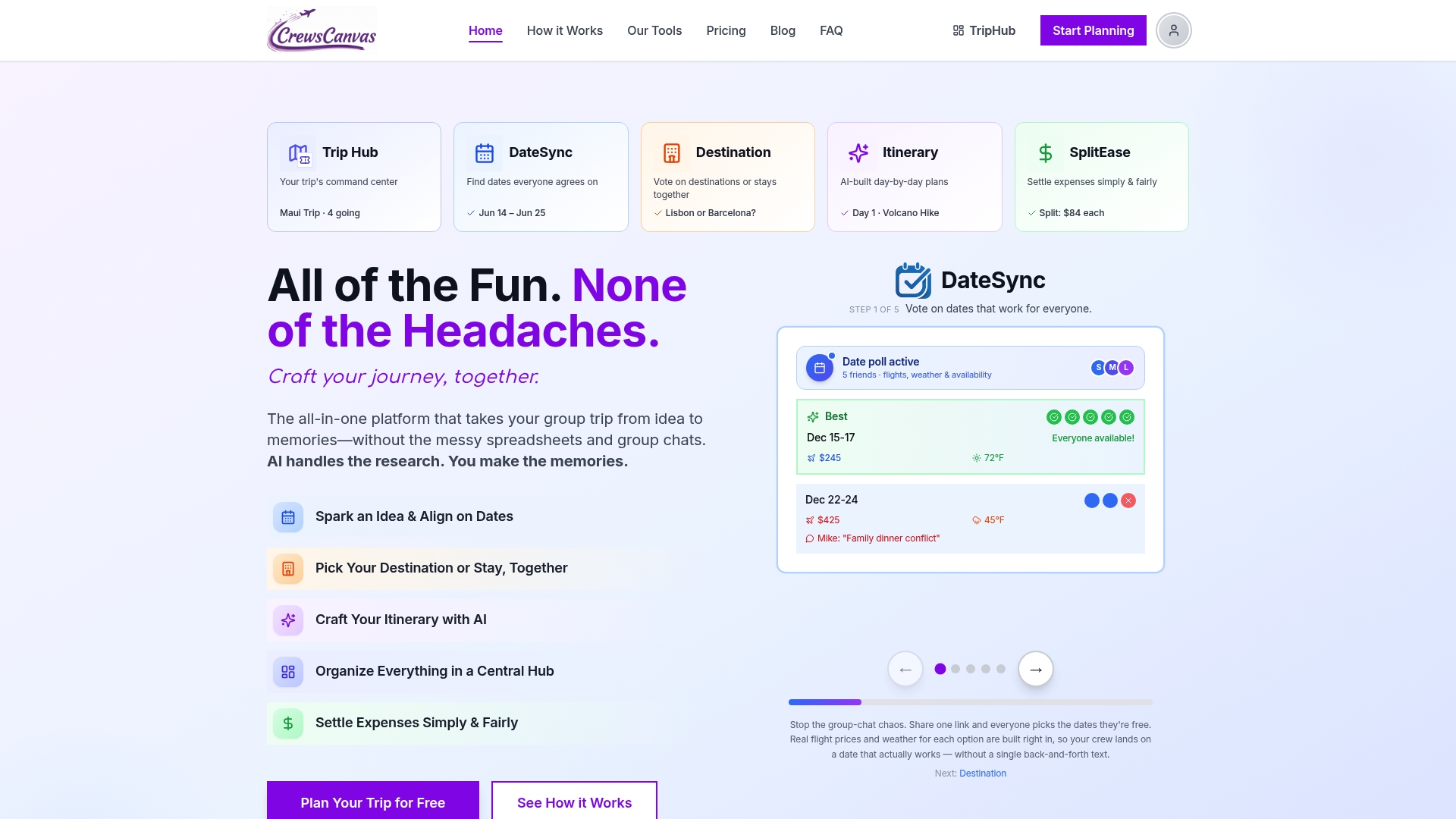
Plug it into the timeline you just read: send the date survey through DateSync before you ever call group sales, build the shared itinerary as excursions get decided, and log expenses in SplitEase from the first deposit onward instead of trying to reconstruct who paid for what three months later. Participation does not require everyone in the group to download an app or create an account.
There are free and paid plans available, including options suitable for smaller groups, subscriptions for organizers running multiple trips, and one-time purchases for access to full toolkits. Check the pricing page and set up your trip hub before your next date poll goes out.
Sources
- Group Cruises: Planning Guide | How to Plan a Group Cruise | Aurora Cruises
- Group Cruise Booking Guide 2026: Discounts, Perks & Planning | Cruise Ship Tracker
- What a Cruise Actually Costs in 2026: Building a Real Budget — In the Wake
- How to Plan a Group Cruise: Step-By-Step Guide | Cruisebound
- How to book a cruise for a large group — Royal Caribbean
FAQ
Is It Cheaper to Book a Group Cruise?
Yes, generally. Group bookings, typically starting around 8 cabins, unlock perks like onboard credit and priority cabin placement that individual bookers don't get access to, and complimentary cabins are sometimes granted at scale. The per-person savings depend on group size and how well the organizer negotiates or works with an agent.
What Is the 3-1-1 Rule on Cruises?
The 3-1-1 rule refers to carry-on liquid restrictions matching TSA airport rules: small containers all fitting in one quart-sized bag, one bag per passenger. It applies to what your group packs for the flight to the port, not to items in checked luggage or purchased onboard.
What Does "Wife on Board" Mean on a Cruise Ship?
"Wife on board" (or "WOB") is informal cruise slang some crew members use to indicate a passenger is traveling with a spouse or partner, typically as a discreet signal among staff rather than an official cruise line term. It has no bearing on group cruise planning or booking logistics.
Which Cruise Line Is Best for Group Travel?
There's no single best line since the right fit depends on your group's demographics, budget, and itinerary preferences. What matters more than the brand name is confirming group thresholds, perks, and deposit flexibility in writing with the group sales desk or your travel agent before booking.
How Do I Track Payments for a Large Group Cruise?
Use one shared, visible system rather than relying on memory or scattered texts, whether that's a structured spreadsheet or a dedicated planning platform. Tools like CrewsCanvas's SplitEase can log group expenses and deposits in one place so nobody has to chase down who paid what.