
The group trips that stay fun share five rules set before anyone packs a bag: money clarity, a named decision-maker, clear communication, punctuality windows, and included solo time. Groups that skip this step end up negotiating in real time, mid-trip, which is where friendships get tested. Checking Department of State advisories and CDC travel guidance matters too, but the interpersonal rules below are what actually prevent most group trip breakdowns.
TL;DR:
- Clear agreements on payments, decision authority, and rooming lists should be established and documented before booking to prevent disagreements.
- Setting punctuality, solo time, and communication norms as daily habits helps maintain group harmony throughout the trip.
- Building and sharing a written safety plan that includes travel advisories, emergency contacts, and buddy systems reduces response time during emergencies.
- Group bookings for flights, hotels, and activities require meeting minimum headcounts and adhering to deadlines to avoid cancellations and forfeited deposits.
- Using tools that make rules visible and enforceable, like shared lists and expense trackers, increases the likelihood that everyone follows the group agreements.
- ✓Collaborative date selection with DateSync
- ✓AI-powered itinerary generation
- ✓Expense management with SplitEase
- ✓One accessible planning hub
Table of Contents
- The essential rules every group trip needs
- Locking in rules before you leave: agreements, deposits, and rooming lists
- Daily habits that keep a group trip running smoothly
- Building a group safety plan before you go
- How airline and hotel group bookings actually work
- Resolving conflict without ruining the trip
- Insurance considerations for group travel
- Legal and liability issues when traveling as a group
- Group discounts and who actually qualifies
- Cultural etiquette groups need to agree on together
- Where group trips actually fall apart
- How the right tool makes these rules easier to enforce
- FAQ
- Sources
The essential rules every group trip needs
Most group trip conflict traces back to one of six gaps: money, decisions, timing, personal space, communication, or chores. Set these rules before departure and you remove the guesswork that turns small annoyances into trip-ending arguments.
- Money and payments. Agree on a deposit amount, a payment deadline, and what happens if someone cancels. Put these terms in writing with clear due dates and refund policies.
- Decision-making authority. Name one person (or a rotating pair) to make final calls on things the group can't agree on quickly, like restaurant picks or transport. Reserve group votes for big decisions: destination, dates, and budget ceiling.
- Punctuality and meet-ups. Set a tolerance window, often 10 to 15 minutes, and a designated meeting point for every outing. After that window, the group moves on and stragglers catch up independently.
- Personal time. Include at least one unstructured time block per day in the itinerary and agree that opting out of an activity requires no further explanation.
- Communication norms. Decide where group updates live (one chat thread, not three), how photos get shared, and what tone is acceptable when someone's running late or annoyed.
- Shared responsibilities. Rotate who books dinner reservations, who carries the first-aid kit, and who handles group transport logistics so the load doesn't fall on one organizer.
Sample wording for a payment request that avoids awkwardness: "Hey all, deposits are due Friday so we can lock the group rate before it opens up. Venmo or card, your call. Shout if you need a few extra days and we'll figure it out."
Pro Tip: Write every rule down somewhere the whole group can see it, even informally. A pinned message in the group chat removes the "I didn't know that was the rule" excuse before it starts.
Locking in rules before you leave: agreements, deposits, and rooming lists
A pre-trip meeting, in person or on video, turns loose ideas into a plan everyone has actually agreed to. Thirty minutes is usually enough if you come with an agenda: budget range, dates, decision-maker, rooming preferences, and safety contacts.
- Run a short pre-trip meeting covering budget, dates, duties, and any dietary or accessibility needs before anyone books.
- Draft a simple team agreement listing the payment schedule, who holds decision authority, chore rotation, and who carries emergency contact info. Troop and group travel guides, including the Girl Scouts of Ohio's Heartland travel guide, use this exact structure for youth and adult group trips alike.
- Document deposits and refund terms in writing, including the date after which deposits become nonrefundable, so no one is surprised later.
- Set rooming list rules early. A practical hierarchy, drawn from etiquette coverage on traveling with friends, gives first dibs on premium rooms to whoever planned or paid the most, defaults to an equal split when contributions match, and falls back to a random draw if neither applies.
- Collect emergency contacts and medical details (allergies, medications, insurance info) from every traveler before departure, not after a problem happens.
Hotel rooming list management follows similar logic on the vendor side. Rooming list templates used by hospitality planners show how room blocks, payment attrition, and cut-off dates get tracked so group rates don't quietly expire.
Daily habits that keep a group trip running smoothly
Rules on paper only work if they turn into daily habits once you're actually traveling together.
- Set a group alarm routine. A shared wake-up reminder and a 10-minute buffer before any scheduled departure keeps one person's snooze button from costing everyone their reservation.
- Name a "solo time" window each day. Even an hour alone to nap, journal, or wander keeps minor irritations from building into resentment.
- Handle meals with a simple split. Decide upfront whether you're splitting every bill evenly or paying for your own order. Mixed approaches cause more friction than either extreme.
- Set photo and sharing norms. Ask before posting someone's face, and agree on whether the trip gets its own shared album or stays in everyone's personal camera roll.
- Track small shared costs as you go. Coffee runs and cab fares add up fast, and letting them slide until the last night guarantees an uncomfortable math session.
Pro Tip: If someone misses a meet-up, have a default plan (a specific café, the hotel lobby) rather than relying on real-time texting that may not land if someone's phone is dead or roaming is spotty.
Building a group safety plan before you go
A written safety plan isn't about distrust. It's a quick reference that saves time if something actually goes wrong.
- Check travel advisories in advance. Reviewing Department of State guidance and CDC health notices for your destination, and noting anything relevant in your plan, takes minutes.
- Build an emergency contact sheet. List each traveler's emergency contact, insurance provider, and any medical conditions, and designate one person (not the only decision-maker, ideally) to hold a copy.
- Set buddy-system rules. Assign pairs for crowded venues or travel days, with an agreed meet-up point if anyone gets separated.
- Outline a basic medical plan. Note the nearest hospital, your group's insurance carrier, and who's carrying prescriptions or an EpiPen if relevant.
- Share the plan before departure. A written safety plan template built for group travel oversight covers trip basics, destination conditions, and emergency procedures, and institutions often require it 30 days ahead of travel, which is a useful benchmark even for informal trips.
How airline and hotel group bookings actually work
Group bookings run on different rules than individual reservations, and missing a deadline can cost real money.
- Know the minimum headcount. Many major U.S. carriers define a group as 10 or more passengers traveling on at least one shared flight segment, which unlocks seat blocks and negotiated pricing.
- Falling below the minimum carries consequences. If your group shrinks past the deadline, the airline can cancel the contract and forfeit deposits already paid.
- Get deadlines in writing. Name-submission dates, deposit due dates, and cancellation terms should all come as written confirmation from the airline or group desk, not a verbal promise.
- Negotiate hotel room blocks carefully. Attrition clauses (penalties for booking fewer rooms than contracted), cut-off dates, and rooming list submission deadlines are standard. Ask the hotel directly what happens if your numbers drop.
- Book early for better terms. Group desks typically recommend contacting them 3 to 6 months before domestic travel and 6 to 9 months before international travel for the best availability and pricing.
A bike touring operator's booking process guide walks through similar registration and briefing steps for activity-based group trips, which is a useful reference if your group is booking a guided tour rather than independent travel.
Resolving conflict without ruining the trip
Most group friction can be defused with a short, predictable process instead of a blowup.
- Step 1: private check-in. Address the issue one-on-one first, calmly and specifically, before it becomes a group topic.
- Step 2: mediated group conversation. If the private talk doesn't resolve it, bring in the decision-maker or a neutral third traveler to help mediate.
- Step 3: a pre-agreed consequence. Nonpayment might mean losing a reserved activity slot; repeated lateness might mean the group stops waiting.
- Know your red flags. Safety violations, aggressive behavior, or repeated disregard for agreed rules justify asking someone to sit out an activity, or in serious cases, contacting local authorities.
- De-escalate without shaming. Try: "I noticed this has come up a few times. Can we figure out a way that works better for everyone?"
Pro Tip: Address small friction early. A two-minute check-in on day two is far easier than a group intervention on day five.
Insurance considerations for group travel
Group trips carry more moving parts than solo travel, which makes coverage gaps more likely if no one checks.
Standard travel insurance covers trip cancellation, medical emergencies abroad, and lost luggage, but group-specific risks deserve a second look. If one traveler cancels, does that affect the group's room block rate or airline contract? Ask your insurer directly, since policies vary by provider and plan. Adventure activities (diving, skiing, guided tours) often need separate riders, and a policy bought by one person rarely covers the whole group automatically. Each traveler typically needs their own policy, even when everyone's trip is identical, because claims are processed individually. For international travel, confirm whether the policy includes medical evacuation, which matters more for group trips to remote destinations where the nearest adequate hospital might be hours away. Building the insurance conversation into your pre-trip meeting, rather than assuming someone else has it covered, closes a gap that surfaces constantly in group trip planning discussions.
Legal and liability issues when traveling as a group
Liability questions rarely come up until something goes wrong, which is exactly why they belong in the planning conversation.
If your group books through a tour operator or activity provider, read the waiver language before anyone signs, since it typically limits what you can claim if something happens during a guided excursion. For informal, self-organized trips, there's generally no formal liability between travelers, but a designated organizer who's handling shared funds (collecting deposits, booking group accommodations) takes on a layer of informal responsibility worth acknowledging openly. If your group is affiliated with a school, employer, or organization, that affiliation may come with its own liability rules and required paperwork, similar to the oversight structures covered in troop and institutional group travel guides. Renting vehicles as a group adds another layer: confirm who's named on the rental agreement and whether that person's personal insurance or a credit card benefit covers additional drivers. None of this requires a lawyer for a weekend trip with friends, but naming these questions out loud before departure, rather than assuming they'll sort themselves out, prevents the kind of dispute that damages friendships long after the trip ends.

Group discounts and who actually qualifies
Group discounts exist across airlines, hotels, and tour operators, but eligibility rules are stricter than most travelers expect.
Airlines generally require the 10-passenger minimum mentioned earlier to access group fares, and that minimum typically has to hold through final ticketing, not just at the time of inquiry. Hotels set their own thresholds, often starting around 10 rooms, and discount tiers usually scale with total room nights rather than headcount alone. Tour operators and activity providers (museums, guided excursions, boat tours) often publish their own group minimums, sometimes as low as 6 to 8 people, with the discount applied per ticket once the group books together. The catch across all three is documentation: discounts are usually tied to a single booking or confirmation number, which means splitting payments afterward (through an app or a shared spreadsheet) is almost always necessary since the vendor doesn't manage individual billing. Before assuming a discount applies, ask directly whether it requires simultaneous booking, a deposit, or a minimum stay length, since these conditions vary by vendor and aren't always advertised upfront.

Cultural etiquette groups need to agree on together
A group that respects local norms as a unit avoids the kind of visible missteps that affect everyone's experience, not just the person who made them.
Research basic customs before arrival: appropriate dress for religious sites, tipping norms (which vary widely by country), and whether haggling is expected or considered rude. Agree as a group on noise levels in shared spaces like hotel hallways or quiet neighborhoods, since one loud member can shape how locals perceive the whole group. Photography etiquette matters especially around people, religious ceremonies, or private property: agree to ask before photographing locals, not just scenery. Language effort counts for more than fluency; learning a handful of greetings and polite phrases as a group signals respect that locals notice. Finally, talk through how your group will handle disagreements about pace or priorities (some travelers want every museum, others want beach time) without turning cultural curiosity into a point of friction within the group itself.
Where group trips actually fall apart
Groups rarely fail because of money alone. They fail because the money rule existed only in someone's head. A fixed deposit with a clear, limited refund window resolves more disputes before they start than any amount of goodwill does once a trip is underway.
Written agreements matter more than group trust, not because people are untrustworthy, but because memory is unreliable under stress and travel is stressful by design. The organizers who hold their trips together aren't the strictest ones. They're the ones who wrote the rule down once, calmly, before anyone needed it enforced.
— CrewsCanvas
How the right tool makes these rules easier to enforce
Writing the rules down is half the work. Keeping them visible, and actually followed, through weeks of planning is the other half, and that's usually where spreadsheets and scattered group chats let groups down.
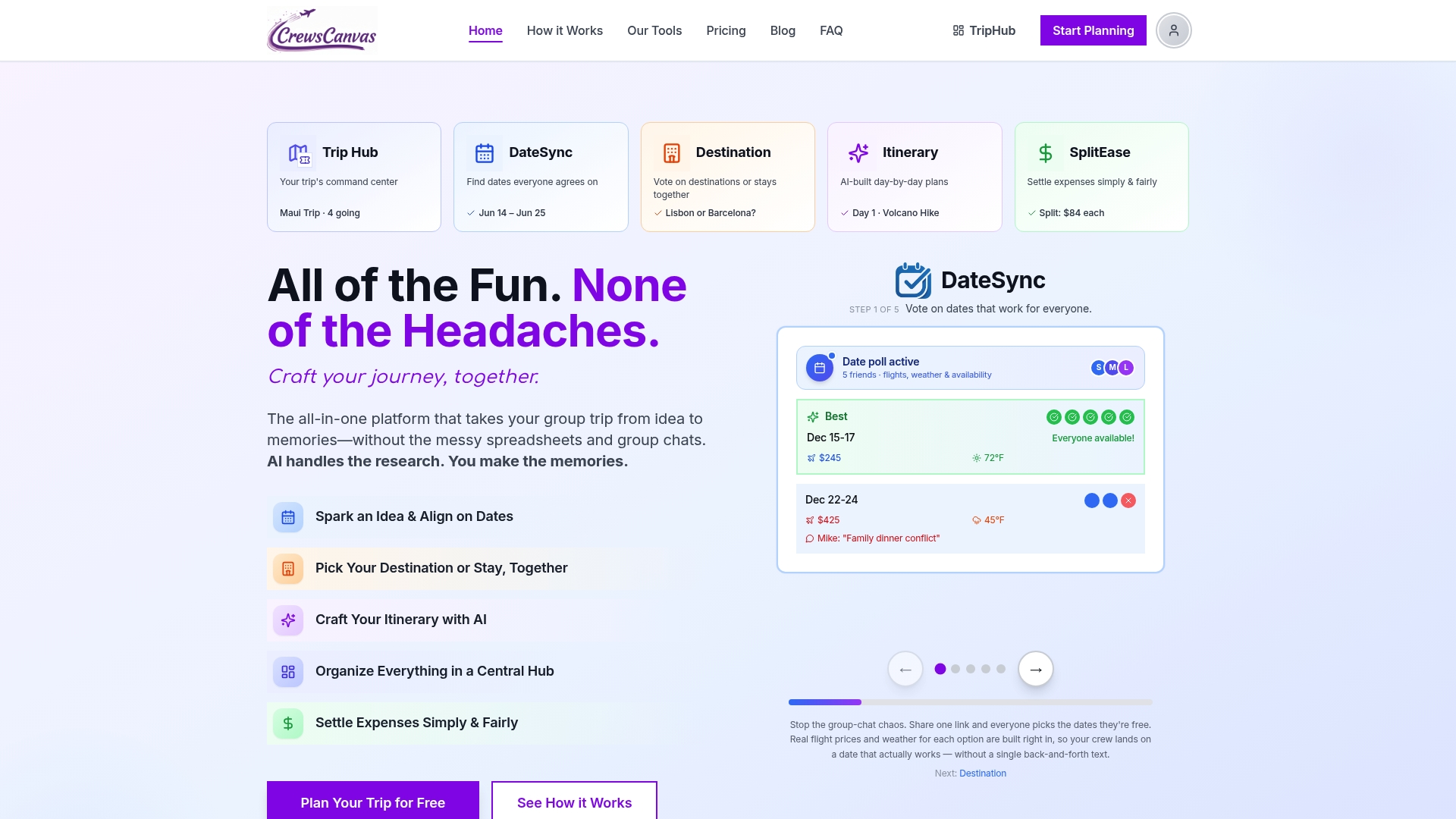
We built CrewsCanvas around exactly this gap. Instead of chasing payment confirmations across three apps, our tools map directly onto the rules above:
- A date voting tool lets the whole group vote on dates once, so there's no 40-message thread trying to find a weekend that works.
- A shared space holds the rooming list, team agreement, and emergency contacts that everyone can check, requiring no app download.
- An expense tracker manages deposits and shared costs with receipt scanning, so the "who owes what" conversation never has to happen out loud.
If you're planning your next trip and want the rules above to actually stick, check our pricing plans, starting with a free tier for smaller groups, or look at the full toolkit to see how DateSync, TripHub, and SplitEase work together.
FAQ
What are the new travel requirements for 2026?
Travel requirements vary by destination and change frequently, so the most reliable step is checking Department of State advisories and the relevant country's entry requirements directly before booking. For international group trips, confirm passport validity windows and any visa requirements for every traveler individually, since group bookings don't simplify individual entry rules.
What is the 3-3-3 rule for a road trip?
The 3-3-3 rule is a road trip pacing guideline suggesting no more than 3 hours of driving before a break, a manageable daily travel distance, and arrival by 3 p.m. to leave time to settle in. Definitions vary slightly across sources, but the core idea is building in regular breaks and avoiding late-arrival stress, which applies directly to group road trips where fatigue affects everyone's mood.
What are some rules for traveling with friends?
The core rules are agreeing on money and payment deadlines upfront, naming a decision-maker for quick calls, setting punctuality windows for meet-ups, and building in solo time so no one feels obligated to join every activity. Documenting these in a simple written agreement before departure, as outlined in guides to traveling with friends, prevents most common disputes.
Do airlines give discounts for group travel?
Many major U.S. carriers offer group rates and seat blocks for parties of 10 or more passengers traveling on at least one shared flight segment, but these bookings come with deposit and name-submission deadlines. Falling below the minimum headcount before final ticketing can cancel the group contract and forfeit deposits already paid.
Sources
- United Airlines group booking guide (hosted copy)
- Safety Plan for Group Travel (WashU template)
- How to travel with friends—without becoming enemies (Town & Country)