
Appoint one trip leader, propose two or three date windows, set a target budget, and open a shared planning hub before anything else gets booked. Do those four things in the first week and you can lock flights, lodging, and a rough budget while the group is still excited. Tools like date-polling apps, expense-splitting apps, and the Travel (or an integrated platform like CrewsCanvas) handle the rest.
TL;DR:
- Prioritize booking core transportation and lodging at least 6 to 12 months in advance, depending on group size, to secure the best rates and availability.
- Use targeted tools for specific planning tasks, such as date polling apps with no-account voting and automatic tallies, to streamline decision-making and maintain group momentum.
- Collect deposits of 20 to 25 percent within two weeks of confirming dates to ensure accurate head counts and avoid delays in booking flights and accommodations.
- Build a flexible itinerary with one or more mandatory core activities per day and optional extras, leaving buffers to prevent overscheduling and keep the group relaxed.
- Consolidate planning, budgeting, and communication in a single platform like CrewsCanvas to reduce login chaos, ensure data security, and improve overall coordination efforts.
Table of Contents
- Your quick action plan for getting started
- Which tool fits which planning job?
- Building a budget and splitting costs fairly
- Designing an itinerary that doesn't overschedule the group
- What to book first and when
- Setting roles and rules so decisions actually get made
- Travel safety, documents, and insurance basics
- How CrewsCanvas brings the checklist into one hub
- Planning around dietary restrictions and special needs
- Resolving conflict before it stalls the trip
- What I wish more organizers knew before they started
- Make the whole process easier with CrewsCanvas
- Where to go for more
- Sources
- FAQ
Your quick action plan for getting started
A large group trip stalls when nobody owns the next step. This checklist gives you a sequence you can start today, with rough deadlines that keep the group moving instead of stuck in a group chat that never resolves anything.
- Name a trip leader (or two): one person owns dates and bookings, another can own money if the group is large.
- Collect high-level preferences: a quick survey on budget range, trip length, and destination type takes the guesswork out of planning.
- Run a date poll with three windows: give the group a week to vote, then commit to the top choice even if it isn't unanimous.
- Set a target budget and request a deposit: ask for 20 to 25% upfront to confirm who's actually coming.
- Book flights and lodging for confirmed participants: lock the big-ticket items first, then layer in activities.
- Pick one payment flow and one planning hub: every decision, document, and dollar should live in a single place.
The destination voting process works best when you limit choices rather than open the floor to every idea. Three solid options beat ten mediocre ones, because decision fatigue is real in groups larger than six people. Once the leader and dates are set, the hardest part of large group trip planning is behind you, and everything else is logistics.
Which tool fits which planning job?
Group trip planning breaks into five distinct jobs, and no single app handles all of them well unless it's built for that purpose. Matching the right tool category to each task saves the back-and-forth that kills momentum.
- Date polling: look for no-account voting, multiple date ranges, and automatic tallying so the leader doesn't have to count manually.
- Itinerary building: prioritize calendar export, drag-and-drop editing, and the ability to flag optional versus core activities.
- Expense management: receipt scanning, multi-currency support, and automatic per-person math matter most here.
- Shared documents: version history and permission controls prevent the wrong person from editing a finalized itinerary.
- Group ticketing or booking coordination: group rate visibility and a single checkout reduce the chance someone books the wrong flight.
The trade-off is real: a handful of specialized apps often do one job better than a generalist tool, but switching between five logins creates its own friction, and every extra app is another place personal and payment data can leak. Privacy matters here, since the US Family Travel Association's 2025 survey found that 48% of parents worry about the security of personal information when booking travel online, even though 65% feel confident using digital tools in general. That gap is worth taking seriously when you're choosing where your group's payment details and travel documents live. Our guide to the best group trip apps breaks down specific options by category if you want to compare before committing to one.
Building a budget and splitting costs fairly
A workable group budget covers six categories: transportation, lodging, meals, activities, contingency, and insurance. Build the total first, then divide by headcount so everyone sees the real number before they commit.
Say a long weekend for eight people costs $4,000 total: $1,600 for flights, $1,200 for lodging, $600 for meals, $400 for activities, and $200 held back as contingency. Split evenly, that's $500 per person, though tiered packages work better when budgets vary widely within the group, since forcing a $500 flat fee on someone who only wants the budget room creates friction nobody needs.
- Equal split: best for groups with similar incomes and the same itinerary for everyone.
- Shared-pool: one person collects a flat amount per head and pays all vendors, simplifying tracking but requiring trust in the collector.
- Itemized splitting: tracks who paid for what and settles up at the end, ideal when people opt in and out of specific activities.
Deposits of 20 to 25% collected within two weeks of confirming dates give organizers a real headcount before locking flights or lodging, and late deposits are the single biggest cause of booking delays.
Collect deposits in one payment round, not a trickle, and set a hard deadline so the leader isn't chasing stragglers for a month. Whatever tool handles the money, treat it the way you'd treat a bank app: the Family Travel Association's 2025 report ties booking security concerns directly to how comfortable people feel sharing payment details digitally, so pick something built for that purpose rather than a spreadsheet passed around by email. A detailed walkthrough of splitting costs without the drama covers edge cases like partial attendance and shared rooms.

Designing an itinerary that doesn't overschedule the group
The best group itineraries have one shared core plan with optional side activities layered on top, not a packed schedule where everyone does everything together. Condé Nast Traveler's group travel guide puts it simply: avoid over-scheduling, and keep at least one shared meal a day so the group actually spends time together without forcing every hour into a group activity.
- Build the skeleton first: arrival, one anchor activity per day, and a shared dinner, leaving mornings or afternoons open.
- Add buffer time between activities: 30 to 45 minutes of transit cushion prevents a late checkout from derailing the whole day.
- Collect preferences through a simple vote or signup sheet: let people opt into optional excursions instead of assuming universal interest.
- Convert the votes into a master itinerary: one visible document that shows what's mandatory, what's optional, and what's still unconfirmed.
- Export it for mobile access: a calendar sync or printable summary means nobody is hunting for the plan on day three.
Our guide to building a group itinerary includes a full day-by-day template you can adapt for trips of any length. The goal isn't to fill every hour. It's to give the group a plan loose enough that nobody feels trapped by someone else's idea of a perfect vacation.
What to book first and when
Core participants' flights and lodging come first, always, because prices climb and availability shrinks the longer you wait. Activities, add-ons, and optional excursions can wait until the group's size is locked in.
- Small groups (4 to 7 people): book 6 to 12 weeks out, since flexibility is easier to manage at this size.
- Medium groups (8 to 15 people): start 3 to 6 months ahead to secure group rates on lodging and flights before blocks fill up.
- Large groups (16 or more): begin 6 to 12 months out, especially for destination weddings, reunions, or peak-season travel.
- Negotiate group rates and deposit terms directly with suppliers: many hotels and tour operators offer reduced deposits or free name changes up to a set cutoff date.
- Decide between a room block and individual bookings: blocks simplify tracking but may require a minimum pickup to avoid penalties.
Finalize traveler names as late as your supplier's policy allows, since large groups almost always lose or gain a person or two before departure. If you're coordinating hotel blocks, a resource like StayStrategy's hotel booking guide walks through what to look for in booking workflows. For multi-day tours or activity bundles, operators using dedicated booking software, the kind covered in Riddlio's tour operator resources, often have more flexible deposit and group management terms than a generic travel site.
Setting roles and rules so decisions actually get made
Groups stall not from lack of ideas but from lack of a process to choose between them. Assign roles early and the whole trip moves faster.
- Lead organizer: owns the calendar, final bookings, and tie-breaking votes.
- Finance lead: tracks deposits, payments, and the shared budget.
- Activity leads: one or two people research and coordinate specific excursions or meals.
Set a simple decision rule up front: majority vote wins, and if the group can't agree within 48 hours, the lead organizer decides. That single rule prevents the slow-motion stall where a decision sits unresolved for two weeks because nobody wants to be the one to call it.
Use group chat for quick questions, but keep every decision, deadline, and dollar amount in the shared hub, not buried in message 147 of a thread nobody can scroll back through. A weekly check-in message works better than constant pinging.
Pro Tip: Send deposit requests and itinerary updates as a single pinned message in your group chat, not a scroll-and-find link, so nobody has an excuse to miss it.
Travel safety, documents, and insurance basics
Every international group trip needs a baseline safety plan, not just a packing list. The Travel.State.Gov traveler's checklist recommends carrying both paper and digital copies of passports and travel documents, and leaving a copy with a trusted contact at home.
- Require proof of travel medical and evacuation insurance before collecting final deposits on international trips.
- Build an emergency contact list with each traveler's allergies, medications, and a designated point person.
- Flag dietary restrictions and medical needs early so lodging and meal bookings can account for them.
Medical evacuation abroad can exceed $100,000, and the U.S. government does not cover these costs or emergency medical bills for citizens abroad. That single fact is reason enough to make insurance mandatory rather than optional for any group heading overseas. A comparison like Grand Canyon Journeys' tour insurance guide can help the group evaluate options before departure.
How CrewsCanvas brings the checklist into one hub
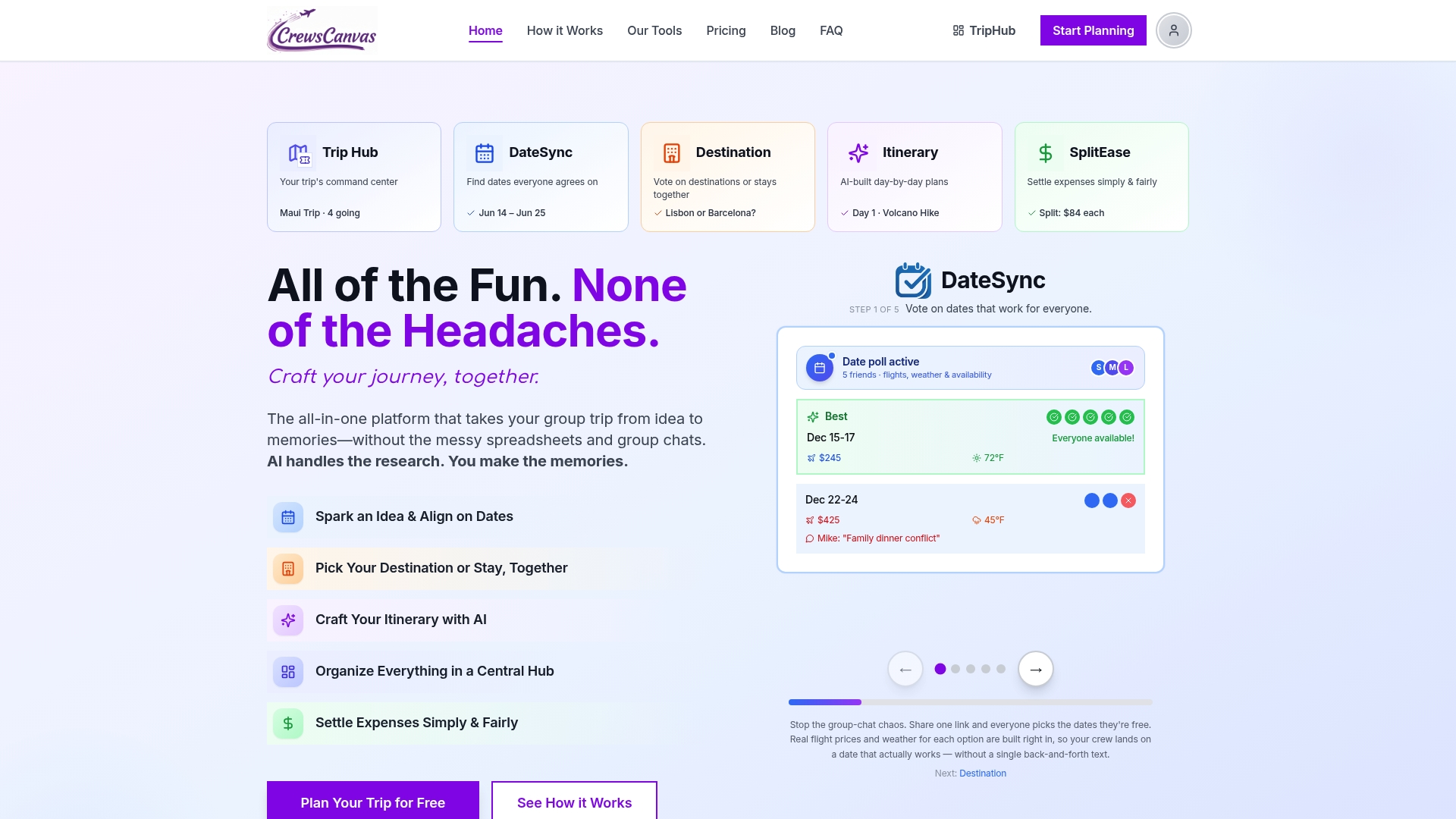
Everything above, dates, budget, itinerary, and expenses, can live in separate apps or in one place. CrewsCanvas was built around that second option: DateSync handles the date poll and tallies votes automatically, the AI itinerary generator turns collected preferences into a draft schedule you can edit, and SplitEase tracks who paid what and settles balances without anyone sending an awkward reminder text.

Consolidating those steps into a single hub cuts down on the login-switching and duplicate updates that happen when dates live in one app, the budget in a spreadsheet, and photos in a group chat. Participants can vote, comment, and check the budget without creating an account, which matters for groups where not everyone wants another app on their phone. Our itinerary builder and destination voting tool walk through exactly how that looks in practice.
Planning around dietary restrictions and special needs
Ask about dietary restrictions, mobility needs, and medical requirements in the same survey where you collect date and budget preferences, not as an afterthought two weeks before departure. Waiting until booking day to find out someone needs a ground-floor room or a gluten-free menu option limits your choices and usually costs more.
Build a simple shared list: name, restriction or need, and severity (preference versus allergy). Share this list with anyone booking meals, activities, or lodging on the group's behalf, so a restaurant reservation or group tour doesn't get locked in without checking it first.
For meals, give the group a vote between two or three restaurant options rather than trying to satisfy every palate with one choice. Many destinations now have apps or menus that flag allergens clearly, so cross-reference before committing to a venue. For mobility or accessibility needs, confirm accessible rooms and transit options directly with the hotel or tour operator rather than assuming standard bookings will work.
The goal isn't to accommodate every possible preference perfectly. It's to make sure nobody finds out on day one of the trip that there's nothing they can eat or nowhere they can comfortably stay.
Resolving conflict before it stalls the trip
Disagreements are normal in any group large enough to have different budgets, energy levels, and travel styles. The difference between a smooth trip and a miserable one usually comes down to how fast the group resolves disagreements rather than whether disagreements happen at all.
Set the decision rule before conflict arises, not during it. A majority vote with the lead organizer breaking ties, agreed at the start, removes the awkwardness of figuring out a process mid-argument.
When tension is about money, bring it back to the shared budget document rather than a group chat argument. Numbers settle disputes faster than opinions do. When tension is about pace or activity choices, the fix is usually structural: build in more optional, opt-in activities instead of mandatory group events, so people who want a slower day can take one without derailing anyone else's plan.
Side conversations and subgroup grumbling are signs the main channel isn't working. Address concerns directly with the person or small group involved rather than letting them simmer in private messages, and route anything that affects the whole trip back to the shared hub so everyone sees the resolution, not just the complaint.
What I wish more organizers knew before they started
The biggest planning mistakes I see are unclear deadlines, nobody owning a specific role, under-budgeting for contingencies, and cramming too much into each day. Every one of those is fixable with the same fix: a single hub, a clear deposit policy, a small steering group instead of twelve decision-makers, and a contingency fund built into the budget from day one.
Templates and automation save the most time, not willpower. Organizers who use them spend less time chasing people and more time actually looking forward to the trip.
— CrewsCanvas
Make the whole process easier with CrewsCanvas
Running date polls, splitting the bill, and building an itinerary in three separate apps works, but it also means three separate places for things to get lost. CrewsCanvas combines DateSync, SplitEase, and an AI itinerary generator into one hub so your group checks one link instead of three apps and a spreadsheet.
The free plan covers small groups getting started, and Pro Subscription at $9.99 per month or One-Trip Pro at $14.99 one-off unlock more capacity for bigger trips. Browse the full toolset or check pricing to see which plan fits your next trip.
Where to go for more
- Travel: official guidance on documents, insurance, and emergency planning.
- US Family Travel Association 2025 survey: data on digital tool confidence and booking security concerns.
- TrovaTrip's 2025 travel trends report: insights on group and community travel demand.
- Condé Nast Traveler's group travel guide: editorial advice on pacing and shared meals.
- Google Travel: lightweight tools for itinerary and booking reference.
Sources
- U.S. Department of State: Traveler's Checklist
- US Family Travel Association: FTA Survey 2025 Report
- TrovaTrip reveals 2025 travel trends
- The Complete Guide to Group Travel — Condé Nast Traveler
FAQ
Is $5,000 enough for a group trip?
It depends entirely on group size, destination, and trip length, since a fixed dollar amount stretches much further for a domestic weekend trip than for an international week-long trip. Build your budget from actual transport, lodging, meal, and activity costs for your specific destination rather than starting from a fixed number.
What is the best website for group trip planning?
There's no single universal answer, since the right tool depends on whether you need date polling, itinerary building, or expense splitting most. Platforms like CrewsCanvas combine those functions into one hub, which suits groups who want to avoid juggling several separate apps.
What is the top 10 bucket list?
Bucket list destinations vary widely by personal interest and travel style, so there's no single agreed-upon list. Focus your group's planning on shared preferences collected through a poll rather than chasing a generic ranked list that may not fit your group's budget or interests.
Can ChatGPT help me plan a group trip?
ChatGPT can help brainstorm itinerary ideas, draft messages, or outline a rough schedule, but it cannot poll your group, track real-time deposits, or split actual expenses. For those collaborative and financial pieces, a dedicated planning tool or platform handles the coordination that a chatbot alone cannot.
How do I split costs fairly in a large group?
Choose equal splitting for groups with similar budgets and identical itineraries, itemized splitting when people opt into different activities, or a shared pool when one person handles all vendor payments. Tools like SplitEase automate the math and track who has paid, which removes the awkward follow-up conversations.