
Settle a shared rental car bill from the closed-out invoice and receipts, not the rate you booked at, then divide that verified total by a rule your group agreed on before the trip. Default to an equal split when everyone used the car the same amount. Switch to a per-day or per-mile split when use was lopsided. Whoever tracks the spending should log the payer, the receipt, and photos of the contract and fuel gauge as you go.
TL;DR:
- Always settle a rental car bill based on the final invoice, not the initial quote, and verify the total with receipts and photos of the fuel gauge.
- Decide in advance whether costs will be split equally, by days, miles, or specific subset expenses, and document this rule visibly for the entire group.
- Track every expense during the trip with photos and a simple ledger to prevent disputes over fuel, tolls, or extra charges at return.
- Reconcile final charges by matching invoice line items with documented receipts and address discrepancies promptly with proof on hand.
- Use a shared expense management tool to automate receipt storing, split application, and net settlement, reducing manual bookkeeping and conflict risks.
- ✓Manage shared trip expenses
- ✓Divide costs fairly
- ✓Keep planning in one hub
Table of Contents
- Before You Book: Agree on Rules and Budget Line Items
- In-Trip Ledger Habits: What to Record and How
- How to Split: Practical Methods and When to Use Each
- Settle After Return: Reconciling the Final Invoice
- Worked Example: A Short Sample Calculation
- Why Transparent Rules Avoid Drama
- Track and Settle Rental Costs With SplitEase
- Sources
- FAQ
Before You Book: Agree on Rules and Budget Line Items
Most rental car disputes start before anyone touches the steering wheel. They start with an unspoken assumption. One person assumes the group is splitting everything evenly. Another assumes gas is on whoever fills the tank. Nobody talks about it until the bill lands and someone feels shortchanged.
Fix this before you book. The FTC's rental car guidance recommends listing every authorized driver on the contract, because an unauthorized driver behind the wheel during an accident can void your collision-damage coverage entirely. Decide as a group whether extra-driver fees get split or fall only on the people who plan to drive.
From there, build a simple pre-trip checklist:
- List every shared cost category: base rental, taxes and fees, fuel, tolls, parking, protection or insurance, extra-driver charges, drop-off fees, and any optional equipment like a car seat or GPS unit.
- Pick your split method now, not after the trip. Equal shares work for most groups; per-day or per-mile splits work better when participation is uneven.
- Write the rule down somewhere everyone can see it, whether that's a shared note, a group chat pinned message, or a tool built for this exact job.
- Decide the payment flow: who books and pays upfront, how reimbursement happens, and whether the group wants to track everything in a dedicated expense app instead of a running mental tally.
The CFPB's budgeting guidance makes a point worth borrowing here: agreeing on priorities and compromises ahead of time heads off most money conflicts before they start. A rental car split is a small-scale version of the same problem.
In-Trip Ledger Habits: What to Record and How
The trip itself is where good intentions either turn into habits or quietly disappear. Build the habit into your routine at pickup, and settlement afterward takes minutes instead of an argument.
- Photograph the rental agreement and the fuel gauge at pickup, before you drive off the lot.
- Save every receipt for fuel, tolls, parking, protection add-ons, and any extras, and attach a photo of each one to your ledger as you go.
- Keep a simple ledger with five columns: line item, amount, who paid, who's included, and a link to the receipt.
- Tag each entry as all-group, subset (only some riders), driver-only, or personal, so nothing gets accidentally split among people who shouldn't owe it.
- Photograph the fuel gauge again at return, before you hand back the keys.
Pro Tip: Rental companies can charge their own inflated fuel rate if you return the car without a full tank and without a receipt to prove it. A timestamped photo of the gauge plus your gas station receipt is the cheapest insurance policy in this entire process, and it takes ten seconds.
This habit matters more than it sounds like it should. The FTC has flagged fuel charges specifically as a common source of inflated final bills, and a receipt is the fastest way to push back on one.
How to Split: Practical Methods and When to Use Each
There's no single correct formula for a split rental car cost. There's a correct formula for your situation, and it depends on how evenly the group actually used the vehicle.
Equal split is the default for a reason. If everyone rode in the car roughly the same amount, divide the total cost (T) by the number of people (n): T ÷ n. Simple, fair, and defensible when usage was genuinely shared. The CFPB's approach to budgeting supports exactly this kind of default rule paired with room for exceptions when circumstances differ.
Per-person-day allocation works better when someone joined the trip late or left early. Instead of splitting the full total evenly, you allocate cost based on how many days each traveler actually had access to the car. Someone there for two of five days pays roughly two-fifths of the per-day rate, not a fifth of the whole bill.

Per-mile or mileage-share splits fit road trips where one person drove most of the distance while others rode along for a shorter leg. This method ties cost to actual use of the vehicle rather than calendar time.
Subset-share handles the odd expenses that don't belong to the whole group. If three of six people took a toll road detour to visit a specific stop, only those three should split that toll, not everyone.
- Equal split: T ÷ n, for even use across the group
- Per-day: allocate by days each person had the car
- Per-mile: allocate by distance driven, best for road trips with uneven legs
- Subset-share: charge tolls, parking, or detours only to those who used them
Driver fees and protection add-ons belong in the shared total only if the group agreed to that in advance. Worth repeating: buying the rental company's protection product does not authorize an unlisted driver to get behind the wheel, according to the FTC's rental guidance. Coverage and authorization are two separate agreements.
Settle After Return: Reconciling the Final Invoice
The number you booked at is not the number you owe. Advertised rates routinely leave out taxes, licensing fees, and optional charges that only show up once the car is back on the lot, which is exactly why the FTC advises settling from the final contract instead of the quote.
- Wait for the closed-out invoice from the rental company before anyone pays a final share.
- Match every invoice line to your ledger and receipts, checking fuel charges, tolls, drop-off fees, and any damage charges one by one.
- Flag anything that doesn't match what you documented, and pull up your photo evidence and receipts before contacting the rental company.
- Contact the rental firm promptly if a charge looks wrong. The FTC's fee guidance notes that fuel disputes in particular are easier to resolve with a receipt in hand than after the fact.
- Compute net balances, not gross reimbursements. Figure out who's owed money and who owes it, then settle those net amounts once every line item checks out.
Keeping copies of receipts and contract photos for a few months afterward is smart practice here, mirroring the substantiation habits the IRS recommends for travel expense records: dates, amounts, and purpose, all documented at the time.
Worked Example: A Short Sample Calculation
Say four friends rent a car for a long weekend. The closed-out invoice comes to $420, and the group has $35 in gas receipts and $18 in tolls on top of that, bringing the true total to $473.
- Equal split (T ÷ n): $473 ÷ 4 = $118.25 per person, if everyone used the car the whole trip.
- Per-day adjustment: if one friend only joined for two of the four days, she might owe half the per-day rate for those two days instead of a full quarter share, roughly $59 instead of $118.25.
- Net settlement: if one person paid the $420 rental charge and another covered the $35 in gas, the ledger shows who's owed what, and only the net differences change hands rather than everyone paying everyone back separately.
Why Transparent Rules Avoid Drama
Most rental car disputes aren't really about money. They're about ambiguity. Nobody agreed on the rule in advance, so every charge becomes a negotiation instead of a formality.
Documented rules fix that before the first mile is driven. When a driver-fee agreement, a split method, and a receipt trail already exist, settlement becomes a five-minute reconciliation instead of a group chat argument. A neutral system that stores those receipts and applies the split rule automatically removes the bookkeeping burden from whichever friend usually ends up doing the math. Photos of the contract and fuel gauge, paired with the final invoice, protect everyone in the group equally, including the person who's about to be accused of shortchanging the rest.
— CrewsCanvas
Track and Settle Rental Costs With SplitEase
Manually building a ledger, chasing receipts through a group chat, and doing the fuel-gauge math by hand works, but it's the kind of task everyone forgets until the money argument starts. SplitEase handles the parts of this guide that eat the most time: it stores receipts, applies the split rule your group already agreed on, and shows net balances instead of a pile of individual reimbursements to untangle.
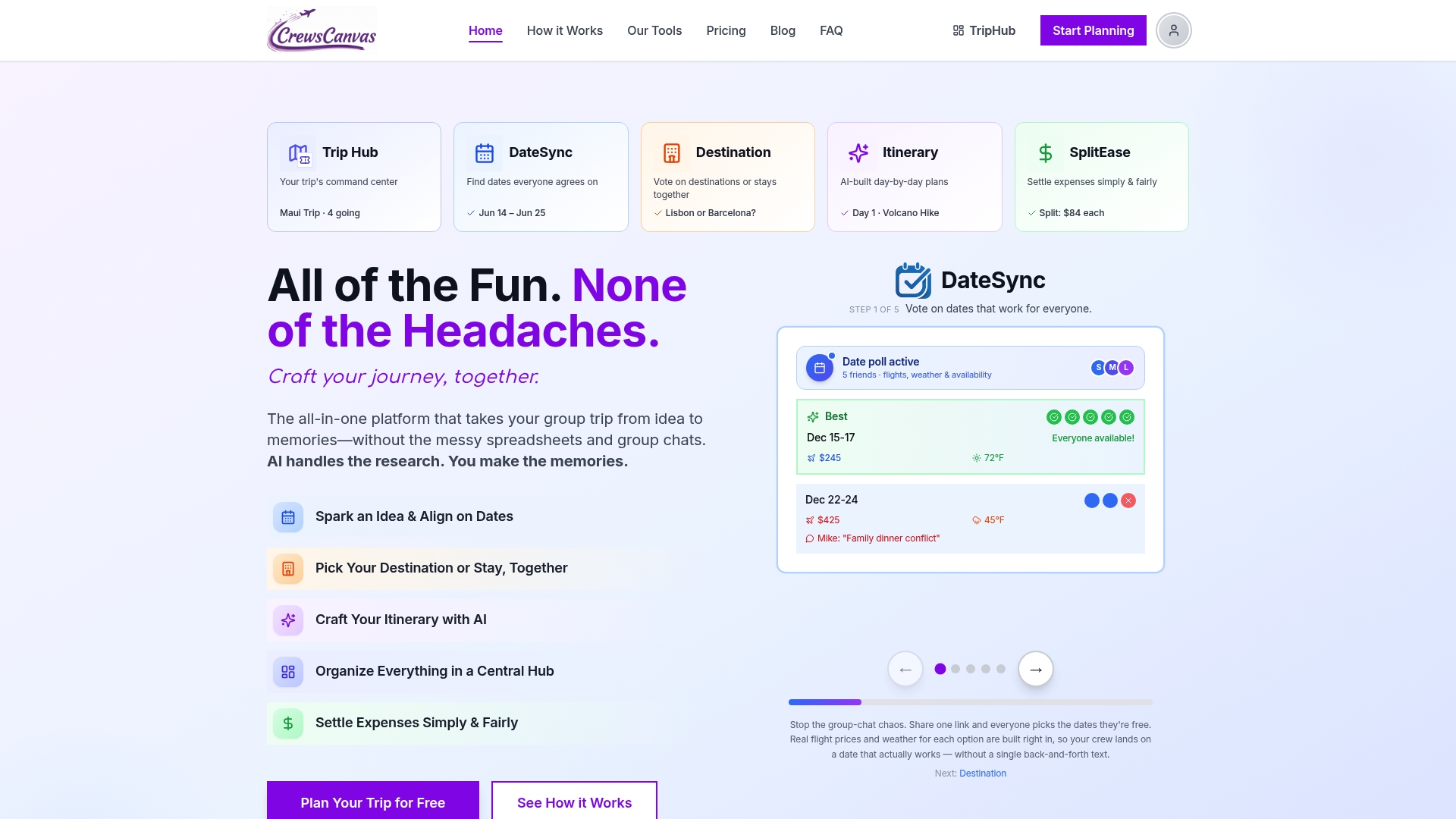
It's built into CrewsCanvas alongside tools like DateSync for picking travel dates and an itinerary builder for planning the trip itself, so the rental car split lives in the same place as everything else the group is coordinating. Participants join through a shared link with no account required, which matters when half your group won't download one more app for a single weekend trip. CrewsCanvas offers a free plan for small groups, a Pro Subscription at $9.99 per month, and a One-Trip Pro one-time option at $14.99 for a single trip; check the pricing page to see which fits your group. If your next trip involves a shared car, set up the trip and add the rental as a shared expense before you even pick up the keys.
Sources
- Renting a car | Consumer Advice
- Budgeting: How to create a budget and stick with it | CFPB
- Instructions for Form 2106 (2025) | IRS
FAQ
What's the fairest way to split a rental car cost?
An equal split, T divided by the number of people, is fairest when everyone used the car the same amount. Switch to a per-day or per-mile allocation when participation was uneven, and always calculate from the final closed-out invoice, not the booking estimate.
Should gas and tolls be split evenly among everyone?
Only if everyone benefited from that driving. Tag tolls and detours as subset expenses when only some of the group took that route, and keep fuel receipts and gauge photos so the fuel charge itself isn't disputed later.
Who should pay for additional-driver fees?
That depends on what the group agrees to before booking. List every authorized driver on the rental contract, since an unlisted driver can affect collision coverage, and decide upfront whether that fee is shared or covered only by the people who plan to drive.
What should we do if a rental charge looks wrong after we return the car?
Compare the final invoice line by line against your ledger and receipts, then contact the rental company with your photo evidence if something doesn't match. Documentation from pickup and return, including fuel gauge photos, is what actually gets a disputed charge reversed.
Does CrewsCanvas help with splitting a rental car specifically?
Yes. SplitEase lets your group log the rental as a shared expense, attach receipts, apply the split method you chose, and see net balances without anyone building a spreadsheet by hand.