
The fastest way to coordinate group packing is a shared, editable template with assigned roles and per-person checkboxes, not a single person's spreadsheet emailed around after the fact. You can build this with a shared document, a reusable checklist template, or a collaborative trip platform. What follows is the method, the categories to include, and the rules your group actually needs to follow before flying.
TL;DR:
- Using a shared, editable packing list with assigned roles reduces confusion and ensures accountability, especially for shared gear and communal items.
- The categorization of items into documents, clothing, toiletries, electronics, medications, and shared gear helps prevent duplication or omissions during group packing.
- Assigning one person as the owner of each shared item, with clear tagging and deadlines, minimizes last-minute scrambling and duplicate packing efforts.
- Packing guidelines like the 5-4-3-2-1 rule or the minimalist 3-3-3 rule help groups limit clothing and gear to essential items suited for trip length and type.
- Coordinating group details such as passports, liquids, medications, and luggage organization in advance prevents delays, lost items, and security issues at airports.
Table of Contents
- 1. Pick a shareable method that fits your group
- 2. A group packing workflow: assign, duplicate, check
- 3. Packing categories to copy into your shared list
- 4. Travel documents, medication, and TSA rules your group must coordinate
- 5. Packing heuristics and the items groups always forget
- 6. Packing considerations for kids, seniors, and mixed-needs groups
- 7. Luggage organization tips that keep group packing simple
- 8. Managing shared items versus individual items in group packing
- 9. Packing strategies for adventure, business, and leisure group trips
- 10. Electronics and chargers checklist for group travel
- One habit that makes shared packing actually work
- Looking for one place to manage the whole trip, not just the list?
- FAQ
- Sources
1. Pick a shareable method that fits your group
The right tool depends less on features and more on how your group already communicates. A shared cloud document or spreadsheet works for almost any group: it is free, duplicable in seconds, and lets everyone check off items in real time without downloading anything new. The tradeoff is that spreadsheets need manual setup for categories, roles, and checkboxes, and permissions can get messy if too many people have full edit access.
Template-based workflows, including Notion templates or printable checklist templates, give you structure out of the box. You duplicate a pre-built format, fill in names, and the categories are already organized. These suit planners who want consistency across multiple trips without rebuilding a list from scratch each time.
A collaborative trip platform earns its place when packing is only one piece of a bigger coordination problem, especially if your group also needs to vote on dates, build an itinerary, or split costs.
Before choosing, run through this quick check:
- Group size: Under 6 people, a shared doc is usually enough; larger groups benefit from more structured permissions.
- Trip frequency: One-off trip favors a quick template; recurring group trips favor a duplicable system.
- Expense splitting needs: If you're also tracking shared costs, an integrated platform saves a second tool.
- Tech comfort: Match the method to your least tech-confident member, not your most advanced one.
2. A group packing workflow: assign, duplicate, check
A good shared list needs a process behind it, not just a template. Here's a sequence you can copy for any trip.
- Assign roles. Name one list owner who sets up the master document, then category leads for shared gear (first aid, chargers, games) and personal responsibles for their own bags.
- Build the master list once. Create every category in a single shared document, then either duplicate a personal copy for each traveler or use filters so each person sees their own section.
- Tag items clearly. Use simple flags like "I will pack for" next to shared gear and "shared item" so nobody assumes someone else has it covered.
- Set a deadline. Give the group a date to have their section checked off, then schedule a short pack-check meeting or call a day or two before departure.
- Resolve duplicates live. During the pack-check, confirm who is actually carrying each shared item so two people don't both pack a first-aid kit while the phone charger gets left behind.
Pro Tip: Designate one person as the carrier for each shared item, like the first-aid kit or the charging hub, and write their name directly next to that line in the list so there's no ambiguity on travel day.
3. Packing categories to copy into your shared list
A group list works best when it is organized by category first, then split by person or shared status. Use this structure as a starting template:
- Documents: passport, ID, boarding passes, printed reservations, travel insurance card.
- Clothing: daily outfits by trip length, one layer for weather changes, sleepwear, swimwear if relevant.
- Toiletries: toothbrush and paste, deodorant, sunscreen, any prescription items in original containers.
- Electronics: phone charger, portable battery pack, adapter, headphones.
- Medications and health: personal prescriptions, basic pain relief, motion sickness tablets, a shared first-aid kit.
- Shared gear: group games, a speaker, a shared power strip, a cooler for day trips.
- Miscellaneous: snacks, reusable water bottle, laundry bag, travel pillow.
For each line, tag quantity and ownership so nothing gets double-packed: "personal x1" for things everyone needs individually, or "shared x1, assigned to Jamie" for communal gear. Scale personal items by traveler count automatically if your template supports formulas, but communal items should stay at a fixed quantity with one clear owner. A simple snippet like "Sunscreen, shared x1, assigned to Dana" tells the whole group exactly what's covered and by whom, which is the entire point of moving off a single person's private list.
4. Travel documents, medication, and TSA rules your group must coordinate
Passport problems are one of the most avoidable group travel disasters. The U.S. Department of State recommends checking passport validity well before departure, since many destinations require at least six months of remaining validity, and advises keeping both physical and digital copies of travel documents in case of loss. Share those digital copies in the same folder your group uses for the packing list.
TSA allows carry-on liquids only in containers of 3.4 ounces (100 ml) or less, all fitting into a single quart-sized bag per traveler. That one rule causes more group delays than almost anything else, since different travelers often assume someone else is tracking it.

Medically necessary liquids and medications can exceed that limit but must be declared for inspection, and lithium-ion batteries, including portable chargers, need to travel in carry-on bags rather than checked luggage. Build a group action around this: collect prescription names in the shared document, pack a few extra days of medication per person, and keep a shared digital folder with photos of documents, medication lists, and emergency contacts that every traveler can access.
5. Packing heuristics and the items groups always forget
Minimalist packing rules give a group a shared language for "how much is too much." The 5-4-3-2-1 rule suggests five outfits, four tops, three bottoms, two pairs of shoes, and one climate-specific extra like a rain jacket or heavy coat. The 3-3-3 rule simplifies further: three tops, three bottoms, three pairs of shoes, built for shorter trips. Either works for groups once you agree on the "1" together, since a shared climate pick (one umbrella, one set of hand warmers) avoids five people packing the same bulky item.
- Chargers and adapters: fix this with one centralized charging hub everyone plugs into.
- Enough medication for delays: pack a labeled pouch with a few extra days' supply.
- Weather-specific layers: decide as a group before anyone packs, not after.
- Toiletry backups: travel-size extras in a shared bag cover forgotten items cheaply.
Pro Tip: Run a shared "pack day" checklist the night before departure: everyone checks off their section, the group confirms who has each shared item, and nothing gets left on a bedroom floor.
6. Packing considerations for kids, seniors, and mixed-needs groups
A group packing list has to flex around who is actually traveling, not just how many people there are. Children need items an adult packing list skips entirely: comfort items for the flight, extra changes of clothes for inevitable spills, and snacks that double as in-flight entertainment. Build a dedicated kids' sub-section rather than folding their items into the general list, since parents often pack for children at a different time than they pack for themselves.
Seniors and travelers managing chronic conditions need their medication list treated as its own category, with extra supply built in for flight delays and a written list of prescriptions kept both on paper and in the shared digital folder. Mobility aids, compression socks for long flights, and familiar pillows for sleep quality are easy to forget when the list is written by someone who doesn't need them.
For mixed groups, the simplest fix is a "special needs" flag on any item tied to one traveler's situation, so the category lead responsible for shared gear knows not to assume standard quantities apply. A family trip packing list that includes a toddler and a grandparent will look different from one with four adults in their thirties, and the shared template should make room for that difference rather than forcing everyone into identical categories.
7. Luggage organization tips that keep group packing simple
Space inside a group's collective luggage is a shared resource, and organizing it well cuts down on lost items and repacking chaos mid-trip. Packing cubes keep each traveler's clothing separated and compressed, which matters more in groups since bags often get stacked, swapped, or searched together at checkpoints.

Roll clothing instead of folding to free up space for shared gear, and keep one bag per traveler dedicated to personal items while a single shared bag or two carries communal gear like games, a first-aid kit, or charging equipment. That separation makes it obvious at a glance whose problem a missing item is.
A few habits that scale well across a group:
- Color-code or label bags so shared gear doesn't get buried in someone's personal suitcase.
- Pack the heaviest items at the bottom near wheels to keep bags stable and easier to lift together.
- Leave 10 to 15 percent of space empty for souvenirs or shared purchases made during the trip.
Coordinating luggage this way also speeds up airport logistics, since a group searching five identical black suitcases for one phone charger loses time nobody budgeted for.
8. Managing shared items versus individual items in group packing
The clearest group packing lists separate ownership into two tracks from the start: personal items that scale with headcount, and shared items that exist once regardless of group size. A first-aid kit, a portable speaker, board games, or a shared power strip only need one owner, while clothing and toiletries belong on each traveler's individual section.
The mistake most groups make is leaving shared items unassigned, which either leads to duplicate packing or, worse, nobody packing them at all. Every shared item in the list should carry a name next to it, not just a category. "Shared x1, assigned to Priya" removes the ambiguity that causes last-minute scrambling at the airport.

It also helps to separate shared items by who uses them. Some shared gear belongs to the whole group (a cooler, a tent), while other items are shared between just two or three people (a phone charger split between roommates at the destination). Tagging the specific sub-group that owns an item, not just marking it "shared," keeps the list accurate once the trip actually starts and people split into smaller units for activities.
9. Packing strategies for adventure, business, and leisure group trips
Trip type changes what belongs on a group's shared list far more than trip length does. An adventure trip, like a group hiking or camping trip, needs a gear category built around function: headlamps, a shared water filter, layered clothing for temperature swings, and a first-aid kit stocked for minor injuries rather than just headaches. Durability and weight matter more than variety, so the "1-climate item" from the 5-4-3-2-1 rule becomes a serious piece of gear, not an accessory.
A business group trip, like a team offsite or retreat, shifts the priority toward professional presentation and shared equipment: one set of AV adapters, a shared presentation remote, printed agendas, and work attire that doesn't wrinkle easily in a shared garment bag. Retreat organizers planning something like a multi-day offsite often need a more detailed shared checklist covering both personal professional wear and group logistics items like a portable projector or extension cords, similar to what's outlined in agenda and AV planning guides for offsite retreats.
A leisure trip, like a beach vacation, leans toward climate-specific shared gear: sunscreen in bulk, beach towels, and any rental equipment the group is splitting. Destination-specific planning resources, like family activity guides for beach destinations, can help a group figure out which shared items are worth packing versus renting locally.
10. Electronics and chargers checklist for group travel
Electronics cause more group packing friction than almost any other category, mostly because everyone assumes someone else is bringing the right cable. Build this section of your shared list with both personal and communal items clearly separated.
Personal electronics items, scaled per traveler:
- Phone and charger: everyone brings their own, no exceptions.
- Headphones: personal, especially for flights.
- Personal camera or tablet: if used individually rather than shared.
Shared electronics items, assigned to one owner:
- Portable battery pack: one per small group is usually enough for a day out.
- Universal adapter: critical for international trips, and easy to forget since it's not needed at home.
- Charging hub or extension cord: lets multiple people charge from one outlet in a hotel room.
Remember that lithium-ion batteries need to travel in carry-on luggage rather than checked bags, which applies to portable chargers and spare camera batteries as much as laptops. Assign one person to double-check this category during the pack-check meeting, since it's the easiest one to overlook until security asks about it.
One habit that makes shared packing actually work
A single-owner checklist fails the moment life gets busy, because one person's memory becomes the group's single point of failure. Collaborative lists work because they spread that responsibility out. The one habit worth adopting: set a shared digital "pack day," where everyone checks their section at the same time and does a final group review together before anyone zips a bag.
— CrewsCanvas
Looking for one place to manage the whole trip, not just the list?
If your packing list is one of five separate chats and spreadsheets for a single trip, that's the actual problem. A group trip planning platform can let a group vote on dates, build a shared itinerary, and split costs fairly, all in one hub instead of scattered across apps.
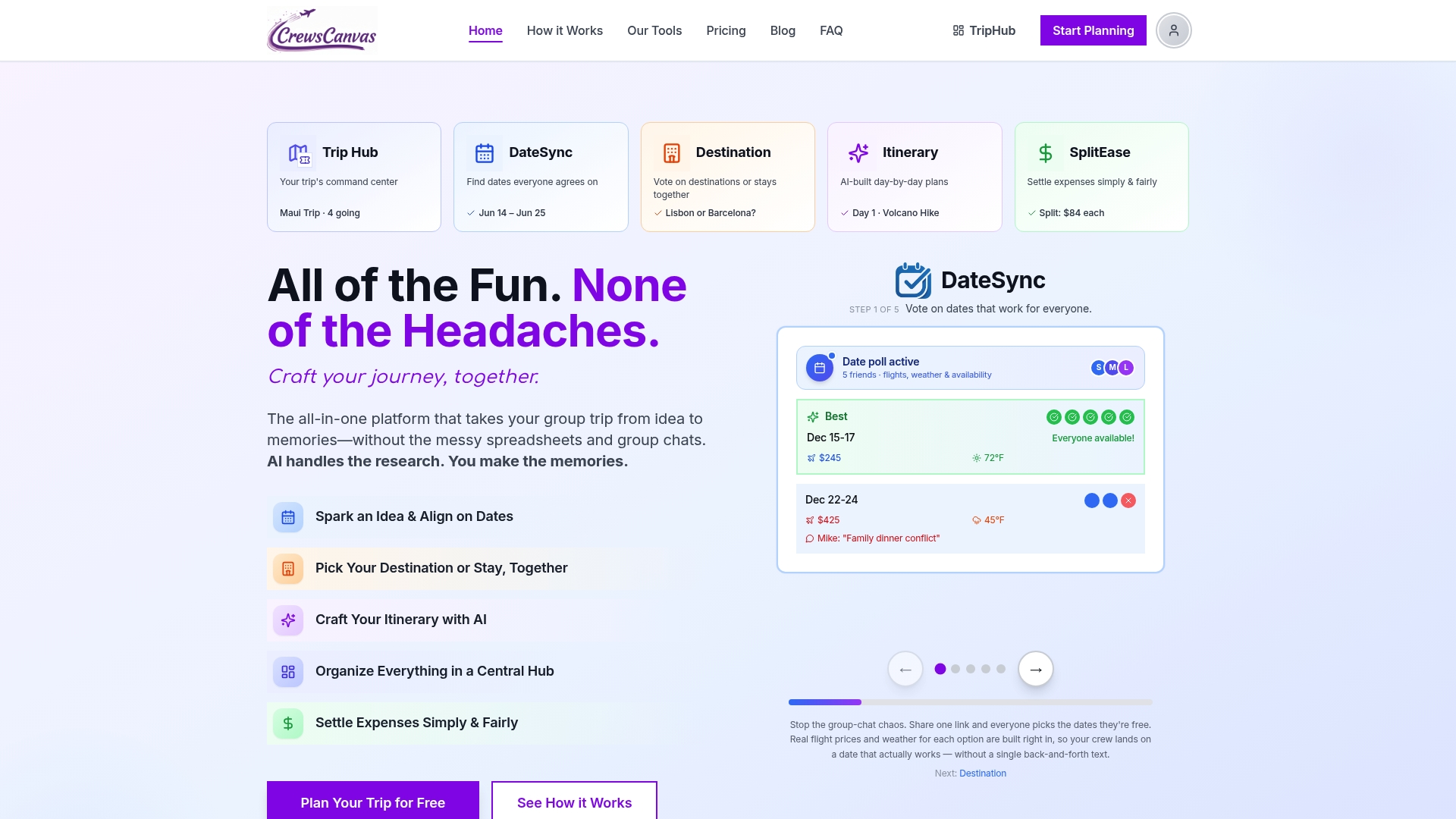
Our free plan covers small groups without needing every participant to download anything or create an account, and our One-Trip Pro one-time upgrade works well for a single big trip that needs more capacity. See what's included on our tools page and start your next trip there.
FAQ
What is the 5-4-3-2-1 rule for packing?
The 5-4-3-2-1 rule suggests packing five outfits, four tops, three bottoms, two pairs of shoes, and one climate-specific extra item like a rain jacket. It gives travelers a simple cap on clothing volume, and groups often adapt the "1" into a shared item everyone agrees on together.
What is the 3-3-3 rule for travel packing?
The 3-3-3 rule is a tighter minimalist guideline: three tops, three bottoms, and three pairs of shoes for a shorter trip. It works well for quick group getaways where luggage space is limited and outfit repetition isn't a concern.
What is the most forgotten item when packing for vacation?
Chargers and adapters are among the most commonly forgotten items, since they're easy to overlook until a device runs low on battery. A centralized charging hub, assigned to one person on the shared list, is a simple fix groups can build into their packing routine.
What is the 3-5-7 rule for packing?
Definitions of the 3-5-7 rule vary across sources, so there isn't one agreed-upon standard version. A common interpretation pairs 3 tops, 5 bottoms, and 7 pairs of socks or similar ratios, but groups are better served picking a clear rule like 5-4-3-2-1 or 3-3-3 that has consistent guidance.
Sources
- Liquids, aerosols, and gels rule | Transportation Security Administration
- Travelers checklist | U.S. Department of State