
Work backward from your departure date and front-load the slow tasks: passports, visas, vaccines, and any big reservations that could sell out. Save packing and app downloads for the last 48 to 72 hours. The buckets that follow, from 12+ months out down to the day you fly, tell you exactly what belongs in each window. If your trip crosses a border, check your passport and visa status today.
TL;DR:
- Booking early is critical for high-demand trips such as safaris, cruises, or exclusive lodges, which often require 9 to 18 months of planning.
- Flights and accommodations for peak seasons should be secured 6 to 12 months in advance to access better prices and availability.
- Health preparations, including vaccines and passport renewals, should be completed within 3 to 6 months to avoid last-minute issues and delays.
- Final reservations for tickets, activities, and practical arrangements must be made 1 to 3 months before departure to prevent missing out on limited bookings.
- Sharing a centralized planning hub helps groups coordinate better, avoids duplications, and ensures everyone stays updated on deadlines and responsibilities.
- ✓Coordinate dates with DateSync
- ✓Generate a smart AI itinerary
- ✓Manage shared costs with SplitEase
Table of Contents
- 12 or more months out: when to plan year-ahead trips
- 6 to 12 months out: lock the trip foundation
- 3 to 6 months out: finalize logistics and health preparations
- 1 to 3 months out: finalize reservations, buy tickets, and confirm practicalities
- 2 to 4 weeks out: detailed planning and packing preparation
- 1 week out: final checks, money prep, and contingency plans
- 1 to 2 days before departure: pack, house prep, and check-in
- Day of travel and arrival: execute the plan and settle in
- International travel: passports, visas, vaccines, and evacuation coverage
- Itinerary building and tools: turn the timeline into a working plan
- Money, insurance, and risk: prepare financially and protect against big-ticket problems
- Why a shared timeline changes how groups plan trips
- Try CrewsCanvas to run your group's timeline in one place
- Sources
- FAQ
12 or more months out: when to plan year-ahead trips
Not every trip needs a full year of lead time, but some absolutely do. Safaris, small-ship cruises, marquee events, and lodges with limited capacity often book out well in advance. Travel editorial sources note that trips like these can require 9 to 18 months of lead time to plan properly, especially when a specific season or festival date is the whole point of going.
This window is also when reward-seat availability tends to be best, since airlines release award inventory ahead of general sale. If you're hoping to use points for a long-haul flight during a popular season, start watching now rather than waiting until fares firm up.
A few things to knock out immediately:
- Check your passport's expiration date and confirm it clears your destination's validity rules.
- Reserve limited-capacity lodges, guided expeditions, or festival and event tickets that sell out early.
- Start a rough budget so later bookings don't blow past what the trip should cost.
- If you're chasing reward flights, begin tracking award seat releases for your route.
Everything else, including detailed itinerary work, can wait. Right now, the job is locking in the things that vanish first.
6 to 12 months out: lock the trip foundation
This is the window where the bones of the trip get set: flights, a place to sleep, and the paperwork that takes weeks to process. Flights for peak-season travel, especially international routes, tend to get harder to find in good seats or fair prices the closer you get to departure, so this bucket is where most travelers commit to their dates and buy.
Accommodation follows the same logic. Peak-season lodging in popular destinations fills first, and specialty stays (think overwater bungalows or a handful of rooms in a boutique inn) can be gone months out. Tours with hard caps, like small-group hiking trips or behind-the-scenes museum access, belong on this list too.
This is also when visa and eTA research should start, since processing times vary widely by country and consulate, and you don't want to discover a six-week backlog three weeks before you fly.
Use this window to:
- Book flights and accommodations for peak travel dates or high-demand destinations.
- Reserve tours and experiences with capacity limits before they sell out.
- Research visa or eTA requirements for every country on the itinerary.
- Start collecting required documents (photos, proof of funds, invitation letters) for visa applications.
- Compare travel insurance options, since some policies price better the earlier you buy them.
3 to 6 months out: finalize logistics and health preparations
Health prep belongs squarely in this window. The CDC recommends scheduling a travel-health consultation at least 4 to 6 weeks before departure, but some vaccines need even more runway. The CDC Yellow Book notes that certain vaccines, including Japanese encephalitis, require a 28-day interval between doses for many age groups, so booking your appointment at the 3 to 6 month mark gives you room for a multi-dose series without a last-minute scramble.
Passport renewals also fit here if you're inside typical processing windows but not yet in a rush. If you're renewing rather than applying fresh, this is the moment to submit rather than wait.
Round out this bucket with medium-lead bookings that firm up your daily plan:
- Schedule your travel-health appointment now to leave room for multi-dose vaccines.
- Submit passport renewal or first-time applications if you haven't already.
- Book intercity trains, ferries, or regional flights that connect the dots of your itinerary.
- Reserve guided experiences (cooking classes, day tours, timed museum entries) that require advance booking.
- Confirm any permits needed for national parks, treks, or protected sites.
1 to 3 months out: finalize reservations, buy tickets, and confirm practicalities
With the big structural pieces booked, this window is about locking in the details that make each day work. Attraction tickets with timed entry, restaurant reservations at places that book out weeks ahead, and any permits you haven't confirmed should all get sorted now.
- Buy tickets for major attractions, shows, or restaurants that require advance booking.
- Confirm your visa and passport are in hand, or check application status if still pending.
- Notify your card issuers of upcoming travel if your bank recommends it, and review foreign transaction fees.
- Finalize travel insurance, especially trip cancellation coverage tied to specific booking dates.
- Draft a day-by-day skeleton itinerary that anchors your fixed bookings (flights, hotel check-ins, timed tickets) and leaves flexible blocks around them.
- If you're traveling with others, circulate the skeleton itinerary and assign who's handling what: transport, dinner reservations, group activities.
This is also the natural point to double-check anything with a hard deadline. If a tour operator needs final headcounts or a hotel needs a deposit, this window is when those requests typically land.
2 to 4 weeks out: detailed planning and packing preparation
The heavy lifting is done. What's left is preparation that keeps the trip from feeling rushed once it starts. Build your packing list now so you have time to buy anything missing, and set aside prescription medications with enough supply to cover the whole trip, plus copies of relevant medical records if you have ongoing health needs.
- Finalize your packing list and shop for any gear you don't already own.
- Sort medications into carry-on-ready containers and pack copies of prescriptions.
- Download offline maps, translation apps, and any local transit apps you'll need without reliable data.
- Check what connectivity options exist at your destination: local SIM, eSIM, or an international plan through your carrier.
- Confirm airport transfers and reconfirm hotel or rental check-in times.
- Make physical and digital copies of your passport, visa, and insurance documents.
Pro Tip: Store a photo of every key document in a cloud folder you can access without WiFi, so a lost passport or phone doesn't mean losing your paperwork too.
1 week out: final checks, money prep, and contingency plans
The last full week before departure is about verification, not new bookings. Pull your passport and visa out one more time and confirm nothing has changed, then pack any prescription medications in your carry-on rather than checked luggage.

Check that you have working access to money on the road: a backup card, some local currency if you're headed somewhere cash-dependent, and a sense of your bank's ATM network abroad. If your bank flagged your travel dates earlier, this is a good moment to confirm the note is actually on file.
Reconfirm your flight status and seat assignments directly with the airline rather than assuming your original booking holds. The Department of Transportation recommends verifying seat assignments and family-seating arrangements directly with the airline, since policies vary by carrier, and it also outlines your refund rights if a flight gets canceled or significantly changed. Knowing those rights now means you're not scrambling to look them up mid-disruption.
1 to 2 days before departure: pack, house prep, and check-in
The final 48 hours are about execution, not decisions. Everything you needed to figure out should already be settled.
- Pack your carry-on with essentials: documents, medications, chargers, and anything you can't afford to have lost with checked luggage.
- Check in online as soon as your airline allows, and confirm your ride to the airport or your parking plan.
- Do a final security pass on your home: lights on timers, mail held, doors locked.
- Charge every device fully and pack the cords.
- Leave a copy of your itinerary and emergency contacts with someone at home who isn't traveling with you.
Skip anything that isn't on this list right now. If it hasn't been booked or bought by this point, it's probably not essential.
Day of travel and arrival: execute the plan and settle in
Arrive at the airport with enough buffer for security and boarding, and keep your documents somewhere you can reach without digging through your whole bag. Follow your airline's carry-on and check-in rules exactly as stated, since gate agents have little flexibility on the day.
Once you land, confirm your accommodation is expecting you, get your phone connected to local data or WiFi, and take a minute to note the nearest pharmacy, hospital, and your country's embassy or consulate. In the first 24 hours, get some local cash if you'll need it, confirm any onward transport bookings, and check in with whoever's holding your itinerary back home so they know you landed safely.
International travel: passports, visas, vaccines, and evacuation coverage
International trips carry a few non-negotiable timing rules that domestic trips don't. Passport validity is the big one: many countries require your passport to be valid at least six months beyond your travel dates, and passports for children under 16 are only valid for five years, so families should check expiration well before booking anything.
Visa and eTA processing times vary by country and consulate, sometimes by weeks. Vaccine timing follows CDC guidance: some vaccines require a 28-day interval between doses, which is exactly why the health appointment belongs in the 3 to 6 month window, not the week before you fly.
Two more steps matter more than travelers often assume:
- Enroll in the Smart Traveler Enrollment Program (STEP) so your embassy can reach you in an emergency.
- Seriously consider medical evacuation coverage as part of your travel insurance.
Medical evacuation can cost more than $100,000 in an emergency, a figure that makes supplemental coverage worth the modest premium for remote or adventure travel.
Itinerary building and tools: turn the timeline into a working plan
A timeline tells you when to book things. An itinerary tells you what actually happens each day, and it should be built backward from your fixed, unmovable bookings: flights, hotel check-in dates, timed tickets. Mark those first, then fill in flexible time around them.
For groups, the biggest risk isn't forgetting a task, it's duplicating one because three people are tracking bookings in three different places. A single collaborative planning hub instead of scattered spreadsheets and chat threads keeps everyone working from the same version, with clear ownership over who's booking what.
A workable itinerary checklist:
- Build in time buffers between activities, especially around transit and meals.
- Keep vendor contact info (tour operators, drivers, hotels) in one accessible place.
- Note a backup plan for weather-dependent or outdoor activities.
- Assign one person to own each day's logistics so nothing falls through the cracks.
Pro Tip: Draft your itinerary skeleton the moment your flights and hotel are locked in, even if it's rough. It's much easier to adjust a real plan than to build one from a blank page two weeks out.
Tools that combine date polling, an AI-assisted itinerary draft, and expense tracking in one place can turn this whole process from a multi-app juggling act into a single shared document everyone can see and edit.
Money, insurance, and risk: prepare financially and protect against big-ticket problems
Notify your bank and credit card issuers about upcoming travel at least a week before you leave, and review your cards' foreign transaction fees so you're not surprised by a statement full of small surcharges. Confirm which of your cards work reliably at ATMs in your destination, since not every network has full coverage everywhere.
Travel insurance timing matters more than people think. If trip cancellation coverage is part of what you're buying, purchase it early enough to cover the money you've already put down on flights, tours, or lodging, since most policies won't cover a cancellation that happens before the policy existed.
Medical evacuation can run over $100,000, which is why remote or adventure travel often calls for supplemental coverage beyond a standard policy, especially if your regular health insurance doesn't cover care outside the country.
For groups, a few basics keep money from becoming the awkward part of the trip:
- Set a shared budget range before anyone books anything, so expectations match.
- Track shared expenses as they happen rather than trying to reconstruct them later.
- Agree early on how costs like a rental car or shared Airbnb will be split.
Why a shared timeline changes how groups plan trips
Most group trips fall apart not because nobody planned, but because everyone planned separately — a common challenge addressed by Ski Holidays with Children: The Right Region for Your Family, which offers tips on coordinating family-friendly travel plans. One person tracks flights in an email thread, another keeps a spreadsheet of activities, and somebody's cousin is still waiting on a text back about dates from three weeks ago. We built CrewsCanvas around a different premise: a group trip works better when the timeline lives in one place everyone can see, not in whoever happens to be the most organized person in the group chat.
Working backward from departure only helps if the whole group is working backward together. A shared timeline means nobody duplicates a hotel booking, nobody misses the visa deadline because they assumed someone else was tracking it, and the itinerary updates once instead of getting retyped into five different phones. That structure matters most for families juggling different schedules, friend groups spread across cities, and any trip where more than two people have a say in what happens.
— CrewsCanvas
Try CrewsCanvas to run your group's timeline in one place
Once you know what needs booking and by when, the harder problem is usually getting a group to agree and act on it together. CrewsCanvas brings that timeline into one shared hub: DateSync lets everyone vote on dates without a 40-message thread, the AI itinerary builder turns your fixed bookings into a day-by-day draft in minutes, and SplitEase tracks shared costs with receipt scanning so nobody has to be the one bringing up money.
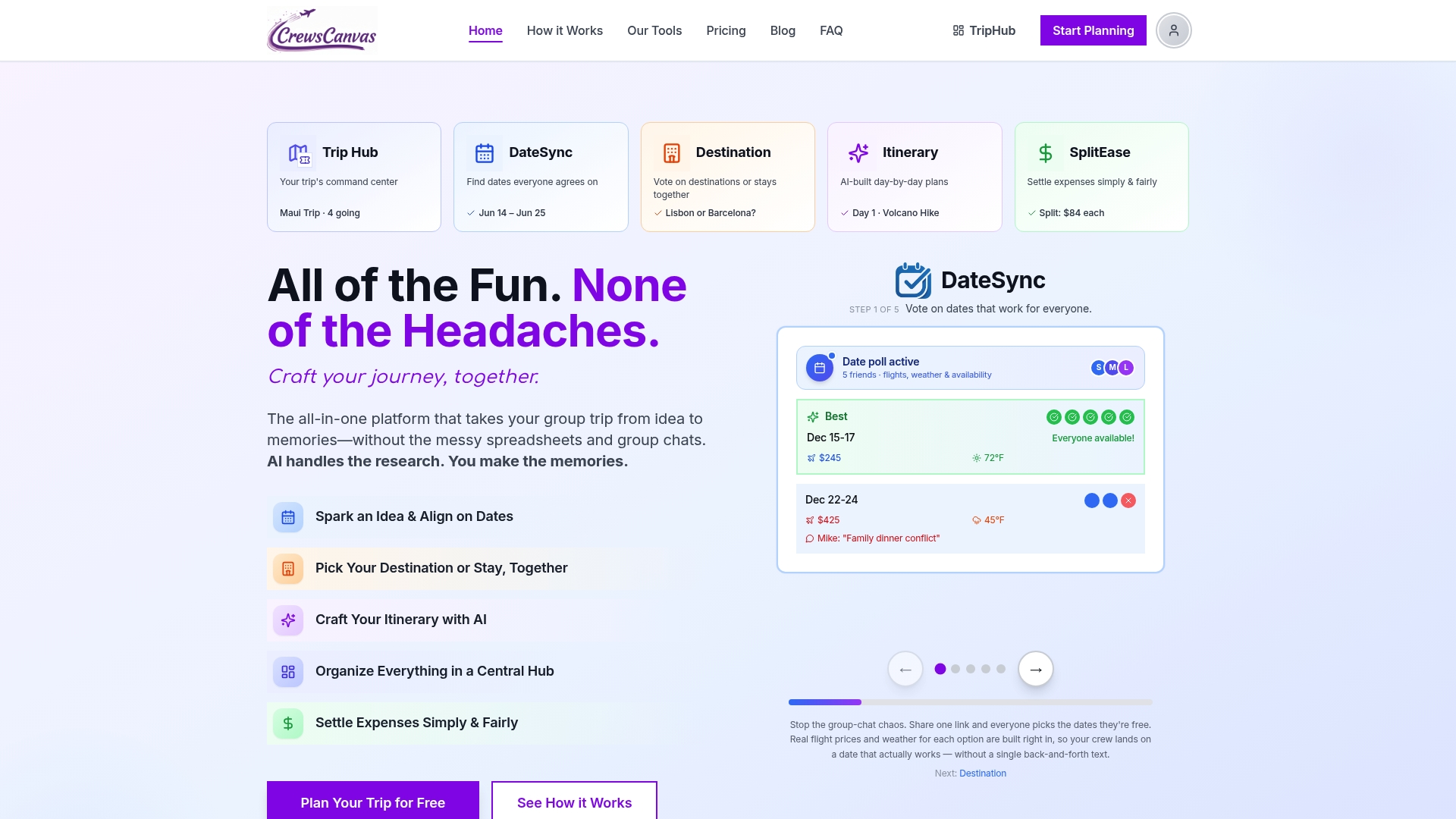
None of your participants need to download an app or create an account to collaborate, they just need the link. The Free plan covers small groups getting started, and if your trip needs more capacity or advanced features, Pro Subscription runs $9.99 per month or you can unlock a single trip with One-Trip Pro for a one-time $14.99.
A few ways to start:
- Use a trip template to skip the blank-page stage entirely.
- Invite your group with a shared link, no signup required on their end.
- Let the AI itinerary builder draft your first skeleton from your booked dates.
Head to Crewscanvas to set up your trip's shared timeline today.
Sources
- International Travel | U.S. Department of State
- Before You Travel | Travelers' Health | CDC
- Tips for families and links to airline pages | U.S. Department of Transportation
- Vaccination and immunoprophylaxis—General principles | CDC Yellow Book
FAQ
What are the 5 stages of travel planning?
Most travel planning breaks into research and dreaming, booking core logistics like flights and lodging, handling documents and health requirements, building a detailed itinerary, and final pre-departure prep. The exact stages vary by source, but they generally follow the same backward-from-departure sequence covered above.
How far in advance should you plan a trip?
It depends on the trip: high-demand experiences like safaris or major events often need 9 to 18 months of lead time, while a standard international trip works well with 6 to 12 months for flights and lodging. Health prep should start at least 4 to 6 weeks out per CDC guidance, since some vaccines need multiple doses spaced weeks apart.
Can I use ChatGPT to plan a trip?
An AI tool can help draft a rough itinerary or suggest activities based on your dates and interests, but it won't know real-time availability, current visa rules, or your group's actual preferences. Treat any AI-generated plan as a starting draft to verify and personalize, not a finished itinerary.
What are the do's and don'ts of building an itinerary?
Do build around fixed, unmovable bookings first, like flights and timed tickets, then fill in flexible time around them, and do leave buffer time between activities. Don't overpack the schedule, don't skip verifying visa and vaccine requirements before booking, and don't rely on a single person's memory instead of a shared, written plan.
When should I buy travel insurance?
Buy trip cancellation coverage as early as possible after your first non-refundable booking, since most policies only cover cancellations that happen after the policy is in place. If you're headed somewhere remote, also look into medical evacuation coverage, since evacuation can cost over $100,000 without it.