
Record every payment as it happens, calculate each person's net balance at the end, then settle up using the fewest transfers possible. Groups usually pick from three methods: equal split, itemized shares, or proportional splitting by usage—check out these best group chat apps to help coordinate your trip communications effectively. If you want the tracking done for you, CrewsCanvas SplitEase builds this ledger automatically inside your trip planning.
TL;DR:
- Equal split is best for groups sharing uniform costs like meals or lodging, while itemized and proportional splits suit varied expenses or differing usage.
- Using a core ledger with five fields and settling with bank transfers, peer apps, or cash minimizes disputes and simplifies reconciliation.
- Favoring low-disparity, contribution-based splits with quick adjustments prevents conflicts, but complex cases may require more detailed fairness algorithms.
- CrewsCanvas SplitEase automatically updates balances when participants log payments and receipt photos, supporting smooth, app-free group expense management.
- Establish clear methods, deadlines, and fee arrangements early, and assign a responsible person for real-time receipt logging to ensure hassle-free trip settlements.
Table of Contents
- Three simple methods to record who paid what
- Worked example: step-by-step calculation for a three-person trip
- Practical settlement: recordkeeping, payment options, and etiquette
- Fairness frameworks and the math behind who paid what
- How CrewsCanvas addresses who paid what with SplitEase
- Practical organizer rules from experienced planners
- Try CrewsCanvas SplitEase to track who paid what
- Sources
- FAQ
Three simple methods to record who paid what
Picking the right method up front saves you from a messy reconciliation later. Each one fits a different kind of trip.
- Equal split: Divide the total cost by the number of participants. If a dinner costing a few hundred dollars is shared by six people, everyone owes an equal share. This works best for uniform costs like a shared cabin or a single group meal where everyone consumed roughly the same amount.
- Itemized ledger: Track each purchase separately, noting who paid and who benefited. This suits trips where spending varies a lot, or where only some people joined a particular activity or meal.
- Proportional or usage-based split: Allocate costs by nights stayed, miles driven, or units consumed. This fits situations where consumption differs substantially, like one person staying an extra night in a shared rental.
For small groups on short, infrequent trips, equal split is usually enough. Once spending gets mixed, or a few people opt out of certain expenses, switch to itemized or proportional splitting. Mixing methods within one trip is fine too: split lodging equally, but itemize meals if some people skip a restaurant. The goal is matching the method to how the money actually moved, not forcing every trip into the same formula.
Worked example: step-by-step calculation for a three-person trip
Say three friends take a weekend trip and split costs unevenly as they went. For example, total expenses might sum to several hundred dollars, divided among lodging, gas, and meals. You calculate each person's fair share by dividing the total cost by three. The person who paid the most is owed money by the others, who settle their debts directly to that person, minimizing the number of transfers.
That clears both debts with just two transfers instead of three separate reimbursements.
- Round to the nearest cent, and if a split doesn't divide evenly, give the extra penny to whoever paid the most.
- Present the settlement as a short list: name, amount owed, amount owed to whom, so nobody has to do the subtraction themselves.
Practical settlement: recordkeeping, payment options, and etiquette
A ledger only works if it's easy to update in the moment. Keep it to five fields: date, payer, amount, who benefited, and a note or receipt photo.
- Bank transfer or Zelle: no fees, but requires everyone to have compatible accounts.
- Peer payment apps: convenient and widely used, though some charge fees for instant transfers or card funding.
- Cash: fast for small amounts, but harder to reconcile against a shared ledger later.
Set a settlement deadline before the trip ends, and agree in advance who absorbs any transfer fees. If a payment slips past the deadline, decide ahead of time whether that's a gentle reminder or a small fee, so nobody has to make that call on the spot.
Disputes happen. Compare receipts or photos first, and if the disagreement is small, fall back to splitting the disputed item equally rather than debating it for another week.
Pro Tip: Photograph every receipt the moment you get it. A blurry memory of a $40 taxi ride two weeks later is how ledgers fall apart.
Fairness frameworks and the math behind who paid what

Two ideas from fair-division research explain why splitting money perfectly is harder than it looks. Envy-freeness means no one would rather have someone else's share instead of their own. Proportionality means everyone gets at least their fair portion of the total value. Both sound obvious, but they can pull in different directions once real preferences and unequal contributions enter the picture.
A fairness gap exists between what's mathematically fair and what feels fair to a group. Research on rent division has found that envy-free allocations always exist for problems like assigning rooms and rent, but there can be many different envy-free solutions, and groups often prefer the one that minimizes disparity between people rather than an arbitrary fair one. In practice, that means the "correct" answer on paper isn't always the one that keeps the peace.
The same tension shows up in cost-sharing more broadly. Research on group-buying and cost-sharing mechanisms shows that fairer, contribution-based schemes usually need more information and more calculation, trading away the simplicity that makes a splitting method easy to use in the first place.
For most trips, that trade-off points toward a practical fix: favor low-disparity allocations, sometimes called maximin approaches, over technically fair but lopsided ones. A small equalizing adjustment, like rounding a shared cost slightly in favor of whoever already paid the most, tends to prevent more disputes than a mathematically pure split. Save formal rent-division algorithms for genuinely complex cases, like assigning differently priced rooms in a shared rental. For a weekend trip with a handful of expenses, equal or itemized splitting with a quick disparity check is usually enough.
How CrewsCanvas addresses who paid what with SplitEase
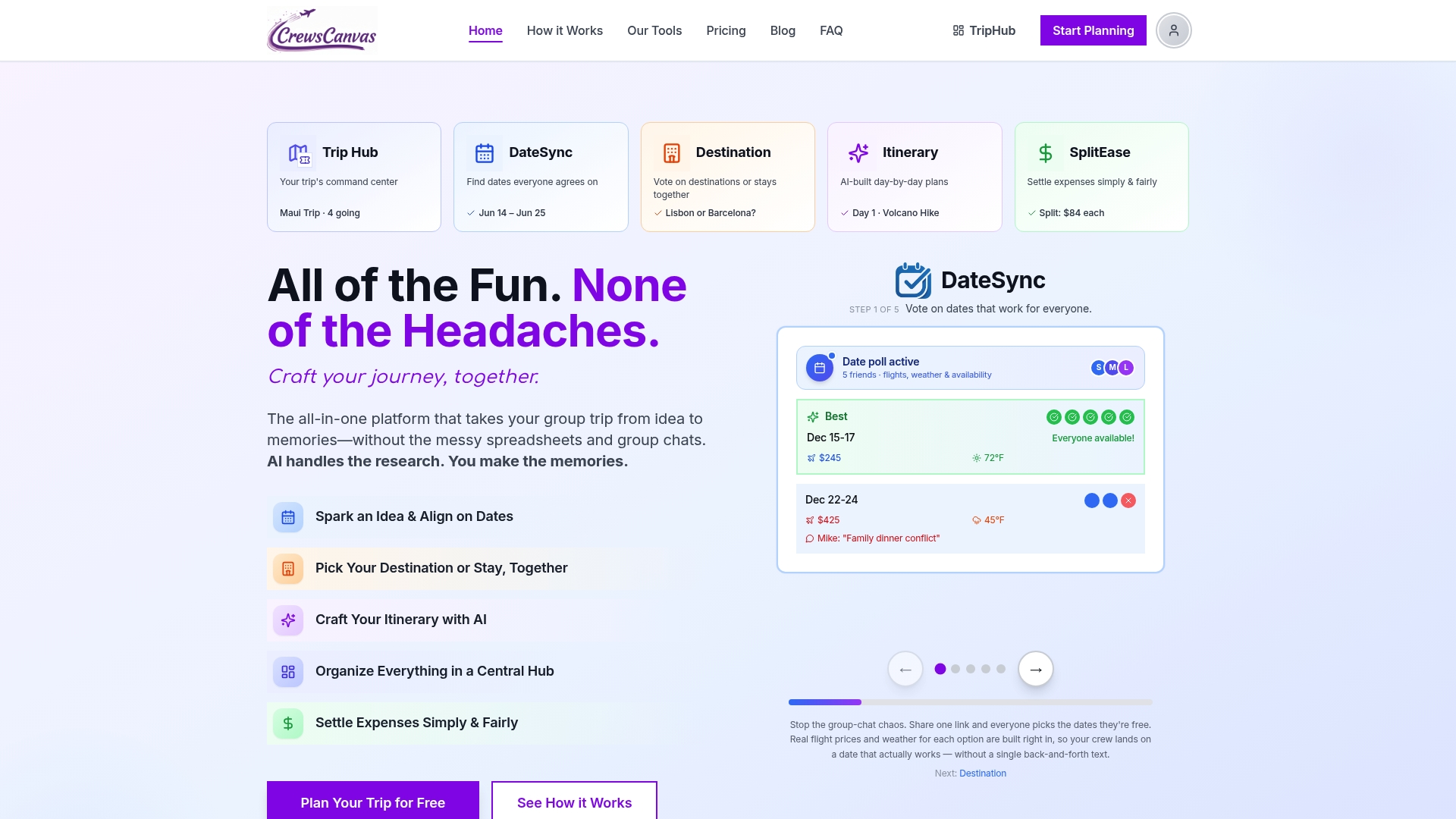
SplitEase builds the ledger described above directly into your trip. Participants log payments and snap receipt photos as they go, and the shared balance updates automatically, no spreadsheet required. Anyone can join through a shared link without creating an account or downloading an app.
It fits best for group trips that already involve date polling or itinerary planning, since expenses sit alongside the rest of the trip details. Try a free plan to start, or unlock more capacity with a paid upgrade.

Practical organizer rules from experienced planners
A few habits separate smooth settlements from awkward group chats.
- Agree on one splitting method before the first dollar is spent, and stick with it for the whole trip.
- Assign a treasurer, or rotate the job, and have that person log receipts as photos right away instead of waiting until the end.
- Set a clear settlement deadline before the trip wraps up, and decide upfront who covers any transfer fees.
- Keep the money conversation neutral: share a plain list of who owes what and how to pay, not a debate about who spent too much.
These rules matter more than any formula. A group that agrees on a method early rarely ends up arguing over pennies later.
— CrewsCanvas
Try CrewsCanvas SplitEase to track who paid what
If you'd rather not build a ledger by hand, SplitEase tracks who paid what alongside your itinerary and dates, so the money side of the trip stays as organized as the plans. Start with the free plan, or grab the one-time One-Trip Pro upgrade for $14.99 if you need more room for one big trip.
Sources
- Which Is the Fairest (Rent Division) of Them All?
- Fairness and stability in group buying / cost sharing
FAQ
What is the best free app for splitting money?
Several free tools handle expense splitting well, and the right one depends on whether you need it standalone or built into broader trip planning. CrewsCanvas offers SplitEase as part of its free plan, letting groups log payments and settle balances without a separate app.
How can I split expenses between three people?
List every expense with who paid and who benefited, then divide the total by three for an equal split, or by actual usage if costs varied. Calculate each person's net balance against their fair share, then have the person owed the most receive payments from the others until balances hit zero.
Is KittySplit free to use?
This article focuses on general splitting methods rather than reviewing specific third-party apps, since pricing and features change over time. Check the provider's own site for current terms before relying on any particular tool.
Who owes who?
Add up each person's fair share of the total cost, then compare it to what they actually paid. Anyone who paid less than their share owes money, and anyone who paid more is owed money, with the simplest settlement having debtors pay creditors directly rather than routing money through everyone.