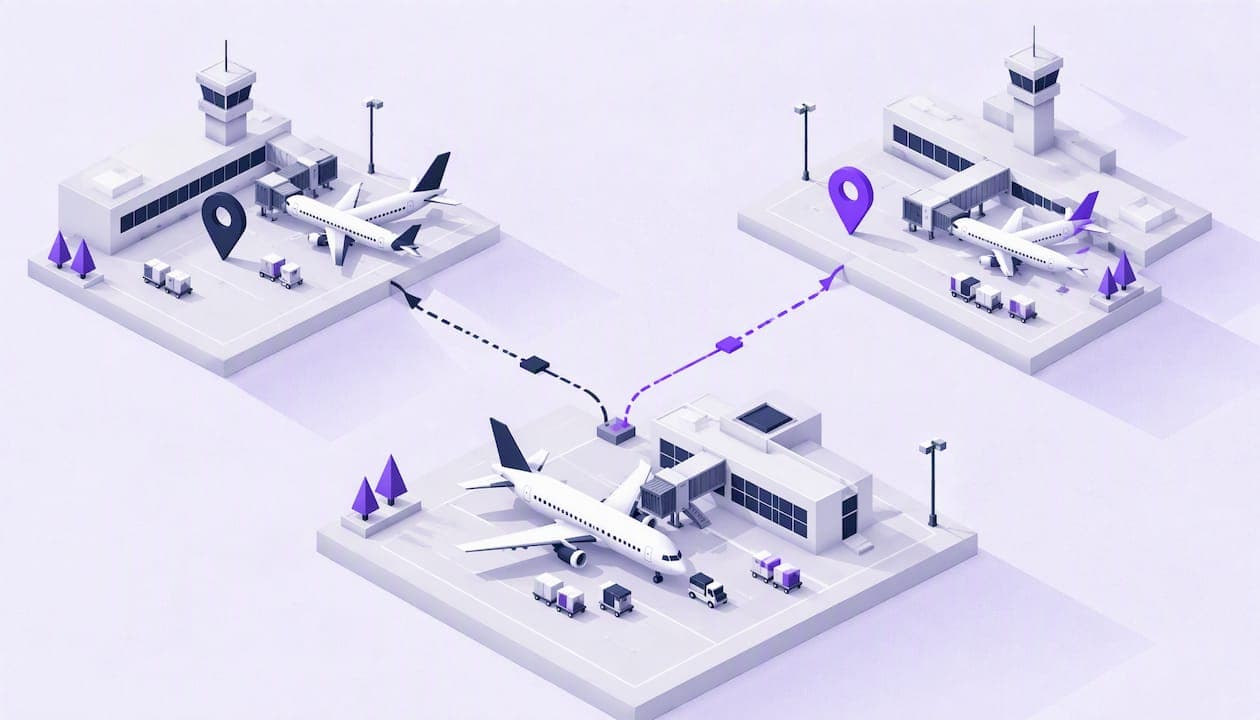
The simplest way to coordinate flight arrivals is to put every traveler's flight details in one shared place, plan the first evening backward from the last scheduled landing, and agree on a single meeting point before anyone leaves home. Add a rule that people message the group when they land and again when they have their bags, and most of the chaos disappears.
If your group is flying in from five cities on six flights, you already know the alternative: a 200-message group chat, a cousin who lands two hours early, and a driver circling the arrivals curb. This guide walks you through what to collect, how to plan pickups, and what to do when a flight slips.
TL;DR
- Collect the same details from everyone: name, mobile number, airline, flight number, scheduled arrival, terminal, bag situation.
- Keep it in one shared record that everyone treats as the final source of truth, not scattered across texts.
- Plan the first evening backward from the last landing, and give delays room to happen.
- Check each airport's official pickup rules, because curbside waiting is often not allowed.
- Decide in advance who does what when a flight is delayed, canceled, or a traveler goes quiet.
Table of Contents
- Why staggered arrivals go wrong
- Step 1: Decide the arrival strategy before anyone books
- Step 2: Collect the same flight details from everyone
- Step 3: Track the actual flights, not the schedule
- Step 4: Plan the meeting point around real airport rules
- Step 5: Build the first day around the last landing
- Step 6: Agree on what happens when something goes wrong
- Step 7: Keep the money side simple
- Perspective: why one shared hub beats a pile of messages
- Plan your group's arrivals in one place
- Quick checklist for the organizer
- FAQ
- Sources
Why staggered arrivals go wrong
Group arrivals rarely fail at the airport itself. They fail in the days before, when nobody knows who is landing when. One person assumes the group is meeting for dinner at 7:00, another does not land until 8:15, and a third booked a flight into a different airport in the same metro area.
The first evening is where this tends to show up. One travel-coordination guide makes the same point: plan the first evening backward from the last scheduled landing so there is slack for delays. That is a useful rule of thumb, and it changes how you schedule everything else: the welcome dinner, the rental car pickup, the check-in window at your lodging.
Three problems cause most of the pain:
- No single record. Flight numbers live in individual email confirmations and private texts.
- No shared definition of "landed." Landing is not the same as being at the curb. Bags, restrooms, and long terminals add time.
- No plan B. When a flight is delayed, the organizer ends up improvising for everyone at once.
Fixing the first problem takes care of most of the other two.
Step 1: Decide the arrival strategy before anyone books
The best time to coordinate arrivals is before flights are purchased. If your group is still choosing dates, settle that first. Our guides on coordinating travel dates for a group and picking a vacation date when your group has 10 different schedules cover how to get everyone onto the same arrival day. If work and school calendars are pulling in different directions, see how to sync group trip dates with mixed work and school schedules.
Once the dates are set, choose one of three approaches:
| Approach | Works best when | Watch out for |
|---|---|---|
| One shared arrival window | Everyone flies from the same region and can land within a couple of hours | People who book the cheapest flight and break the window |
| Two or three arrival waves | Groups from different coasts or hubs | Needing a meeting point for each wave |
| Everyone for themselves | Small groups, a walkable or transit-friendly destination, adults who travel often | Missing the first group activity |
A transportation company's pickup guide describes the same trade-off: a single shared pickup works well when arrival times are close, while separate pickups may be better when there is a large gap, young children, or travelers who cannot reasonably wait. Saving on one vehicle is rarely worth an extra hour of uncertainty for tired travelers.
For longer trips across time zones, you may also want to build in a buffer day. Our post on time zone scheduling for group trips explains why arriving two days early can pay off.
Step 2: Collect the same flight details from everyone
The most common mistake is asking "when do you land?" and accepting any answer. A time alone is not enough for the person who has to plan pickups. Ask for a fixed set of details from every traveler.
A pickup guide from a U.S. transportation company recommends that the shared record include each traveler's full name, mobile number, airline, flight number, scheduled arrival time, terminal, luggage expectations, destination address, and special requests. For a group trip, here is a practical version:
- Full name and mobile number. The mobile number matters most when someone is walking out of baggage claim and cannot find the group.
- Airline and flight number. Flight numbers let you track the actual arrival time instead of relying on a schedule created weeks earlier.
- Departure and arrival airports. Confirm the airport code, especially in metro areas with more than one.
- Scheduled arrival time and terminal. Ask for the time in local destination time.
- Checked bag or carry-on only. This changes pickup timing by a lot.
- Where they are going next. A hotel, a rental house, or the group meeting point.
- Anything that affects pickup. A car seat, a wheelchair, a long layover, or a flight that connects somewhere else.
Put it in one place
The same guide advises keeping the key details in one place that the organizer and any transportation provider can reference, and says a shared document or group message works if everyone knows it is the final source of truth. The important part is that last clause. A spreadsheet that half the group ignores is just another thing to update.
This is where a trip hub earns its keep. In CrewsCanvas, TripHub keeps shared documents and reservations together, so flight confirmations sit next to the itinerary rather than buried in someone's inbox. Participants can use a shared link without installing an app or creating an account, which matters when your uncle will not download anything.
Step 3: Track the actual flights, not the schedule
A scheduled arrival time is a plan, not a promise. Once travelers are in the air, the real arrival time is what counts.
Live flight tracking is available through websites and mobile apps such as FlightAware, which show real-time updates on gate changes, delays, and cancellations. You do not need the whole group to track every flight. Assign one person, usually the organizer or a co-organizer, to watch the flights and post updates to the shared record.
Airlines also have a duty to keep passengers informed. According to the U.S. Department of Transportation, airlines must notify passengers about cancellations and significant delays or changes and about their right to a refund, and subscribed notifications must go through the passenger's chosen method, whether email, text, or mobile app. Remind each traveler to sign up for their airline's alerts, and ask them to forward anything important.
A simple check-in rhythm
Set a short routine so the organizer does not have to chase people:
- Day before: Everyone confirms their flight number and time in the shared record.
- Morning of travel: Travelers post "on my way" and any changes.
- On landing: They message "landed."
- At baggage claim or when ready: They message again, "I have my bags."
That last step is borrowed from a good practice in group pickup guides: ask travelers to notify the organizer when they land and again when they have their bags. It gives drivers and organizers a precise signal instead of a guess.
Step 4: Plan the meeting point around real airport rules
"We'll meet at arrivals" is not a plan. Airports have specific rules for where you can wait, and those rules differ from one to the next.
At Chicago Midway, for example, arriving passengers can be picked up at the lower-level outermost curb, but curbside waiting is prohibited. The airport directs drivers to wait in the cell phone lot until passengers deplane, collect baggage, and call for pickup. Orlando International Airport's official FAQ says curb pickups are only for active loading, not unattended waiting, and suggests allowing at least 20 minutes after the aircraft arrives, or 40 minutes when the passenger has checked baggage.
Those two airports show why you should check your own destination airport's official page before writing the plan. Look for:
- Which curb or level is used for arrivals pickup
- Whether there is a free cell phone waiting lot
- Where rideshare pickups are located
- Where rental car shuttles leave from
- Whether the terminal you are using is different from your travelers' terminals
Rideshare timing
If some travelers will take a rideshare, tell them when to request it. Lyft's guidance for U.S. airports tells riders to request the ride when their bags are in hand, verify the terminal and the designated pickup location, and follow airport-specific instructions. Requesting too early means a driver waiting and possibly canceling.
Pick a fallback meeting spot
Every plan needs a backup. Name one fixed spot inside the terminal, such as a specific baggage carousel or a coffee shop near arrivals, and post it in the shared record. If phones die or messages fail, everyone knows where to go.

Step 5: Build the first day around the last landing
Once you know when everyone arrives, build the first day with a buffer. Work backward from the last scheduled landing, then add time for the following:
- Deplaning and walking to baggage claim
- Checked bag delays
- The trip to the lodging
- Check-in
An arrival within 15 minutes of schedule is generally treated as on time, which means even "on time" can be a little later than the clock suggests. One group-travel guide recommends allowing more room for airport exit, bags, and delays than the schedule alone suggests.
A sample first evening for a group where the last flight lands at 5:30 p.m.:
| Time | Plan |
|---|---|
| 5:30 p.m. | Last flight scheduled to land |
| 6:30 p.m. | Last traveler likely at the curb, with bags |
| 7:15 p.m. | Arrive at lodging |
| 8:30 p.m. | Casual dinner, nothing prepaid or tightly timed |
Notice that nothing important happens before 8:30. Leave the ticketed show, the reservation with a 15-minute grace period, and the sunset hike for day two.
If you are choosing where to stay, check the details before paying a deposit, including check-in times and late arrival rules. Our guide on checking beds and fees before paying a deposit covers the rest. Put the plan into a shared schedule using a group trip itinerary everyone will actually follow.
Step 6: Agree on what happens when something goes wrong
Delays and cancellations are not a matter of if. Decide the response before the trip so the organizer is not making calls for ten people at once.
If a flight is delayed
The delayed traveler should tell the group immediately and update the shared record. If the delay is long, they should ask airline staff whether the airline will cover meals or a phone call. The Department of Transportation notes that airlines have their own amenity policies and that there are no federal requirements for this. So it is worth asking, but not worth assuming.
Then decide what the rest of the group does:
- Wait together if the delay is under an hour and the group is small.
- Split off if the delay is long, and send the delayed traveler to the lodging by rideshare or shuttle when they land.
- Reschedule the group activity if several people are affected.
If a flight is canceled
The traveler should contact the airline right away and be clear about what they want: rebooking or a refund. DOT says airlines must notify passengers about cancellations and tell them about their right to a refund. The shared record should show the new flight number and time as soon as it is confirmed.
For international itineraries, there is another route. DOT notes that passengers on international flights may be able to recover expenses caused by a delayed or canceled flight under Article 19 of the Montreal Convention by filing a claim with the airline. Keep receipts, and have travelers hold onto them for later.
The importance of timely notices is not abstract. After the 2022 holiday meltdown, DOT penalized Southwest Airlines $140 million, and the case highlights how failures to give timely, accurate flight status information can leave travelers stranded. That is one more reason not to rely on a single source of updates.
If someone cannot be reached
Set a rule in advance: if a traveler has not checked in 30 minutes after their flight's actual landing time, the organizer checks the flight status, then calls. If there is still no answer, the person goes to the fallback meeting spot, or the organizer calls the backup contact the traveler listed. Having each person name a backup contact in the shared record takes ten seconds and saves an hour.

Step 7: Keep the money side simple
Arrival logistics produce small expenses: a shared shuttle, a rideshare for the early group, a late-night grocery run. These are exactly the costs that turn into awkward conversations later. Decide early whether airport transport is split evenly or paid by those who use it. Our guide on how to budget for a group trip fairly can help you set the rule, and SplitEase tracks shared costs and settles up at the end, including by scanning receipts.
Perspective: why one shared hub beats a pile of messages
We built CrewsCanvas because we kept seeing the same pattern: the flights get booked, then the details scatter across email, texts, and a spreadsheet that only the organizer understands. By the time the group lands, nobody is sure who is arriving where.
Our view is that arrival coordination is a planning problem, not a messaging problem. The details that matter, such as who is on which flight, when the group meets, and who owes whom for the shuttle, should live next to the itinerary where everyone can see them. That is why TripHub, the itinerary builder, and SplitEase sit together, and why participants can join through a shared link without downloading an app or creating an account.
We designed it so the organizer is not the human switchboard. When arrival times change, the plan changes in one place, and everyone sees it.
CrewsCanvas
Plan your group's arrivals in one place
If you are tired of piecing together arrival times from a dozen texts, CrewsCanvas gives your group one shared hub for dates, itinerary, reservations, and expenses. You can start on the free plan for small groups, and upgrade to Pro for $9.99 per month or One-Trip Pro for a one-time $14.99 if you need more capacity or advanced features. See the details on the pricing page, or explore the full toolkit.
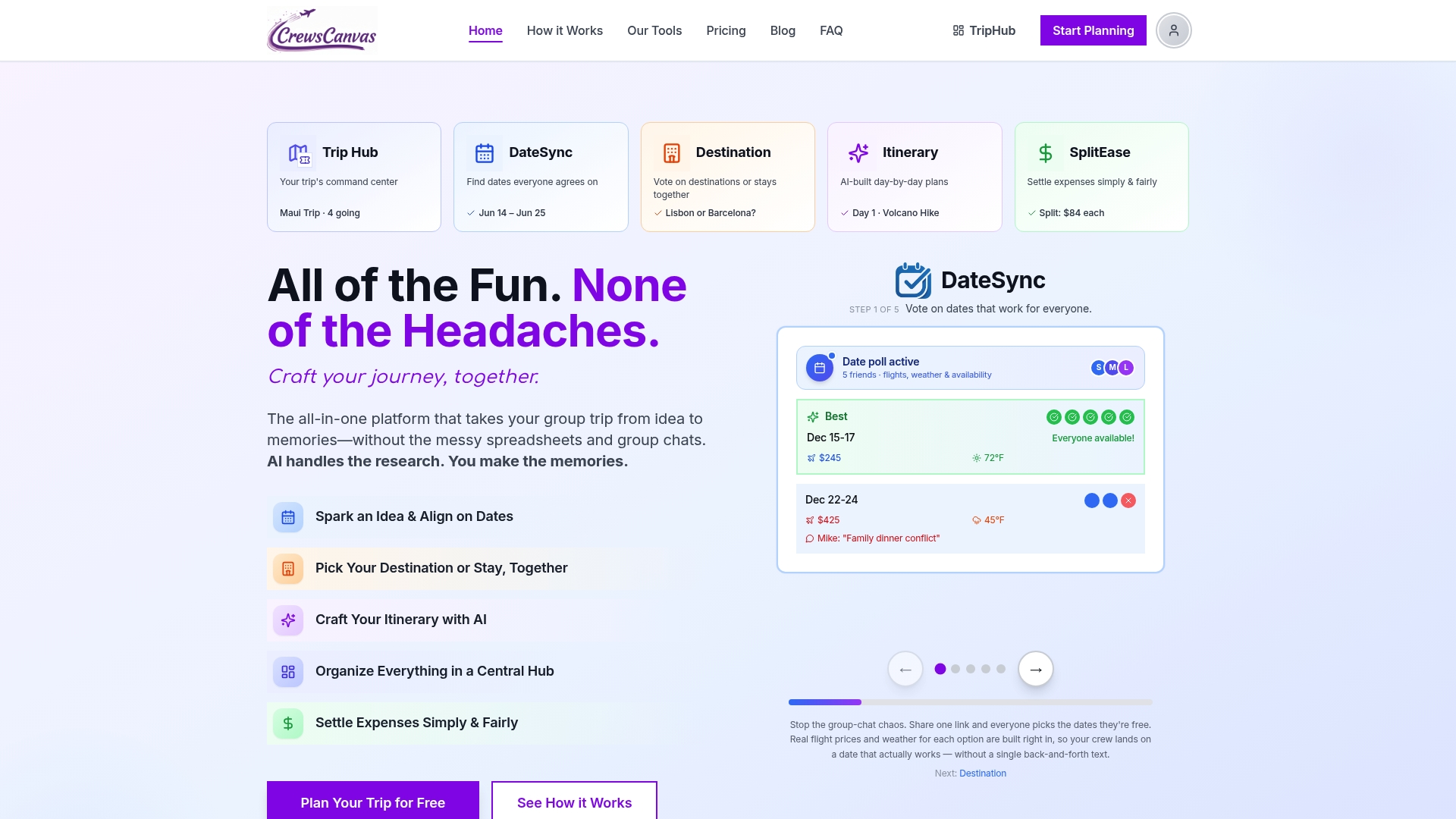
If you want to map out the first day around everyone's landing time, try the itinerary builder, which creates an AI-generated draft you can customize.
Quick checklist for the organizer
Before the trip:
- Collect name, mobile number, airline, flight number, arrival time, terminal, and bag plan from every traveler.
- Post it all in one shared record and say that it is the final source.
- Check the destination airport's official page for pickup rules.
- Name a primary meeting point and a fallback.
- Plan nothing time-sensitive within about three hours of the last scheduled landing.
- Ask each traveler to name a backup contact.
On travel day:
- Track flights through one person, not ten.
- Ask for "landed" and "have my bags" messages.
- Tell rideshare riders to request a car only when their bags are in hand.
- Update the shared record with any change as soon as it happens.
After arrival:
- Log shared transportation costs right away, while everyone remembers who rode with whom.
FAQ
What details should everyone share when coordinating flight arrivals?
At a minimum: full name, mobile number, airline, flight number, scheduled arrival time, terminal, and whether they are checking a bag. Add the destination address and any special requests, such as a car seat or mobility needs. Keep everything in one shared record so the organizer is not hunting through texts.
How early should we plan to meet after the last flight lands?
Allow more than the schedule suggests. Orlando International Airport advises at least 20 minutes after arrival for pickups, or 40 minutes if the passenger has checked baggage. For a group, add buffer for delays, the walk to the curb, and the ride to your lodging, and keep the first evening easy.
Should we all travel to the lodging together?
Only if arrival times are close. A single shared pickup works well when everyone lands within a short window, but a large gap, young children, or tired travelers make separate pickups a better choice. When in doubt, let early arrivals go ahead and meet the others later.
What should we do if a flight is delayed or canceled?
The traveler should tell the group and update the shared record right away, then contact the airline about rebooking or a refund. Airlines must notify passengers about cancellations and significant delays, and about the right to a refund, according to the Department of Transportation. Keep receipts for any expenses in case you can claim them.
Do we need a special app to coordinate arrivals?
No. What matters is having one agreed place that everyone checks. A shared document works if the group treats it as the final word. With CrewsCanvas, participants can open a shared link without installing an app or creating an account.
Sources
- Refunds, US Department of Transportation
- Fly Rights, US Department of Transportation
- DOT Penalizes Southwest Airlines $140 Million for 2022 Holiday Meltdown
- Drop Off / Pick Up, Chicago Midway International Airport
- Picking Up and Dropping Off, Orlando International Airport
- Airport information for riders, Lyft Help
- FlightAware Flight Tracker
- How to Coordinate Group Airport Pickups Without Stress
- Group Trip Coordination When Flights Are Different