To avoid time confusion on a group trip, centralize every traveler's arrival details in one table and publish all times in the destination's local time, with a UTC offset. When you cross several time zones, the CDC advises arriving at least 2 days before anything important. Harvard Health agrees on the adjustment steps. CrewsCanvas gives you one place to keep it all.
TL;DR:
- For trips crossing more than three time zones, plan arrival at least 2 days before the first important event, and announce the buffer before anyone books.
- Group travelers landing within an hour or two under one pickup lead, and keep the first day free of timed tours while bodies adjust.
- Label times with the destination city or UTC offset, not abbreviations such as EST, and check daylight saving transition dates along the route.
- Travelers can shift sleep and wake times about 1 hour daily for 2 to 3 days before departure, then seek daylight and follow local meal times.
Table of Contents
- What should your organizer checklist include?
- How do you sequence arrivals and the first day?
- How can you cut jet lag for the whole group?
- How should you format times and handle daylight saving?
- What workflow keeps everyone on the same page?
- Why a central arrival table changes everything
- How we help you plan across time zones
- FAQ
- Sources
What should your organizer checklist include?
Work through these steps in order, and you will catch most timing problems before anyone books a flight.
- Build one arrival table. Give each traveler a row showing arrival time in destination local time, not departure time.
- Collect flight details. Ask for flight numbers, estimated arrival times, a phone number and the agreed meeting point.
- Check offsets. Confirm the UTC offset for every origin city and for the destination before you lock anything.
- Set the buffer. Decide how many days before the first group event people should arrive, and tell everyone early.
- Name one source of truth. One organizer owns the master file or platform link, and everyone else reads from it.
Say the buffer out loud in your first message. People book flights quickly, and a rule announced after tickets are bought is a rule nobody can follow.
Pro Tip: Ask travelers to paste their confirmation email details into the table themselves. You verify the times, and you avoid retyping errors.
If your group is still choosing dates, our guide on coordinating travel dates for a group covers the earlier steps.
How do you sequence arrivals and the first day?
Arrival logistics go wrong when one person reads "4:30 PM" as home time and another reads it as local time. Listing every arrival in destination local time removes that ambiguity for pickups and hotel check-ins. Here is how we sequence the rest:
- Anchor on the first important event. Count backward from it, then add your buffer. The CDC recommends arriving at least 2 days early where possible, and that applies most when you cross more than three time zones.
- Group travelers by arrival window. Cluster people landing within an hour or two so one driver or one shared ride covers several of them.
- Stagger airport pickups. Assign a pickup lead for each cluster and put that name next to the row in your table. Nobody should wonder who is meeting them.
- Keep day one light. Plan a casual dinner or a walk, not a tour with a booked entry time. Travelers whose bodies are still adjusting to local time make poor sightseers.
- Pick flights for daylight. When you can, choose arrivals that let people get outside in daylight on the first day, which helps the body clock reset.
Planning from further out? Our travel planning timeline for small groups shows how to space these decisions over many months.
For cabin trips, arrival windows matter even more, because check-in often has a hard cutoff. This cabin group activity planning guide has useful ideas for filling the first evening.
How can you cut jet lag for the whole group?
Jet lag is a mismatch between your internal clock and local time. Your group will feel it most when it crosses more than three time zones, according to Harvard Health, so share these tips before departure rather than at the airport.
- Before the trip: Shift your sleep and wake times by about 1 hour per day for the 2 to 3 days before you leave, moving toward the destination schedule.
- In the air: Go easy on caffeine and alcohol, drink water, and take short naps of 15 to 20 minutes if you need to stay alert.
- On arrival: Get outside in daylight, eat meals at local times and go to bed at local bedtime, even if it feels early.
- Melatonin: Treat it as a conversation for each traveler and a healthcare provider, not a group-wide rule.
- Your schedule: Keep strenuous or time-sensitive activities out of the first day or two after a long, multi-zone trip.
The CDC says experts recommend arriving at least 2 days before important events so travelers have time to adjust. That one line should shape your whole itinerary.
How should you format times and handle daylight saving?

A time without context causes arguments. Always write times in the destination's local time and add either a UTC offset or a city name. NIST explains that Coordinated Universal Time is the shared reference, and local zones are offsets from it. Skip abbreviations like EST and EDT, which are often ambiguous and do not adjust on their own for daylight saving changes.
Daylight saving trips up more groups than you would expect. Rules are local, and the gap between two places is not constant all year. The U.S. Department of Transportation oversees time zone boundaries and daylight saving observance in the U.S., so check transition dates for each place on your route, especially if your trip falls in spring or fall.
- Name the city: "Lisbon, local time" beats "6 PM."
- Send calendar invites: Attach an ICS file and include a local time note in the description.
- Link a converter: Add a time converter link so travelers can check their own home time.
- Reuse a template: "All times shown are [city] local time (UTC±X). Convert at [converter link]."
Pro Tip: Put the template line at the top of your arrival table and your itinerary, so no one has to search for it.
What workflow keeps everyone on the same page?
The best system is simple: gather availability in one place, vote, then lock the result in one itinerary. When responses normalize to destination local time, you stop translating between time zones by hand. Our guide on picking a vacation date when everyone has different schedules shows the voting side in detail.
- Pick one merger. One organizer combines every response so there is a single answer.
- Keep one itinerary. Lock times in destination local time and show each traveler's arrival window.
- Assign roles. Name a pickup lead, a hotel contact and a time verifier who double-checks offsets.
- Use the right tools. With DateSync for date voting, TripHub for reservations and SplitEase for shared costs, we keep these jobs in one place.
Why a central arrival table changes everything
I want to be direct about what we believe: most group travel stress is a communication problem wearing a time zone costume. People rarely miss an activity because time zones are hard. They miss it because multiple versions of the schedule were floating around, and each one used a different clock.
A single arrival table, a firm buffer before the first big event and times written in destination local time fix most of it. Those habits are cheap and unglamorous, and they beat any clever workaround you invent on the day.
— CrewsCanvas
How we help you plan across time zones
When you plan with us, the workflow above lives in one shared hub.
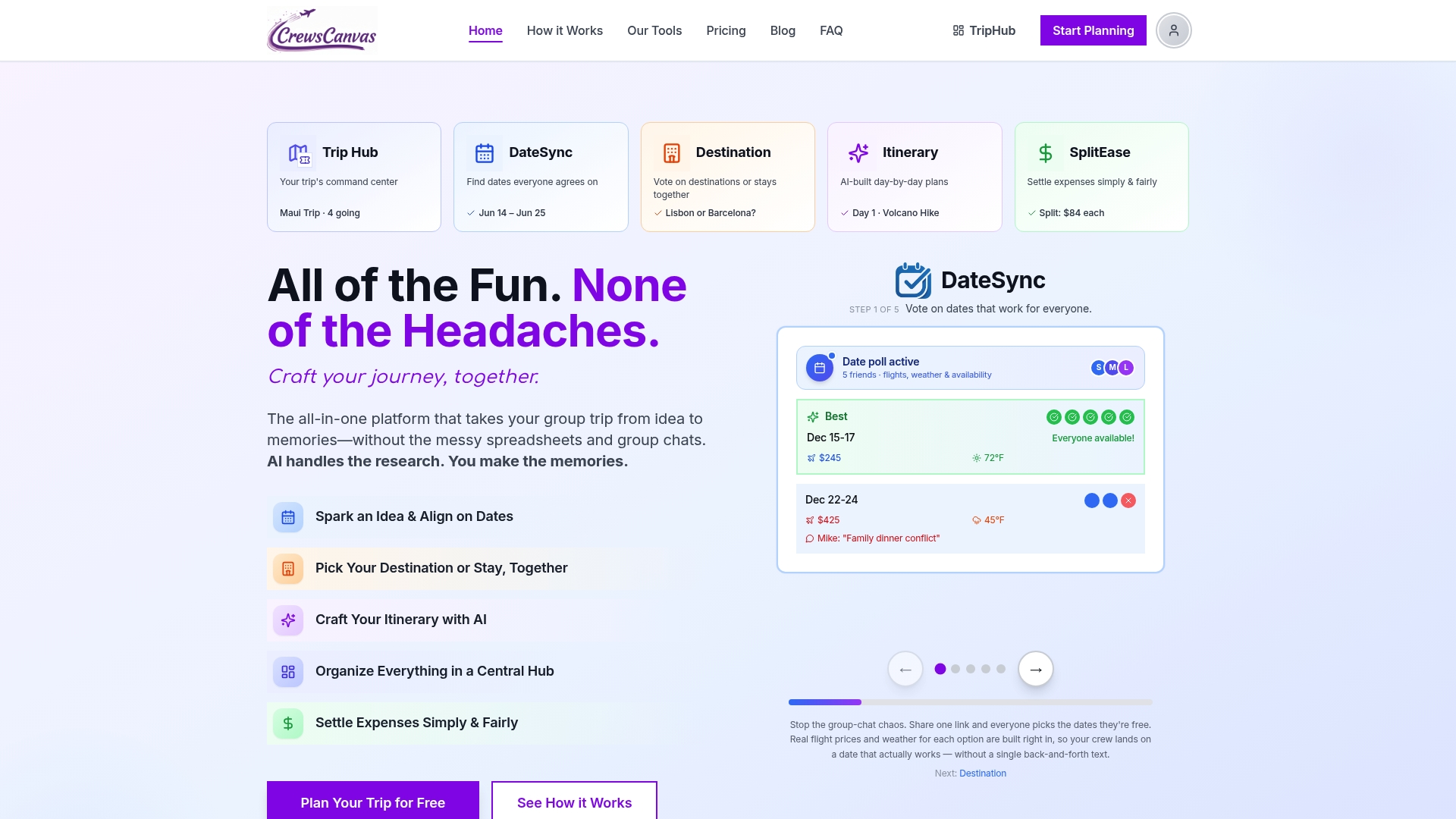
- DateSync: Your group votes on dates, so you can see what works before anyone books.
- Smart itinerary generator: Our AI planner builds a day-by-day plan that you can edit to match destination local time.
- SplitEase: Shared costs stay transparent, with no awkward money conversations.
Start with the free plan, or compare options on our pricing page when your group is ready for more.
FAQ
How early should a group arrive before an important event?
Arrive at least 2 days before when you can, especially if you cross more than three time zones. The CDC recommends this buffer so travelers have time to adjust. Shorter trips can use a smaller buffer, but keep day one light.
Should we use the home time zone or the destination time zone?
Use the destination time zone for every arrival, pickup and activity. Add a UTC offset or city name so nobody has to guess. This keeps check-ins and pickups consistent for the whole group.
Why avoid abbreviations like EST and EDT?
They are easy to misread, and they do not tell you whether daylight saving is in effect. A city name or UTC offset states exactly what you mean. That one change prevents many missed pickups.
How do we handle travelers coming from different countries?
Give each traveler a row in a shared table with their arrival in destination local time. Then cluster similar arrival windows for rides. Everyone reads the same clock, wherever they started.