
Start your Disney World group trip by running a date vote, then set a per-person budget and name a dining lead to watch the 60-day reservation window. Student-group tickets follow separate rules, so friends and families should not count on them. Keep votes, money and reservations in one place, and we built CrewsCanvas for exactly that.
TL;DR:
- Close the date vote by a stated deadline, assign owners for payments and dining, and publish deposit, ticket, reservation, and final payment deadlines together.
- Build a per person budget from tickets, lodging, transport, meals, extras, and gratuities; pool deposits, then itemize trip spending and set a settlement date.
- Student group tickets require at least 10 students ages 3 to 22, payment 45 days before arrival, and are nonrefundable, excluding friend and family trips.
- Book essential meals when the 60 day window opens; one dining lead should manage plans, with staggered times for large parties.
- Choose meeting points and backups in each park; check resort transit, which starts 45 minutes before opening and runs up to an hour after closing.
Table of Contents
- How do you get everyone to agree before booking anything?
- What should a per-person Disney World budget include?
- How do you build a daily itinerary a whole group will follow?
- What works best once you are inside the parks?
- Which tools actually cut down the planning work?
- What we think organizers get wrong
- Run your Disney World group trip from one place
- FAQ
- Sources
How do you get everyone to agree before booking anything?
A loose "we should all go" becomes a real trip only when it has a deadline and an owner. Treat the initial planning period as a small project, and the bookings that follow will actually happen.
Open a date vote with a clear response deadline, then close it by majority rule. Our DateSync page shows how this kind of poll works. If your group argues about destinations too, our guide on getting a friend group to agree on a vacation destination covers it.
Once dates are locked, settle the trip's priorities. Pick two or three group must-dos (a character meal, a signature ride, a fireworks night) and let everything else stay optional. Fewer shared commitments means fewer arguments on the ground.
Then hand out jobs and write them down:
- Lead organizer: owns the master plan and final decisions.
- Payments manager: collects deposits and tracks who has paid.
- Dining lead: sets a calendar alert for the 60-day booking date.
- Meeting-point lead: picks the daily landmarks and backups.
- On-site first responder: the calm person who handles lost phones, blisters and meltdowns.
Add the key deadlines to a shared note, including the deposit, ticket purchase, dining booking and final payment cutoff.
Pro Tip: Publish the deadlines in the same message that announces the final dates, so nobody can say they missed them.
What should a per-person Disney World budget include?
Skip the hunt for one "average cost" number. Totals swing with dates, hotel category, ticket length, dining and paid add-ons, so build the budget by category and divide by head count. Our post on friends trip planning shows how to keep budgets and peace intact together.
A workable template has these buckets:
- Park tickets: buy after dates are final, based on the number of park days.
- Hotel: divide by rooms, then by people per room.
- Transport: flights, rental car or rideshare, plus any paid on-property service.
- Dining: sit-down meals, snacks and drinks.
- Extras: photo packages, tours and other add-ons.
- Gratuities and incidentals: a small cushion per person for tips and surprises.
Timing matters here. Dining reservations open up to 60 days before arrival, so decide your restaurant spending early. Disney's student-group program is a different animal: it requires at least 10 students ages 3–22, full payment at least 45 days before the visit, and tickets are nonrefundable. It is a youth-group program, so a large party of friends or relatives should not assume it applies.
For money flow, choose one of two models. A pooled fund, where one person collects everything, is simple but puts pressure on that person. Itemized splitting, where everyone pays their own share, is fairer but needs better tracking. We suggest pooling for deposits and itemizing for on-trip spending, with a firm settlement date.
Pro Tip: Photograph every receipt when you get it and keep a running balance, so final settlement is easier and avoids an evening of arguing.
How do you build a daily itinerary a whole group will follow?
Keep one master itinerary that everyone can open, with a start time, one or two ride anchors and a fallback for each day. Our guide to a group trip itinerary everyone will follow goes deeper on format.

Treat travel time as part of the plan. Resort transportation generally begins about 45 minutes before park opening and runs up to an hour after closing, and routes differ by resort. Some services, like Minnie Van, are separate and cost extra. Build walking and waiting buffers around those windows.
Use this structure for each day:
- Morning: one group anchor, ideally the most popular ride, while energy is high.
- Midday: a break or split time, since a rest in the hotel and a second headline ride are both fair choices.
- Dining: decide in advance which meals need one big reservation and which can be two smaller ones nearby. Book must-have restaurants the day the window opens, and consider staggered times for big parties.
- Evening: one together moment, such as a parade, dinner or fireworks.
- Reservations hub: link bookings and manage plans in My Disney Experience, so the dining lead and organizer see the same list.
Two anchors a day is plenty. The rest of the hours belong to smaller groups who want to ride different things.
What works best once you are inside the parks?
Pick one fixed, easy-to-spot meeting point in each park, near a landmark, and name a backup. Post both in your shared plan the night before.
- Low-cost shared time: resort transportation rides, exploring Disney Springs, resort lobbies and scheduled entertainment cost little, though availability and hours can change, so check close to travel.
- Splitting for rides: break into subgroups for high-demand attractions and use paid Lightning Lane options only where your budget allows.
- Regrouping: leave buffer time after each split, because transfers always take longer than the app suggests.
- Evening extras: if the group wants something beyond the parks, an event such as the Orlando Caribbean Festival can fit a free evening.
Check before you go: transportation is not uniform, since complimentary service depends on the route and resort. Confirm the schedule for your own hotel before locking daily start times.
Which tools actually cut down the planning work?
Look for five things in whatever you use:
- Date polling that anyone can answer.
- A shared itinerary builder.
- Storage for reservations and documents.
- Receipt capture and split settlement.
- Guest links, so relatives can join without creating accounts.
Here is how the workflow runs on one platform. The date poll closes, deposits come in, the group drafts the itinerary, the dining lead confirms reservations, and during the trip receipts go straight into the shared balance. Nobody has to chase anyone through a long chat to find out who owes what. You can see the full toolkit on our tools page.
Pro Tip: Require two confirmations before final payments: one automated reminder and one personal follow-up from a named person.
What we think organizers get wrong
Most group trips fail on boring things, not big ones. Before you leave, check that you have locked dates, collected deposits, booked tickets, reserved dining, assigned daily meeting points and planned receipt management.
A few mistakes show up again and again. Waiting on dining: give one person the 60-day alert. Unclear payment deadlines: publish a one-line payment policy. No on-site plan: choose landmarks before you arrive. Keep everything in one visible hub so accountability is built in.
— CrewsCanvas
Run your Disney World group trip from one place
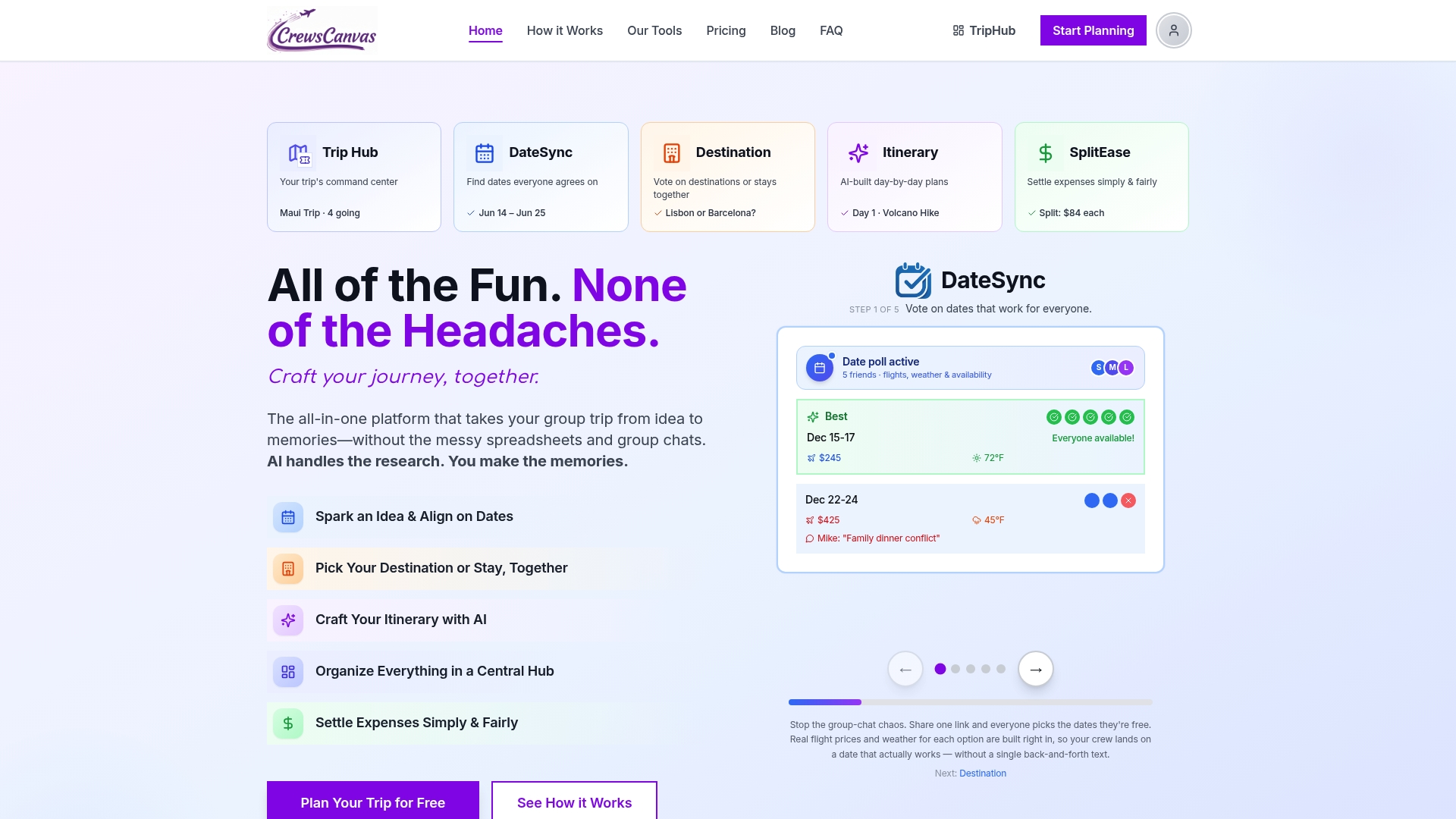
Every step in this guide maps to a tool we built, so your group stops juggling spreadsheets and chats:
- DateSync runs the date vote.
- Our AI itinerary builder drafts your park days, which you then edit.
- TripHub stores reservations and documents.
- SplitEase captures receipts and settles shares.
Our Free plan covers small groups. For bigger crews, One-Trip Pro is $14.99 one-off and the Pro Subscription is $9.99 per month. Start with a date vote today, and see the full toolkit on our tools page.
FAQ
When do Disney World dining reservations open?
Dining reservations can be made up to 60 days before your arrival, and popular restaurants fill quickly. Set a calendar alert for that date and book your must-have meals first.
Do student-group tickets work for a family reunion?
No, they are built for youth groups through Disney Imagination Campus, not for friends or relatives. Large family parties should plan on standard ticket purchases instead.
What free things can you do at Disney World?
Riding resort transportation, exploring Disney Springs, visiting resort lobbies and watching scheduled entertainment cost little or nothing. Park admission, dining and add-ons cost extra, and availability can change, so verify before you travel.
Is Walt Disney World part of the United States?
Yes. It is in Lake Buena Vista, Florida, near Orlando.
Sources
- Student Group Theme Park Tickets | Disney Imagination Campus
- Resort & Theme Park Transportation | Walt Disney World Resort
- Undercovertourist
- Vacation Checklist & My Disney Experience | Walt Disney World Resort