
The fastest way to choose a hotel as a group is to vote, but only after you agree on the rules. Set a deadline, write down 5 to 9 criteria, trim the options to a short list, compare the real all-in price of each, and then let everyone vote privately so the loudest person in the chat doesn't decide. This guide walks through each step, shows which voting method fits which kind of group, and covers ties, silent members and the fee surprises that can wreck a fair vote.
If you have ever watched a hotel decision die somewhere around message 140 of a group chat, you already know why this matters. Links get posted, three people react with a thumbs up, one person says "anything works," and the booking never happens.
TL;DR
- Agree on the deadline, the decision rule and the criteria before anyone posts a hotel.
- Cap the ballot at 3 to 5 options, each judged on the same 5 to 9 criteria.
- Compare total cost (fees, taxes, parking, deposits), not the nightly rate shown on the listing.
- Vote privately, choose a method that fits your group, and settle the tie-break rule in advance.
- Book as soon as the vote closes, because the winning room may not wait.
Table of Contents
- Why hotel decisions stall in group chats
- Set the rules before you post a single hotel
- Build a short list the group can actually compare
- Compare total cost, not the nightly rate
- Choose a voting method that fits your group
- Handle ties and silent members before they happen
- A five-step process you can run this week
- Our perspective: voting only works if it's easy to join
- Run your hotel vote in one place
- FAQ
- Sources
Why hotel decisions stall in group chats
Hotel choices stall for a different reason than destination choices. Everyone has an opinion, but few people have the full picture. One person cares about price, another about a pool for the kids, a third about being able to walk to dinner. Because those priorities never get said out loud, the group argues about specific properties when it is really disagreeing about what matters.
Three patterns show up again and again:
- Link flooding. Eleven listings land in the chat in an hour, and no one can compare them.
- Silent agreement that isn't. People who don't speak up are treated as fine with the outcome, then complain after booking.
- Moving targets. A new option appears after the vote is "done," and the debate restarts.
A vote fixes all three, but only a structured one. A poll with no deadline, no criteria and no ballot limit just moves the same chaos into a new tab. If you are still choosing where to go, start with our guide to picking a group trip destination everyone agrees on, then come back here for the stay.
Set the rules before you post a single hotel
University of Minnesota Extension's guidance on meeting agendas applies neatly to a hotel decision. It recommends defining the result you want, setting a time frame, giving each topic a time limit and deciding who will decide and how. It also says to specify next steps if time runs out without a decision. Harvard's Program on Negotiation makes a similar point: consensus-building starts by defining the problem and agreeing on ground rules, timelines and decision criteria, and only then generates and evaluates options.
For a hotel vote, that translates into a short message from the organizer. Send it once, before anyone shares a link:
- The result: "We are choosing one hotel or rental for the trip."
- The deadline: "Voting closes Sunday at 8 p.m."
- Who decides: "Majority of the people who vote, with a tie-break rule below."
- The budget ceiling: a total per person or per room, stated as an all-in number.
- The fallback: "If we have no clear winner by the deadline, the organizer picks from the top two."
That last line matters most. A group that knows what happens when it can't decide tends to decide.
Build a short list the group can actually compare
Open submissions for a limited window, say 48 hours, and ask each person to propose one or two options at most. Then the organizer trims the list to 3 to 5. Fewer than three isn't really a vote. More than five and people stop reading the details.
Before trimming, agree on criteria. UMN Extension's criteria-grid technique suggests using 5 to 9 selection criteria, scoring each option against the same list, and favoring the option that meets the most. It also notes that tied options can sometimes be combined. Here is a starter set for a group stay:
| Criterion | What to check | Why groups fight about it |
|---|---|---|
| All-in price | Room rate plus resort fees, taxes, parking | The nightly rate on the listing rarely matches what you pay |
| Sleeping setup | Beds, rooms, who shares | Couples, kids and singles have different needs |
| Bathrooms | Count versus headcount | Morning bottlenecks sour a trip quickly |
| Location | Walkability, transit, drive times | Decides how much you spend on rides |
| Cancellation terms | Deadline and deposit | Protects the person who fronts the money |
| Shared space | Lobby, kitchen, pool, living room | Matters most for reunions and friend trips |
| Parking and access | Cost, distance, accessibility | A dealbreaker for some, invisible to others |
You don't need all seven. Pick the five or six your group genuinely cares about, then post the grid so every proposed hotel gets judged the same way. Our piece on choosing group accommodation and checking beds and fees before paying a deposit goes deeper on the sleeping-arrangement side.
Compare total cost, not the nightly rate
Price is where fair votes quietly go wrong. If one hotel shows $140 a night and another shows $175, the cheaper one wins, until someone notices the first adds a daily resort fee and charges for parking.
Take a real example of what a published fee looks like. One Miami-area resort's policy page lists a 13% room tax and a daily $53 resort fee plus tax, along with separate valet and food-and-beverage service charges. A property like that can look very different once those lines are added.

How the total is displayed also varies by booking channel. Skyscanner's U.S. hotel price policy says displayed prices include the base room price and mandatory fees such as resort, destination and service fees, while taxes are shown separately. Its own worked example: a $100 net room rate, $20 city tax, $10 resort fee and $20 other taxes add up to $150, with $120 paid online and $30 paid at the property. So two listings can show the same headline number and still cost different amounts, or require different amounts at check-in.
Before the vote opens, have one person build a cost line for each finalist:
- Room or property total for all nights, with fees and taxes
- Parking or transport to and from the property
- Deposit amount and the date it is due
- Cancellation deadline
- Any meals or add-ons you expect to share
Divide by the number of people and post the per-person figure next to each option. That one number often ends a long argument. If you want to track who fronts the deposit and settle up later without awkward messages, a shared expense tool helps, which we cover in the promo section below.
Choose a voting method that fits your group
There is no single best way to vote. The right method depends on how many options there are, how different people's preferences are, and how much the decision matters. Here are the four that work for hotel choices.
Simple majority
Everyone votes for one option, and the one with the most votes wins. UMN Extension describes this as effective when there is no time to build consensus and members are equally informed. It suits small groups, two or three finalists, and trips with low stakes. The weakness: with four or five options, a winner can emerge with only 30% of the group behind it.
Ranked choice
Each person ranks the finalists from first to last. You assign points (for example, 3 for first, 2 for second, 1 for third) and add them up. This is a version of the Borda count, and MindTools notes that its modified form lets each member contribute individually, which reduces the chance that stronger personalities dominate. Ranking is the best default for groups of five or more, because it rewards the hotel most people can live with, not just the one a vocal minority loves.

Scoring
Each person rates every option, say 1 to 5, against your criteria. It takes more effort but produces the richest picture. Use it when the stay is expensive, like a week-long family reunion rental, and when people's priorities truly differ.
Consensus
UMN Extension defines consensus as a cooperative process where all members develop and agree to support a decision, with each person's input considered. Harvard's Program on Negotiation says consensus-building groups tend to reach more stable and efficient agreements than groups using majority rule. It works well for small, close groups such as couples or four friends. It breaks down when 12 people have to coordinate, because it takes time most groups don't have.
| Group size | Stakes | Method that usually fits |
|---|---|---|
| 2 to 4 | Low | Consensus or simple majority |
| 5 to 8 | Medium | Ranked choice |
| 9 or more | Medium to high | Ranked choice or scoring against criteria |
| Any size | High cost, split rooms | Scoring against a criteria grid |
Keep votes private and independent
Whatever the method, collect ballots before anyone sees the tally. MindTools' Stepladder Technique has members form their own views before being influenced by the group, which is meant to stop louder members from overpowering quieter ones. In a hotel vote, that simply means: no "I'm going with the lake house, who's in?" messages until the poll closes.
Handle ties and silent members before they happen
Ties and non-voters are the two things that reopen a closed decision. Settle both in the rules message.
Ties. Pick a tie-break in advance. Reasonable options:
- A runoff between the tied options, 24 hours only
- The option with the lower all-in cost per person
- The option that scored best on your top-priority criterion, such as cancellation flexibility
- The organizer's pick, if everyone agreed to that up front
A coin flip is fine when the options are truly equal. Announcing it beforehand makes it feel fair rather than arbitrary.
Silent members. Decide whether non-votes count as "yes to whatever wins." For a casual weekend, yes is usually fine. For a trip where each person pays hundreds of dollars, send one direct reminder with a clear cutoff, then proceed. If more than a third of the group doesn't respond, the problem is probably the question, not the people. Narrow the list or shorten the ballot and ask again.
If the vote is lopsided but one person has a real constraint (a mobility need, a tight budget), treat that as information, not an obstacle. Ask what would make the winner work, or check whether a runner-up fits better.
A five-step process you can run this week
- Post the rules. Deadline, budget ceiling, decision method, tie-break, fallback.
- Collect options for 48 hours. One or two per person, with a link and the all-in price.
- Trim to 3 to 5. Remove anything over budget or failing a dealbreaker, such as too few beds.
- Share the comparison. A grid with per-person cost, sleeping setup, location and cancellation terms.
- Vote, announce, book. Close the ballot on time, share the result, and have the organizer reserve within 24 hours.
The same structure works for other choices on the trip. Our guides on group date voting and activity voting with ready templates use the same logic, and the broader piece on group travel decisions without a fight shows how to sequence them: destination, dates, stay, then activities.
Our perspective: voting only works if it's easy to join
We built CrewsCanvas around one observation: most group votes fail not because people disagree, but because the process asks too much of them. Make someone download an app, create an account and learn a new interface just to pick a hotel, and a third of the group will simply not vote.
That is why participants in our platform join through a shared link in the browser, with no required app install or account. The organizer sets up the poll, everyone taps their choice, and the results are visible to all. We think a good hotel vote should take a participant under two minutes.
We also believe the money question belongs inside the same conversation. A group that votes on a hotel and then argues over who paid the deposit has only solved half the problem. Keeping the decision, the booking details and the expense split in one place is what keeps a trip enjoyable after the vote ends.
— CrewsCanvas
Run your hotel vote in one place
CrewsCanvas lets an organizer put destination and accommodation options up for a group vote, share one link, and collect everyone's picks without anyone needing an account. You can see how the group destination and accommodation voting works, and pair it with DateSync for dates and SplitEase for deposits and shared costs.
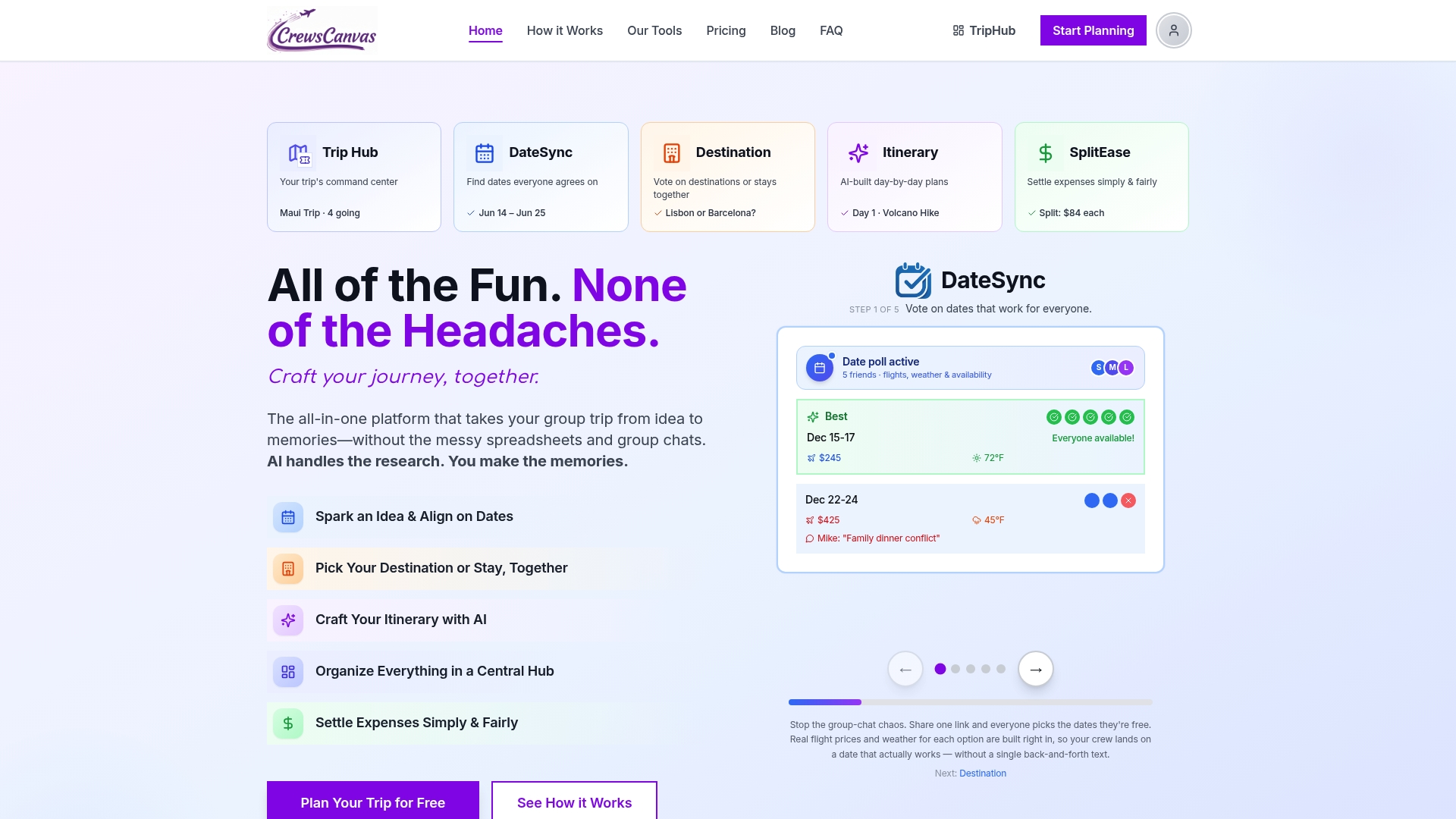
There is a free plan for small groups. When you need more capacity or advanced features, Pro Subscription is $9.99 per month, and One-Trip Pro is a one-time $14.99 for a single trip. Compare them on the pricing page, or browse our tools to see the full toolkit.
FAQ
How many hotels should be on the ballot?
Three to five. With two, you are not really voting, and beyond five people skim instead of compare. If you receive more suggestions, have the organizer remove any that break the budget or bed count before the vote opens.
Should we vote openly or privately?
Privately, with results shown after the poll closes. Open voting lets early votes influence later ones, and quieter people tend to follow the crowd. Private ballots surface what people actually prefer.
What if the cheapest hotel loses the vote?
Check the all-in numbers first. If the winner costs more per person, show the difference openly and ask whether the group accepts it. Agreeing on a budget ceiling before voting prevents most of these disputes.
What should we do if the vote ends in a tie?
Use the tie-break rule you agreed on at the start: a short runoff, the lower per-person cost, or the best score on your top criterion. If you didn't set one, run a 24-hour runoff between only the tied options and let the organizer decide if it ties again.
Do all participants need an app or an account to vote on CrewsCanvas?
No. Participants open the shared link in a browser and vote, with no required app install or account. Only the organizer needs to set up the trip.
Sources
- Planning an effective meeting agenda, UMN Extension
- Decision making techniques: criteria grid, UMN Extension
- Best methods for making group decisions, UMN Extension
- Benefits to consensus decision making, UMN Extension
- Consensus-Building Techniques for Better Group Decisions, Harvard Program on Negotiation
- What is Consensus Building? Program on Negotiation
- Avoiding Groupthink, MindTools
- The Stepladder Technique, MindTools
- Skyscanner Hotels Price Policy
- Resort Policies, Trump International Beach Resort