
The way to plan a vacation with several families is to settle the shared decisions first (dates, lodging, a cost-splitting rule), leave the rest to each household, and keep everything in one place everyone can open without creating an account. That is how a multi-family trip stays a vacation instead of a 200-message group chat. We built CrewsCanvas around exactly this: date polling, voting, a shared itinerary and expense splitting on one link.
Below is the full routine, from the first survey to the final settle-up, with the places where these trips usually go wrong.
TL;DR
- Collect every household's constraints and priorities before anyone looks at destinations.
- Decide which choices are shared (dates, lodging, major transport, one or two anchor activities) and which each family makes alone.
- Agree on how costs are split before anything is booked, and write down who pays, who reimburses and what happens if a family cancels.
- Plan one anchor activity a day, leave open blocks, and make sure separate outings are actually possible.
- Keep dates, votes, reservations and expenses in one shared hub, not scattered across texts and spreadsheets.
Table of Contents
- Why multi-family trips are harder than a single-family trip
- Step 1: Gather constraints before you shortlist anything
- Step 2: Pick dates the whole group can actually make
- Step 3: Rank priorities and choose the destination
- Step 4: Choose lodging that gives each family room to breathe
- Step 5: Agree on how to split costs before you book
- Step 6: Build an itinerary with anchors and open space
- Step 7: Set a booking timeline and deadlines
- Step 8: Separate shared decisions from private ones
- What a multi-family trip planner should include
- Perspective: why one shared hub beats a pile of tools
- Start your multi-family trip in one place
- FAQ
- Sources
Why multi-family trips are harder than a single-family trip
When one family travels, one set of parents decides. When three families travel, you have three school calendars, three budgets, different ages, different sleep schedules and, often, a few people who quietly dislike the plan but never say so in the group chat.
The trouble is rarely the destination. It is the sequence. Someone books a rental before the dates are settled, someone else pays a large deposit and waits weeks for reimbursement, and a late opinion reopens a decision everyone thought was closed. A good process fixes the order of decisions so that this does not happen.
Step 1: Gather constraints before you shortlist anything
Start by asking each household the same questions, separately, before any group discussion. AARP's November 2025 guide on multigenerational trips recommends starting with an online survey of every traveler. Travel planner Starr says it surfaces constraints nobody volunteers, such as a relative who cannot fly for medical reasons. Compiling the answers gives everyone a voice and heads off squabbles later.
A short survey for each household should cover:
- Fixed dates: school calendars, work blackouts, a wedding or a sports season.
- Documents: passport validity if you might leave the country.
- Health and access: dietary needs, medical needs, mobility limits, stairs.
- Budget range: a comfortable total per household, not a vague "we're flexible."
- One must-have and one tradeable wish: what makes the trip worth it, and what they can let go.
- Private time: how much downtime per day they expect.
If you want a worked example of turning a survey into a spreadsheet, this family travel planning guide walks through the idea. The catch with a spreadsheet is that it needs someone to build it, chase answers and keep it current. A shared trip hub does the collecting for you: in CrewsCanvas, participants open a link in a browser, answer, and never need to install an app or make an account.
Step 2: Pick dates the whole group can actually make
Dates are the first shared decision, and the one that most often drags on. Do not ask "what works for everyone?" in a chat. You will get ten replies and no answer. Offer a short list of candidate windows and let each household mark which they can do.
A few rules make this faster:
- Offer three to five windows, not an open calendar.
- Set a response deadline and say what happens after it. Silence means "I'll go with the majority."
- Prioritize school-calendar families first. Their windows are narrowest, so start there and see who else fits.
- Lock the dates before you pay for anything.
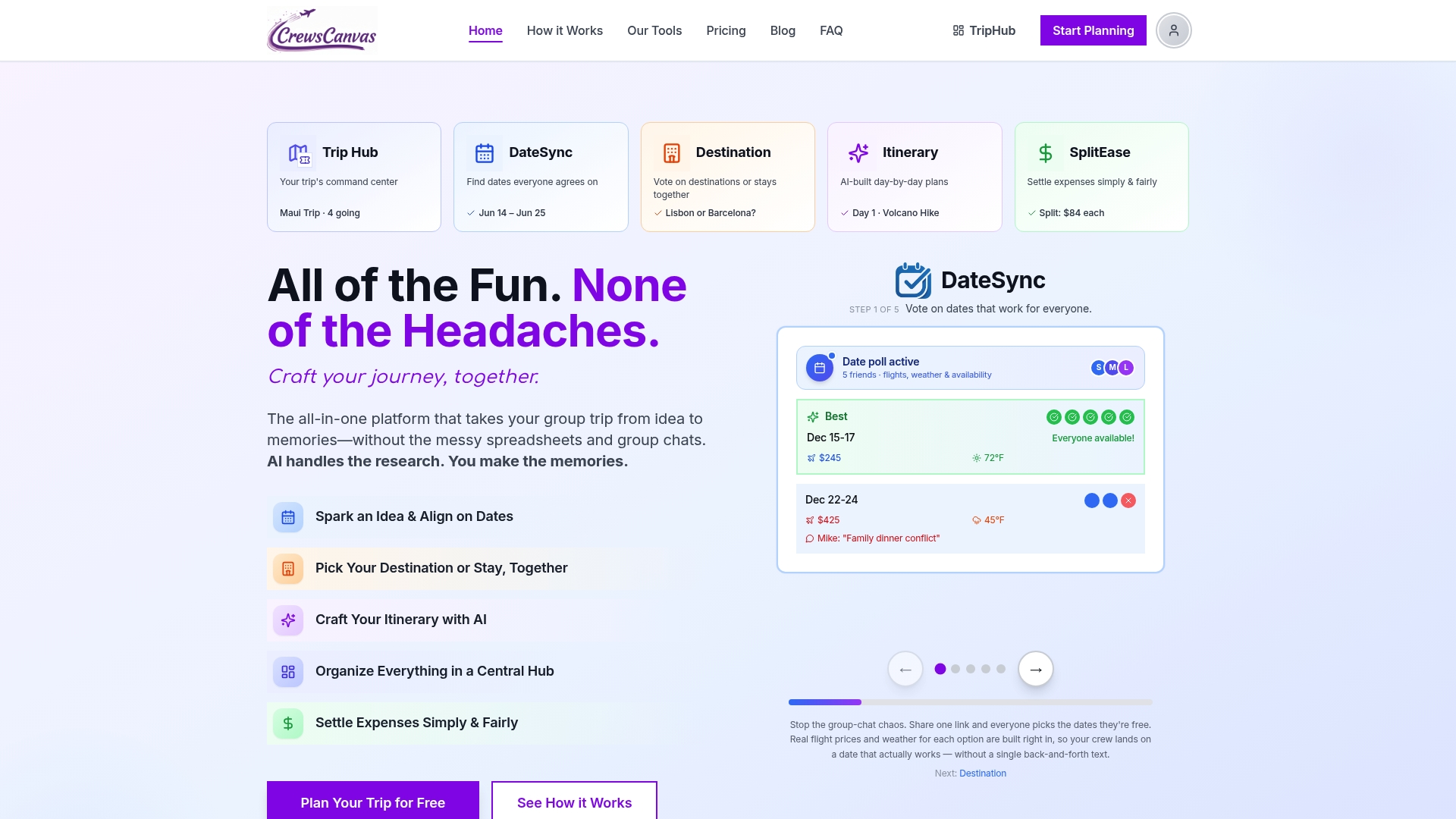
This is what DateSync is for: you propose windows, every household votes on the same page, and the overlap is visible at a glance. If your group has a mix of work and school schedules, our guides on picking a vacation date when your group has 10 different schedules and syncing dates across mixed work and school schedules go deeper.
Step 3: Rank priorities and choose the destination
Once you have a date range, look at the survey answers and find the three priorities the group shares. These might be "kid-friendly and low-effort," "a beach within a short drive" and "a kitchen so we can cook some meals." Then shortlist two or three destinations that meet them, and have the households vote.
AARP's guide says to choose a destination with options for different paces, balancing high-energy activities with calmer ones. Think theme park for the teenagers and a gentle waterfront for grandparents and toddlers, both within a short ride.
Two habits keep this step clean:
- Vote on a shortlist, not a blank page. Three options get an answer. Thirty get a debate.
- Share the maximum travel time. If one family has a long drive with small children, the destination should respect that.
In CrewsCanvas, destination and accommodation options can be put to a vote in the same place as the dates, so the result is visible to everyone and nobody has to scroll back through a chat to find what was decided.
Step 4: Choose lodging that gives each family room to breathe

Lodging shapes the whole trip. The best setup for several families is space to be together and apart. AARP recommends multi-level rentals where each family has its own floor, or hotels with connecting suites and accessibility features. For cruises, travel expert Starr notes that different room categories let budget and splurge travelers share one trip, with meals included.
Before you commit, ask these concrete questions about a rental or hotel:
- How many bedrooms and beds, and who is sleeping where?
- Are there stairs to reach any bedroom or bathroom? How many steps?
- How many bathrooms for the total headcount?
- Is there a kitchen and a common space big enough for everyone to eat together?
- How far is parking from the door, and can everyone park?
Ask for concrete details rather than relying on labels like "suitable for grandparents." For a place to sit down together, check the layout. If your group includes someone who uses a wheelchair or needs accessible seating at events, this explainer on accessible seating rules and how to buy tickets helps you plan outings that work for everyone.
Once you have two or three finalists, put them in front of the group with the price per household for each, so the vote is about the real cost, not the nightly rate.
Step 5: Agree on how to split costs before you book
Money is where friendly trips turn tense. The fix is to decide the rule first, while nobody has paid anything and nobody feels slighted.
There is no universally fair split. Common methods include:
| Method | How it works | Best when |
|---|---|---|
| Per person | Total divided by headcount | Households are similar in size |
| Per household | Each family pays an equal share | Families vary in size but use space similarly |
| Per bedroom | Cost follows the room each family takes | Rooms differ in size or quality |
| Mixed | Lodging by room, groceries per person, activities by who joins | Needs and ages vary widely |
People hold real opinions here. A Vrbo-commissioned OnePoll study of 2,000 U.S. adults, reported on Expedia's newsroom in March 2026, found that half of respondents think guests who arrive a day late or leave a day early should pay a smaller portion, and 44% think you should pay less if you share a room when others don't. Vrbo's tip is to agree on a per-person budget before booking and decide whether to split per person, per bedroom or per night.
That is why the rule needs to be explicit. Write down:
- What is shared: lodging, shared groceries, a rental car, group meals.
- What is individual: souvenirs, extra excursions, one family's special dinner.
- Who books and pays up front, and by what date everyone reimburses them.
- What happens if a household cancels, including who is responsible for their share of a deposit.
To estimate the total before booking, add up the big line items (lodging, transport, food, activities) for the whole group, divide them with your chosen rule, and ask each household whether that number fits. If it does not, adjust the lodging or the length of the trip, not the guest list.
Our guides on splitting costs on a group trip without the drama and splitting a rental cost fairly show worked examples, and itemized expense splitting covers shared and individual items in one tally.
Keep a running ledger, not a memory
As soon as one person puts a large charge on a card, you need a record of who owes what. SplitEase tracks shared expenses, supports receipt scanning, and settles balances at the end, so one family is not left chasing others for money. Participants use the shared link, so the family that owes a small amount does not have to sign up for anything.
Step 6: Build an itinerary with anchors and open space
The most common mistake is overscheduling. With several families, every extra planned hour is one more thing someone has to be tired, late or unhappy about.
The pattern that works is a layered plan:
- One anchor activity per day. A group dinner, a morning hike, a boat ride. AvantStay's November 2026 guide advises one or two anchor activities a day with the rest left open.
- Optional extras around the anchor. Keep a running list of ideas, and let smaller groups choose each morning.
- At least one unscheduled block every day. It absorbs late departures, tired kids and weather.
- Mornings for the big stuff. Older adults and young children usually have more energy early; leave afternoons for rest.
A simple four-night shape: an arrival dinner together, one shared outing on day two, open days in the middle, and a final lunch. One household visits a museum while another stays at the house, and everyone meets for dinner.
Make splitting up actually work
Separate time only works if the logistics do. Travel Begins at 40 suggests agreeing where you will meet afterward, when you expect to be back, how to get in touch if plans change, and checking that everyone can reach the accommodation independently. Add to that: who has a key or door code, and whether anyone is left without a vehicle if the car leaves.
The Itinerary builder in CrewsCanvas generates a draft plan with AI that you can customize, so the group starts from something concrete and edits it, instead of staring at a blank page. TripHub keeps reservations and documents (confirmation numbers, addresses, tickets) in the same place, so nobody has to dig through emails at the check-in desk.
Step 7: Set a booking timeline and deadlines
With several households, work backward from the date you want to travel. Agree on a calendar with named checkpoints:
- Survey and priorities: a week or two.
- Dates vote: one week, with a stated deadline.
- Destination and lodging vote: one week.
- Cost rule agreed and deposits collected: before the first booking.
- Core reservations: lodging, major transport, any activity that sells out.
- Itinerary draft and final details: a few weeks before departure.
Peak seasons and big groups need more lead time because there are fewer rentals that sleep many people. For ground transport in particular, groups that need a coach or minibus should book early. This guide to group transport planning in Iceland shows how vehicle size and itinerary fit together, and the same logic applies anywhere you are moving a large party.
For every deadline, state what response you need, by when, and what happens afterward. If someone does not answer an optional-plan poll, silence means they are left out of that plan, not that you chase them in the chat.
Step 8: Separate shared decisions from private ones
A group chat turns into a referendum when every detail is open for vote. Draw a line:
Shared decisions (the group decides):
- Dates
- Lodging structure
- Major transportation
- One or two anchor activities
- The cost-splitting rule
Private decisions (each household decides):
- Packing and what to bring
- Incidental spending
- Optional outings
- How they spend their free time
When everyone knows which bucket a question falls in, the group only talks about what affects everyone. It also makes it easier to say no to a request without it feeling personal.
What a multi-family trip planner should include
Whether you use a spreadsheet, a notes app or a dedicated hub, the planner should cover these things in one place:
- A poll for dates with visible results.
- Voting for destination and lodging, so decisions are recorded.
- A shared itinerary that everyone can see and edit within limits.
- Reservations and documents attached to the trip.
- An expense ledger with shared and individual costs, payer and reimbursement.
- No account wall. If a grandparent has to download an app to see the plan, many will not.
CrewsCanvas covers all of these through DateSync, voting, the Itinerary builder, TripHub and SplitEase, available on the web with no required app installs or participant accounts.
Perspective: why one shared hub beats a pile of tools
We built CrewsCanvas because group trips tend to fall apart in the gaps between tools: dates in one chat, money in a spreadsheet, the itinerary in someone's notes. With several families, those gaps are wider, because more people need to see the same information and fewer of them want to learn a new app.
That is why participants join through a shared link and never need an account. The organizer sets things up; everyone else votes, adds, and checks. DateSync turns "when can you go?" into a visible overlap. The itinerary generator gives the group a first draft to react to. SplitEase keeps the money transparent, so the awkward conversation about who owes what mostly never has to happen.
Our view is simple: a multi-family trip works when the decisions are visible, the money is clear, and everyone can open the plan without friction. Having it all in one place is how you get there.
CrewsCanvas
Start your multi-family trip in one place
CrewsCanvas has a free plan for small groups, so you can set up the dates poll and invite every household without paying. When your group grows or you want advanced features, there is a Pro Subscription at $9.99 per month, or One-Trip Pro at a one-off $14.99 for a single trip.
See the plans and pricing, or look at our tools to see how DateSync, the Itinerary builder, TripHub and SplitEase fit together. If your group spans generations, our guide to multigenerational travel covers extra considerations.
FAQ
How far ahead should I plan a multi-family vacation?
Start the survey and the dates poll as early as you can, since several households means several calendars. Many groups settle dates and lodging first, then book core reservations well before departure, and earlier for peak seasons. Set checkpoints with deadlines so decisions do not drift.
What is the fairest way to split costs between families?
There is no single fair rule, so the best approach is to pick one and agree on it before booking. Per person suits similar households, per household suits mixed family sizes, and per bedroom suits uneven rooms. Keep lodging, shared groceries, optional activities and personal purchases in separate categories.
Who should book and pay up front?
Choose one organizer to book the big items, and write down when everyone reimburses them. Record each payment as it happens so nobody relies on memory. A shared ledger like SplitEase shows balances and settles them at the end of the trip.
Do all families need to download an app?
Not with CrewsCanvas. Participants use a shared link on the web, and they do not need an account to vote, add to the plan or follow expenses. That keeps it easy for relatives who prefer not to install anything.
How do we avoid every day being scheduled?
Plan one anchor activity per day, such as a group dinner or a morning outing, and leave the rest open. Add an unscheduled block daily for rest and surprises, and let smaller groups pick optional activities each morning.
Sources
- AARP: Tips to Create a Harmonious Multigenerational Trip
- Expedia Newsroom: Group Travel Made Easy, Vrbo's Guide
- AvantStay: Multigenerational Family Vacation Guide
- Travel Begins at 40: Travelling Together Without Doing Everything Together
- Family Travel Planning Guide 2026
- Family Group Transport in Iceland
- ADA Seating Explained