
Multigenerational travel means three or more generations, such as children, parents and grandparents, taking a trip together. It works when you ask everyone what they want before you book anything, pick a destination with options for different paces, plan one main activity a day, and agree on how shared costs get split. This guide walks through each of those steps, with the research behind them and the places where groups usually get stuck.
If you are the person who ended up in charge, you already know the hard part isn't finding a beach house. It's getting a 72-year-old, a busy couple, a 15-year-old and a 6-year-old to agree on dates, a budget and a plan, without burying everyone in a 200-message group chat.
TL;DR
- Survey the whole group first: pace, budget, mobility, dietary needs and available dates. Build the trip from the answers.
- Choose a destination and lodging that offer different paces and some privacy, not just the most famous option.
- Plan the itinerary around the least mobile traveler, with about one planned activity per day and real choose-your-own time.
- Agree on how costs are divided before booking, and track them as you go.
- Use a shared link so grandparents and teens can vote and see the plan without installing an app.
Table of Contents
- What multigenerational travel is, and why families do it
- Why these trips get messy
- Step 1: Ask before you plan
- Step 2: Choose a destination with room to move
- Step 3: Pick lodging that gives everyone space
- Step 4: Plan around the least mobile traveler
- Step 5: Mix together time and choice time
- Step 6: Talk money before you book
- A simple planning timeline
- Planning with teenagers and seniors in the same group
- Perspective: why the organizer needs a shared hub
- Plan your family trip in one place
- Common mistakes to avoid
- FAQ
- Sources
What multigenerational travel is, and why families do it
The 2025 U.S. Family Travel Survey defines multigenerational travel as three or more generations traveling together, such as children, parents and grandparents. It is common: the same survey found 71% of grandparents had taken a multigenerational trip in the previous three years, and 57% were planning one. The survey ran from July 18 to August 25, 2025, among 1,596 eligible parents and grandparents.
The main reason is simple. The Family Travel Association attributes the trend mostly to family bonding and quality time for parents and grandparents with children and grandchildren, away from daily demands. A 2025 academic narrative review adds that family travel can strengthen relationships and communication, support learning across generations and expose children to new places, languages and traditions.
There is a practical side too. Travel Daily Media reported that Sabre booking data showed bookings for eight or more people up 23% year over year, comparing January to September 2024 bookings for 2025 travel. Bigger groups are becoming normal, which means more people need a better way to organize them.

Kids have a say now
The survey also points to what NYU SPS calls "kidfluence", the growing influence of children on family travel planning. In the Family Travel Association's data, parents said involving children in planning makes them more adaptable and open to new experiences (84%). That is a good reason to give teens a real vote rather than an itinerary handed down from above.
Why these trips get messy
The same trip has to satisfy very different people. The narrative review names budget, activity level and differing expectations as common sources of conflict, and it recommends compromise, negotiation and planning before departure.
In practice that looks like this:
- Grandparents want an unhurried pace and a bed they can get in and out of easily.
- Parents want to see something and still get a quiet hour.
- Teenagers want some independence and decent Wi-Fi.
- Younger kids need naps, snacks and something to do.
- One household can spend more than another, and nobody wants to say so out loud.
None of these is a problem on its own. The trouble starts when the preferences surface at the airport instead of in the planning stage.
Step 1: Ask before you plan
AARP's 2025 guide recommends starting with a survey of the whole group covering desired pace, downtime, interests, mobility and constraints, then using the answers to work out destination, costs and logistics. CAA-Quebec suggests discussing must-do activities, walking tolerance, dietary restrictions and physical limitations before departure, along with who is responsible for what.
A short question list covers most of it:
- Which dates work, and how many days can you take?
- What is a comfortable budget per household for lodging, food and activities?
- How far can you walk in a day before you need a break?
- Any dietary needs, medical needs or mobility aids?
- What is the one thing you would hate to miss?
- What is the one thing you would happily skip?
The last two questions are the most useful. They show you quickly which activities are anchors and which are optional.
Collect dates without the back-and-forth
Dates are where most family threads stall. Instead of asking "Does the second week of July work?" to twelve people one at a time, put a few windows in front of everyone and let them vote. Our guide to family reunion planning suggests starting with three date windows, and DateSync is built for exactly this kind of date voting. Families with school-age kids and retired grandparents rarely overlap by accident, so seeing the overlap on one screen saves a lot of messages.
Step 2: Choose a destination with room to move
AARP's guidance is that the best destination is the one with flexibility for everyone's pace, balancing high-energy options with calmer activities, rather than simply the most famous place. Ask yourself two things: can the energetic people find something to do, and can the people who want to sit still do it comfortably nearby?
Some trip types make that easy:
- A cruise. AARP notes that travelers can choose different room categories and join excursions together or go their own way.
- A house or villa. Shared space for meals and games, plus separate bedrooms and corners for quiet.
- Coast or lake towns. Beach time and short walks for some, boat trips or hikes for others.
- Water-based itineraries. If a group likes the idea of a crewed boat, it helps to read about family-friendly yacht destinations that mix active water sports with slow days at anchor.
When the group can't agree, put two or three destinations in a vote and let everyone rank them. People accept a result more readily when they had a say, even if their first pick didn't win.
Step 3: Pick lodging that gives everyone space
ABTA's multigenerational advice highlights adjoining rooms and accessibility across airports, transport and hotels. AARP recommends accommodations with room for both privacy and time together.
A few things to check before you book:
- Bedrooms on the ground floor or an elevator for anyone who struggles with stairs.
- Enough bathrooms for the headcount.
- A kitchen, if you want to cook together or manage dietary needs.
- A common area large enough for everyone to sit at the same time.
- A spot where one household can step away without leaving the group.
With a larger group, a single rental can be a better fit than several hotel rooms. Seven or more bedrooms is not unusual. If you're comparing lodging options, put the top two or three in a vote and attach the listing links so people can look before they decide.
Step 4: Plan around the least mobile traveler
Kiplinger's guide advises discussing each traveler's abilities and building the itinerary around the least fit or able member. It also suggests limiting planned activities to one per day, with optional events or choose-your-own-adventure time so some people can rest while others hike.
This is the part of the plan that tends to save the trip. If the slowest walker can do the main plan, everyone can join it, and faster walkers can add extras on their own.
Think about pace before destination
CAA-Quebec advises alternating cultural tours, day trips and relaxation, and managing fatigue for young children, grandparents and anyone less tolerant of heat or thrills. A few practical checks:
- How long is the flight, and how long is the transfer after landing?
- How far will people walk between the car and the attraction?
- Are there early mornings that will wear out the youngest and the oldest?
- Is there a rest day halfway through?
We have more on this in our post about how many activities per day to plan on a group trip.
Transport and accessibility
If anyone uses a wheelchair, walker or cane, work out transport early. In some destinations, private minibuses with drivers are the simplest way to move a larger group, and it helps to read up on how to plan accessible group tours in Iceland as an example of what to ask about vehicle size and mobility needs, wherever you are headed.

Step 5: Mix together time and choice time
A good multigenerational trip is not forty-eight hours of everyone doing everything together. Kiplinger's guide describes shared activities such as meals, walks, rafting, a boat charter, snorkeling and fishing, and notes the group can split up to suit different interests.
A simple structure:
- Anchor moments. One shared dinner each night, plus one main outing every day or two.
- Choice blocks. Teens go to the pool or town, grandparents rest or read, parents take a walk alone.
- A flexible day. One day with nothing booked, so weather or tired legs don't wreck the plan.
If you're not sure what suits each age, ask for suggestions in the group instead of guessing. Teenagers in particular answer "What would you want to do?" better than "Do you like this?"
Ideas that tend to work across ages
| Activity type | Why it works | Watch for |
|---|---|---|
| Shared cooking or a cooking class | Everyone has a role, from chopping to taste-testing | Dietary needs, kitchen space |
| Easy nature walks | Flat routes suit most ages and abilities | Heat, uneven terrain |
| Beach or lake day | Natural split between swimmers and sitters | Shade, swimming ability |
| Boat outing | Seated, scenic and easy to join | Age or health limits on excursions |
| Cultural visit with hands-on parts | Gives kids something to do and adults something to learn | Long walking distances |
Before choosing, check walking distance, elevation, heat, uneven terrain and swimming ability, and look at any age or health restrictions on excursions.
Step 6: Talk money before you book
Budget disagreements are among the usual sources of friction, so talk about them first. ABTA recommends setting a budget before researching, then agreeing how to divide flights, accommodation, meals, drinks, activities, excursions and tips.
The narrative review notes that grandparents may provide financial support while parents often coordinate logistics. That is worth putting on the table: if grandparents are paying for the house, say so, and agree what everyone else covers.
Some options for dividing costs:
- Equal split by household. Simple, but it can favor larger families.
- Split by head, with kids free or discounted. Fairer for families with many children.
- Grandparents cover lodging, others cover food and activities. Clear and easy to explain.
- Optional extras paid by those who join. Keeps people from paying for outings they skip.
Discussing costs early, and agreeing how expenses will be shared, is also a theme in this look at planning luxury family holidays, which treats budget as a first step rather than an afterthought. For more on handling this fairly, see our guides on budgeting for a group trip, planning when everyone has different budgets and splitting costs without the drama.
Track costs as you go
Kiplinger suggests dividing shared costs with an agreed method and tracking them during the trip, using a shared spreadsheet or a cost-splitting app, with optional peer-to-peer payments to settle balances. Receipts pile up fast when a dozen people share groceries and tickets, so choose one place to record them.
A simple planning timeline
- Eight to twelve months out: Start the conversation. Send the survey and collect date windows.
- Six to eight months out: Vote on destination and lodging. Set the budget and the cost-sharing rule.
- Three to six months out: Book lodging and major transport. Share confirmations in one place.
- One to three months out: Draft the itinerary, mark the anchor moments and choice blocks, and note dietary and mobility details.
- During the trip: Log shared expenses as they happen and adjust the plan to energy levels.
- After the trip: Settle balances quickly and share photos.
These timeframes are our suggestion, not a rule. Shorter trips with fewer people need less lead time, while peak-season rentals for large groups often need more.
Planning with teenagers and seniors in the same group
These two ends of the age range have a lot in common: both want to be asked, and both dislike being managed.
For teenagers:
- Give them a role, such as choosing one activity or one dinner spot.
- Offer independent time, with clear check-in rules their parents set.
- Ask what they want to see before you hand over the plan.
For seniors:
- Check walking distance, steps and heat before adding an activity.
- Build in rest after travel days.
- Don't assume grandparents are the default babysitters. Agree on childcare as a group so downtime is shared fairly.
It also helps to make sure everyone can see the plan. Many older travelers prefer not to download another app or create another login, which matters when you need the whole group involved.
Perspective: why the organizer needs a shared hub
We built CrewsCanvas around a simple observation: in a multigenerational group, the person organizing the trip is usually also the person chasing everyone for answers. Dates arrive in texts, ideas in emails and receipts in photos, and the plan lives in one person's head.
We think the fix is a single shared place. Everyone should be able to vote on dates, weigh in on destinations and see the itinerary without creating an account or installing an app. That matters when grandma prefers a link to a login and a teenager would rather tap than type.
We also believe money should be part of planning, not an awkward afterthought. When the cost split is clear from the start and tracked through the trip, nobody has to bring it up at dinner. Our aim is for the organizer to spend less time managing and more time enjoying the trip with everyone else.
CrewsCanvas
Plan your family trip in one place
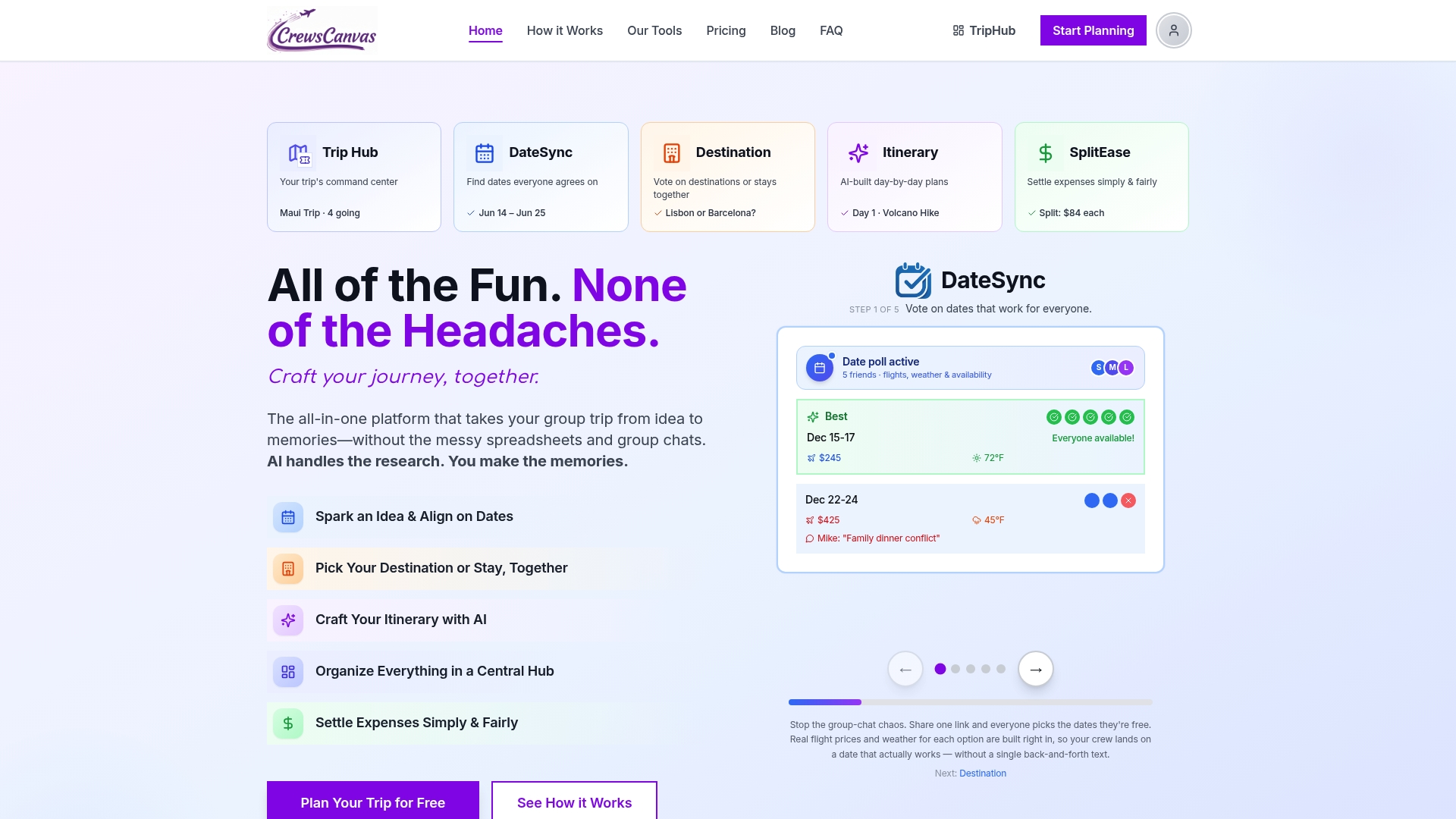
CrewsCanvas gives a multigenerational group one shared hub. DateSync lets everyone vote on dates, the itinerary builder can generate an AI-powered plan you then customize, and SplitEase tracks shared expenses and supports receipt scanning. Documents and reservations can sit in TripHub, and participants use a shared link without needing an account or app.
There is a Free plan for small groups. Pro Subscription is $9.99 per month, and One-Trip Pro is a one-off $14.99 for a single trip. See the details on the pricing page, or start from the CrewsCanvas home page.
Common mistakes to avoid
- Booking before asking. Once a deposit is down, it's hard to change course.
- Overscheduling. More than one big activity a day wears out the youngest and the oldest.
- Assuming one pace. Offer a slower and a faster option for most days.
- Leaving money vague. "We'll sort it out later" becomes tension by day three.
- Treating alone time as rejection. Planned independence usually makes the shared moments better.
- Putting all the work on one person. Assign responsibilities, such as cooking nights or booking activities, with clear deadlines.
For more on keeping friends and family on the same page, our posts on shared travel itineraries and expense splitting etiquette cover the details, and our guide to planning a family reunion vacation applies many of the same ideas on a larger scale.
FAQ
What is multigenerational travel?
It is a trip where three or more generations travel together, such as children, parents and grandparents. The U.S. Family Travel Survey uses this definition. The trips are usually about family bonding and shared time away from everyday routines.
How do you plan a trip for mixed ages?
Start by surveying everyone on pace, budget, mobility, dietary needs and dates. Then choose a destination with options for different energy levels, plan around the least mobile traveler, and leave room for downtime. Agree on how costs are divided before you book.
How many activities should you plan per day?
A good rule is one planned activity per day, with optional extras. This keeps the schedule workable for the least mobile traveler and gives others the chance to rest or explore. Kiplinger's guide recommends this approach.
How do you split costs on a multigenerational trip?
Agree on a method before booking, such as equal by household, by head or by category. Then track shared expenses during the trip in one place and settle up at the end. A shared spreadsheet or a cost-splitting tool both work.
How do you keep teenagers engaged on a family trip?
Give them a say in planning, a role during the trip and some independent time. Teens tend to engage more when they helped choose an activity. Planned choice time is a normal part of a good trip, not a sign it's going badly.
Sources
- US Family Travel Survey 2025 report, Family Travel Association
- Making the Most of the Multi-Generational Travel Trend, Family Travel Association
- Multigenerational Travel: A Narrative Review, Universiti Teknologi MARA
- Travellers pivot to serviced apartments as multigenerational trips rise, Travel Daily Media
- The 2025 Family Travel Survey Highlights the Rise of Kidfluence, NYU SPS
- Tips to Create a Harmonious Multigenerational Trip, AARP
- Multigenerational travel: 6 tips for a successful trip, CAA-Quebec
- Nine things to consider for multi-generational holidays, ABTA
- 6 Family Vacations for Every Generation, Kiplinger
- Family-Friendly Yacht Destinations 2026
- How to Plan Accessible Tours in Iceland for Groups
- Luxury Family Holidays: How to Plan One That Works