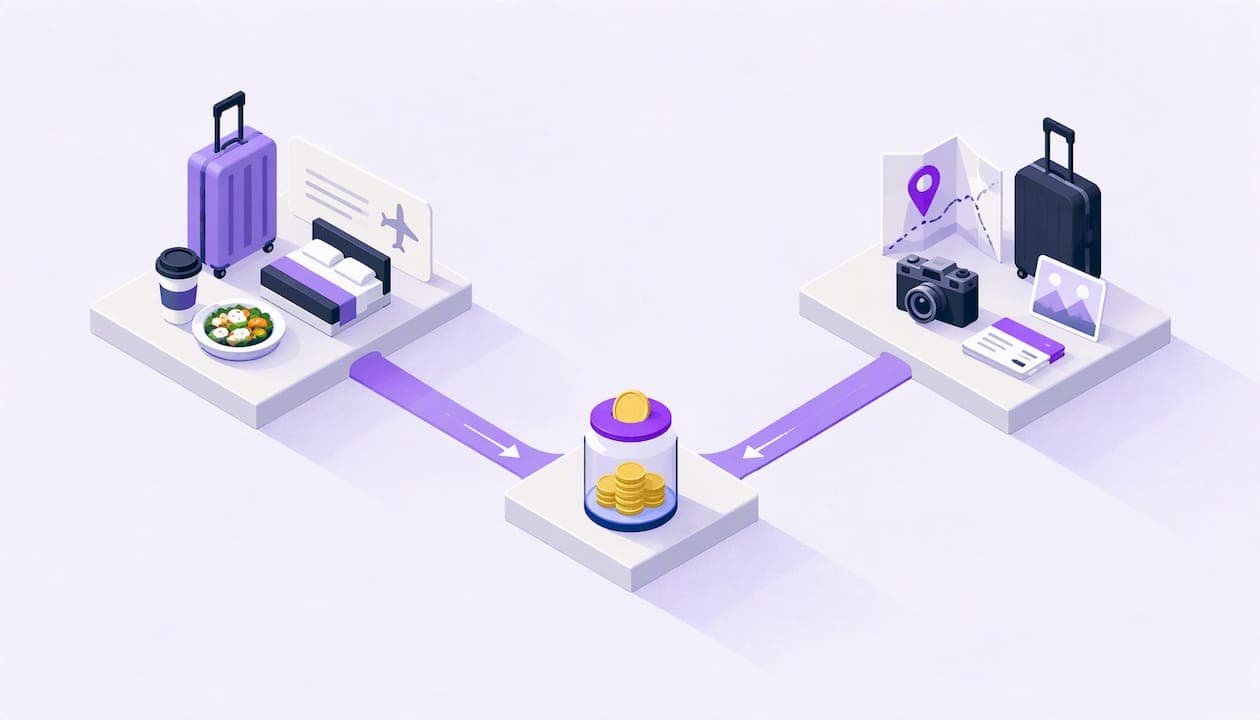
Good expense splitting etiquette comes down to one rule: agree on how money works before anyone spends it, then keep a single shared record so nobody has to chase or remember. Most trip friction does not come from the money itself. It comes from surprises, vague expectations and awkward timing. This guide covers what to settle up front, how to handle the tricky moments, and how to ask for money politely.
TL;DR
- Talk numbers before you book: a dollar range per person, not words like "affordable."
- Decide in advance which costs are split evenly (lodging, shared rides) and which are paid by individual consumption (restaurant meals, optional activities).
- Record each expense once, in one shared place, the moment it happens.
- Settle on a set date after the trip, and send reminders as facts, not accusations.
- If a plan is out of your budget, say so early and privately to one trusted person in the group.
Table of Contents
- Why money gets awkward on group trips
- The etiquette rules that matter most
- Before the trip: set expectations
- During the trip: keep the ledger honest
- After the trip: settle up without the sting
- Special situations
- Our perspective: transparency beats good intentions
- Make the etiquette automatic with SplitEase
- A simple pre-trip agreement you can copy
- FAQ
- Sources
Why money gets awkward on group trips
Picture it: eight friends, one rental house, and a group chat that has turned into a ledger. Someone fronted the deposit. Someone else covered groceries. Two people skipped the boat tour. Nobody wants to be the one to bring it up.
The numbers back up that it's a common problem. In a June 2025 survey of more than 700 US travelers, only 1 in 4 said their friend group sets a budget upfront, even though setting expectations early is the most effective way to cut financial stress. The same survey found that 35% of millennials name different budget ranges as their top challenge when planning group travel. It also reported that 1 in 5 Gen Z and millennial travelers have ended a friendship over a money issue.
The good news: nearly all of this is preventable with a few agreements made early and a record everyone can see.
The etiquette rules that matter most
Think of these as the house rules your group agrees to, ideally before the first deposit is paid.
- Talk money before you commit. Raise budget in the first planning conversation, not after the flights are booked.
- Use dollar amounts. "Around $1,200 all in, flights excluded" means the same thing to everyone. "Affordable" does not. Experienced group planners recommend discussing budgets in absolute dollar terms for exactly this reason.
- Define the split method per category. Evenly, by usage, or by room. Write it down.
- Log expenses as they happen. Memory is a poor ledger by day four.
- Pay people back promptly. If someone fronted money for you, they are lending you an interest-free loan.
- Never make someone justify their budget. Having less to spend is not a character flaw, and having more is not a license to dictate.
- Treat the organizer's time as valuable. The person planning is already contributing. Do not let them also absorb the cost of anything that was never split.
Before the trip: set expectations
Start with a real budget conversation
Even close friends rarely know each other's finances. As one financial coach quoted in The Cut's guide to splitting group trip expenses puts it, you never really know the full extent of someone's situation or what they will spend on. So ask, and make it safe to answer honestly.
A simple way to do it:
- Have the organizer propose a per-person range for the big items: lodging, transport, and a daily spending estimate.
- Invite people to reply privately if the range is a stretch.
- Adjust the plan, not the person. A cheaper stay or fewer paid activities often solves it.
If you want a step-by-step version, our guide on how to budget for a group trip fairly walks through it, and the one on planning when everyone has different budgets covers the harder case. Checking lodging prices early also helps ground the number; a quick read on comparing hotel rates before you settle on a budget can show how much room there is.
Agree on the split method for each category
Not every cost should be split the same way. A practical default:
| Cost | Common fair approach | When to change it |
|---|---|---|
| Lodging | Split evenly, or by room if rooms differ a lot | Someone arrives late or leaves early |
| Shared rides and gas | Split among riders | Riders join midway |
| Groceries and shared supplies | Split evenly among those eating | Dietary or heavy-drinker differences |
| Restaurant meals | Itemized, or evenly if everyone orders similarly | Big gap in what people order |
| Optional activities | Paid only by those who join | Group-booked discount needs a minimum |
| Alcohol | Separate from the food split | Mixed drinkers and non-drinkers |
The Cut's advice is to agree up front whether shared transit will be split evenly or restaurant bills itemized by what each person ordered, since resentment builds when one person feels they are subsidizing everyone else's choices. For specifics, see our pieces on splitting an Airbnb fairly between friends, itemized expense splitting and splitting road trip gas when riders join midway.
Decide who fronts what
Someone will put the deposit on a card. Agree who, and when everyone else will pay them back. A good norm: the person who fronts a large cost gets reimbursed within a week or two, not at the end of the trip. Nobody should carry hundreds of dollars on their credit card for a month as a favor.
During the trip: keep the ledger honest
Record once, in one place
The fastest way to create confusion is to have three people tracking expenses in three places. Pick one shared record and add each expense as it occurs, with who paid and who shares it. Schwab's planners note that a shared digital ledger lets the group avoid the math anxiety of dividing bills at the table.

If your group wants options for how to track, we compare three approaches in settling group trip costs: 3 ways to track who paid what.
Handling the restaurant bill
The group dinner is where etiquette is tested most. Etiquette expert Myka Meier has said the fix for a group dinner can come before the meal even begins, in the form of a quick, friendly agreement about how the bill will be handled. Some easy scripts:
- "Should we just split it evenly, or does everyone want separate checks?"
- "I'm skipping drinks tonight, so I'll pay for my food and share of the appetizers."
- "Let's alternate: I'll pick up tonight, you take tomorrow."
If you are the person who ordered the least, saying so early and kindly is fair. If you ordered the most, offering to cover a bit more is gracious. Neither should be a debate.
When someone wants out of an activity
Optional means optional. If a group activity is not in someone's budget, the etiquette is simple: no one pressures, no one comments, and the cost is split only among those joining. The person opting out should say so early so the booking numbers are right.
If you are the one who cannot afford the plan, the Experian survey highlights experts recommending "radical honesty": talk to one trusted person in the group first to reduce vulnerability, then decide whether to bow out or set boundaries on optional activities.
After the trip: settle up without the sting
Set a deadline and stick to it
Agree on a date, such as two weeks after you get home, when everyone is squared up. A shared deadline makes reminders impersonal. You are not nagging; you are reminding people of what the group agreed to.
How to ask for money politely
The goal is to be clear, brief and warm. A few patterns that work:
- The factual nudge: "Settling up is due Friday. Your share is $214.50, here's the breakdown."
- The group reminder: "Quick reminder that we're closing out the trip ledger this weekend."
- The private check-in: "Hey, no rush, just making sure you saw the request. Happy to resend."
Attach the itemized breakdown every time. People rarely resist a number they can see the logic behind.
If someone is slow to pay
Start with the assumption of forgetfulness, not bad intent. Follow up once privately and kindly. If it drags on, ask whether a payment plan would help. Avoid calling someone out in the group chat; it turns a small money matter into a social one.
Payment app etiquette and safety
Payment apps make paying back easy, but a few habits help:
- Double-check the recipient's name or handle before sending. The Consumer Financial Protection Bureau advises that you verify who you are paying, and notes that these apps are not bank accounts.
- Sending money to friends you trust carries far less risk than paying strangers, where fake ticket and housing deposit scams are common and hard to reverse.
- Use a clear note, like "Lake house, groceries," so everyone's records match.
If you ever think you sent money to the wrong person or were scammed, contact your bank or the payment app right away.
Special situations
Friends with different incomes
Even splits feel fair only when budgets are similar. When they are not, the most workable solutions are structural, not personal: choose lodging at the lower end of the range, make expensive activities optional, and let people with more flexibility treat for something small, like a round of coffees, without making it a pattern anyone must match.
There is also research on how closeness changes feelings about paying. A Bond University study found that with close friends, people report higher happiness when paying the full amount themselves, while with acquaintances they prefer to split or have the other person pay. Practically, that suggests it's worth noticing how comfortable each person is with the arrangement, rather than assuming one method suits every pair.
Couples
Couples face the same questions with higher emotional stakes. Proportional splits, based on income, are common when earnings differ a lot. Our guide on splitting costs fairly as a couple takes you through five steps to calculate each share.
Family reunions and team retreats
Families and coworkers add hierarchy to the mix. Whether a senior relative treats, or an employer covers certain costs, say it clearly and in writing, so no one is guessing who owes what. Mixed households (a family of five versus a single traveler) should usually split by household size for shared meals and lodging, not by head count alone.
When the organizer pays for everything
The organizer should not be the group's bank. If they front a large booking, reimburse them quickly. If they spent hours planning, a thank-you or a small treat is a nice gesture, but it does not replace paying your share.
Our perspective: transparency beats good intentions
At CrewsCanvas, we see the same pattern in group trips again and again: people are rarely unfair on purpose. They're working from different assumptions. One person thinks "split everything evenly" means everything. Another assumes it means shared costs only. Nobody said which.
That's why we built SplitEase around a simple idea: agree on the rules, record every expense once, and let the math happen in the background. The people on your trip should be able to open a link, see exactly what was spent and who owes whom, and never have to do a calculation at a dinner table. They do not need to download an app or create an account to take part.
We also believe etiquette is much easier when the facts are visible. When a number is on a shared screen, it is no longer a personal ask. It is just the number.
— CrewsCanvas
Make the etiquette automatic with SplitEase
If you want to put these rules into practice, SplitEase lets your group track shared expenses, scan receipts and settle up in one place. CrewsCanvas has a free plan for small groups. For larger groups or more features, Pro Subscription is $9.99 per month, and One-Trip Pro is a one-time $14.99 for a single trip. See the details on the pricing page, or explore the full planning toolkit, including date voting and the itinerary builder.
A simple pre-trip agreement you can copy
Send this to your group chat, adjusting the numbers:
- Budget: "We're aiming for about $X per person, excluding flights."
- Lodging: "Split evenly among everyone staying."
- Food: "Groceries split evenly; restaurants itemized unless we all agree to split."
- Activities: "Optional, paid only by those joining."
- Tracking: "All expenses go in the shared ledger the same day."
- Settling: "Everyone pays up within two weeks of getting home."
That's it. Six lines can save you a lot of unspoken tension. For a longer walkthrough, read our guide to splitting costs on a group trip without the drama, or see how we approach friends trip planning that keeps budgets, dates and peace intact.
FAQ
How do you politely ask to split the bill?
Raise it before ordering, and keep it casual: "Should we do separate checks or split it evenly?" Asking early removes the pressure of deciding when the check arrives. If you're the one who ordered less, say so lightly and offer to pay for your own items.
Is splitting the bill a red flag?
No. Splitting costs is normal, and clear agreements are a sign of a healthy group. The warning sign is evasiveness: someone who avoids paying, hides what they owe, or gets defensive about a fair breakdown. Disagreeing about the method is a conversation, not a character verdict.
How should you split expenses on a trip?
Split lodging and shared transport evenly among those using them, split groceries among those eating, and itemize restaurant meals when orders vary widely. Make activities optional and paid only by participants. Agree on this before the trip, and log each expense in one shared place.
When should you settle up after a group trip?
Aim for within one to two weeks of returning, and agree on the date beforehand. Large costs fronted by one person, such as a lodging deposit, are best reimbursed even sooner. A set deadline keeps reminders neutral instead of personal.
Sources
- Experian: survey on how travelers handle group vacation costs
- Charles Schwab: money planning for group trips
- The Cut: how to split expenses with friends on a group trip
- PayPal Newsroom: bill splitting doesn't need to be awkward
- Consumer Financial Protection Bureau: tips for using mobile payment services
- Bond University: who foots the bill, happiness in shared experiences