
When incomes differ, the fairest practical default is an income-proportional split paired with agreed repayment rules. A straight 50/50 split or a hybrid category approach can work in specific situations, like equal roommates or shared subscriptions, but proportional splitting based on what each person earns tends to hold up best over time. Your next move: calculate your shares below or open a shared tracker to make the math automatic.
TL;DR:
- Use equal shares for shared subscriptions or similar incomes, and adjust by room size or actual usage when people receive different benefits.
- With incomes of $60,000 and $40,000, a $2,000 rent bill becomes a 60/40 split: $1,200 from the higher earner and $800 from the other.
- Log advances immediately and agree on a repayment deadline, with three to five days recommended for smaller amounts instead of an open ended promise.
- When someone joins or leaves mid trip, recalculate costs from that date forward and settle earlier expenses separately, unless everyone agreed otherwise beforehand.
- For international trips, choose one base currency and convert each purchase using the exchange rate on its purchase date; reconcile weekly abroad.
Table of Contents
- Common methods to split costs: equal, proportional, and hybrid approaches
- How to calculate a proportional split (formula + worked example)
- Tools and trackers that remove the friction
- Communication and fairness: research-backed practices to prevent disputes
- Operational checklist: put the split into practice today
- Perspective from CrewsCanvas: why built-in tracking and clear rules reduce awkward money moments
- Handling shared costs when participants join or leave the group midway
- Managing and reconciling multi-currency expenses in international group trips
- Addressing advances and reimbursements to avoid conflicts
- Guidance on setting budgets and spending limits to prevent overspending
- Strategies to manage and split irregular or one-off expenses fairly
- What actually matters more than the formula you pick
- CrewsCanvas SplitEase: a practical way to keep splits fair without the awkward talk
- FAQ
- Sources
Common methods to split costs: equal, proportional, and hybrid approaches
Picking the right method matters more than getting fancy with the math. Most groups and couples land on one of three approaches.
Equal (50/50) splits work best when incomes are similar or when the group explicitly wants simplicity over precision. If you and your roommate earn similar amounts, dividing rent and utilities equally is often the simplest approach.
Proportional splits base each person's share on income, so someone earning more money covers a larger slice of shared costs. This approach tends to feel fairer specifically when incomes diverge, since it prevents the lower earner from carrying a share that eats up a much bigger chunk of their budget.
Hybrid or category splits mix methods depending on what's being paid for. You might split rent by room size or private bathroom access, divide utilities by actual usage, and keep shared subscriptions like streaming services at a flat equal rate.
A few practical rules help you choose:
- If everyone benefits equally from a cost (a shared streaming account), split it equally regardless of income.
- If one person's income is noticeably lower, default to proportional splitting for big recurring bills like rent.
- If physical space or usage differs (bigger bedroom, more car miles driven), layer in a category adjustment on top of the base method.
- If your household stage is temporary or costs are one-off, simpler equal splits often save time without sacrificing fairness.
How to calculate a proportional split (formula + worked example)
The formula is straightforward: divide each person's income by the combined household income, then multiply that percentage by the shared cost.
(individual income ÷ total income) × shared cost = that person's share
Here's a worked example. Say Partner A earns $60,000 a year and Partner B earns $40,000, for a combined $100,000. If rent is $2,000 a month, Partner A pays $1,200 and Partner B pays $800, a 60/40 split that mirrors their actual earnings.
- Add both incomes together to get the household total.
- Divide each person's individual income by that total to get a percentage.
- Multiply each shared bill by the corresponding percentage.
- Round to the nearest dollar and track any leftover cents in a shared note so they don't vanish.
- Repeat the calculation whenever a recurring bill changes, like a rent increase or a new subscription.
For multiple bills each month, it helps to calculate your percentages once and apply them consistently across rent, utilities, and groceries rather than recalculating from scratch every time. A simple spreadsheet with a formula column handles this automatically, and free online proportional-split calculators exist for couples who'd rather skip building their own. Templates built into budgeting apps or a basic Google Sheets formula using the percentages above work just as well.
Tools and trackers that remove the friction
The right tool depends on how much automation you want versus how much manual tracking you're willing to do.
- Shared spreadsheets cost nothing and work well for small households that just need a running log of who paid what.
- Bill-splitting calculators and apps handle the proportional math automatically and track IOUs so nobody has to remember who owes whom.
- Scheduled transfers between linked accounts remove the need to ask for reimbursement each month, though they require both people to trust the automation and keep enough buffer in their accounts.
- Shared accounts work for couples merging most expenses but add complexity if you later need to untangle who contributed what.
Features worth prioritizing include receipt or photo capture so expenses don't get lost, the ability to aggregate several bills into one running tally, and a way for participants to join without creating a full account, since that barrier alone causes a lot of shared trackers to go unused.
Pro Tip: Pick one tool for everything, rent, groceries, trip costs, so your group isn't juggling three different apps with three different running balances.
Communication and fairness: research-backed practices to prevent disputes
The math is rarely what actually causes conflict. A large-sample study found that perceived unfairness in dividing shared expenses is strongly linked to lower relationship satisfaction, more strongly in some models than unfairness in dividing housework, according to research on fairness and relationship satisfaction. In other words, how fair a split feels matters as much as whether it's mathematically precise.
Separate research on couples found that proactive, regular conversations about financial values predict higher relationship satisfaction, with financial communication acting as a mediator between shared values and marital outcomes. Couples who talk openly about money, rather than letting assumptions build, report better outcomes overall.
Practical takeaways from this: schedule a recurring "money date" where you and your partner or roommates review shared expenses together, treating it as routine rather than a confrontation. Keep receipts visible in a shared log so nobody has to ask what a charge was for. Agree on a repayment deadline in advance so reimbursement never turns into a guessing game.
Perceived fairness in how shared expenses are divided predicts relationship satisfaction more consistently than a perfectly even math split does.
A split that feels negotiated and understood by everyone involved tends to hold up better than one that's technically equal but was never discussed.
Operational checklist: put the split into practice today
Clear rules upfront prevent most arguments before they start.
- Decide who pays each recurring bill and set a firm repayment window, for example, reimburse within three days or on the first of the month.
- Automate what you can: scheduled transfers for rent, a shared card for groceries, or autopay through your bank for recurring utilities.
- Reconcile monthly using a simple ledger or your tracking app's built-in summary, catching small discrepancies before they pile up.
- If a disagreement comes up, hold a short review meeting rather than letting it simmer, and recalculate together using your agreed formula.
Pro Tip: Write your repayment rule down somewhere both people can see it, a shared note or pinned message works, so "I'll pay you back later" never becomes a point of contention.
Perspective from CrewsCanvas: why built-in tracking and clear rules reduce awkward money moments
We've seen the same friction points come up again and again in group trip planning: someone fronts the hotel deposit, someone else covers dinner, and by the end of the trip nobody remembers the full picture. That's part of why we built SplitEase into our platform rather than treating expense tracking as an afterthought.
When the rules are built into the tool itself, proportional splits calculated automatically, reimbursement reminders sent without anyone having to ask, the awkward conversation just doesn't need to happen. Groups that agree on a method and let a tool enforce it consistently tend to avoid the slow resentment that comes from one person always chasing payments.
Handling shared costs when participants join or leave the group midway
Group trips and shared households rarely stay static. Someone joins a trip a day late, or a roommate moves out mid-lease, and the original split needs to adjust without unraveling everything that came before.
The cleanest approach is to recalculate shares from the point of change forward rather than trying to retroactively redo the whole arrangement. If a new participant joins a trip on day three of five, they owe a proportional share of costs from day three onward, not the costs incurred before they arrived, unless the group agrees otherwise in advance.

For costs already paid before someone leaves or joins, settle those separately as a one-time reconciliation rather than folding them into the ongoing split. This keeps the math clean and avoids disputes over who "should have" paid for something before they were even part of the group.
A shared tracker helps enormously here, since it lets you timestamp when each person joined the expense pool and automatically adjusts who owes what going forward. For household situations, like a new roommate moving in, it helps to agree on a prorated first month's rent based on the exact move-in date rather than rounding to a full month, which keeps the arrangement feeling fair from day one. The CrewsCanvas blog on group trip costs walks through more scenarios for shifting group sizes.
Managing and reconciling multi-currency expenses in international group trips
International trips add a layer of complexity that domestic splits don't have to deal with: exchange rates shift daily, and a bill paid in euros doesn't translate cleanly to a dollar-based ledger without some conversion.
The simplest fix is to pick one base currency for the entire trip, usually whatever currency most participants use at home, and convert every expense to that currency at the time it's logged. Using the exchange rate from the day of purchase, rather than waiting until the end of the trip to convert everything at once, keeps the numbers accurate and avoids disputes over which rate should apply.
Credit card statements usually show the converted amount and the rate used, which makes them a reliable reference point when reconciling. If you're tracking manually, a quick note of the rate at the time of each purchase saves a lot of back-and-forth later.
For groups spending time in multiple countries, it helps to reconcile currency conversions weekly rather than waiting until the trip ends, since smaller batches are easier to double-check than one massive multi-country ledger. A tracker that handles currency conversion automatically removes this friction entirely, letting participants log an expense in whatever currency they paid and see it reflected in the shared base currency without manual math.
Addressing advances and reimbursements to avoid conflicts
Someone almost always ends up fronting money, a hotel deposit, a rental car hold, a group dinner bill. How you handle that advance determines whether it becomes a non-issue or a lingering source of tension.
The fix starts with naming the advance clearly the moment it happens. Log it in your shared tracker or group chat immediately, including the exact amount and what it covered, rather than relying on memory. Waiting until the end of a trip to reconstruct who covered what is where most disputes start.
Set a repayment deadline at the same time the advance is logged, not after the fact. A short window, three to five days for smaller amounts, works better than an open-ended "whenever you get a chance," which tends to drift indefinitely.
For couples sharing a credit card to cover group or household expenses, it's worth knowing that the primary cardholder carries legal responsibility for the full balance regardless of informal splitting arrangements, according to guidance on shared credit card use. That makes clear repayment rules even more important when a shared card is involved, since the financial liability doesn't automatically match the agreed split.
When advances are frequent, like during a multi-day group trip, a running tally that updates in real time beats trying to settle everything in one lump sum at the end. Our guide on tracking who paid what covers a few lightweight methods for keeping that tally current.

Guidance on setting budgets and spending limits to prevent overspending
A fair split only works if the total amount being split stays reasonable in the first place. Setting a budget before costs start accumulating prevents the situation where a fair percentage split still leaves someone owing far more than they expected.
Start by agreeing on a per-category ceiling before a trip or shared arrangement begins: a maximum for lodging, a rough daily food budget, a cap on activities. This gives everyone a shared reference point, so if a planned excursion blows past the group's comfort level, it gets flagged before the booking happens rather than after the bill arrives.
For recurring household costs, a simple spending limit on discretionary shared purchases, groceries beyond a set weekly amount, for example, keeps one person's choices from quietly inflating everyone else's share. Checking in on the budget partway through a trip or a billing cycle, rather than only at the end, gives the group a chance to adjust before a small overage becomes a big one.
Our checklist of travel expense categories breaks spending into categories that make setting these limits easier, since a single "trip budget" number is often too vague to act on. Breaking it into lodging, food, transportation, and activities lets each category get its own realistic ceiling.
Strategies to manage and split irregular or one-off expenses fairly
Recurring bills are easy to plan around. One-off costs, a rental car, a surprise repair, a group gift, are where splits tend to get messy because there's no established pattern to fall back on.
The most reliable approach is to apply your existing split method, equal or proportional, consistently to one-off costs rather than negotiating each one individually. If your household already uses a proportional split for rent, applying that same percentage to an unexpected shared expense keeps things consistent and avoids a fresh debate every time something unplanned comes up.
For costs tied to a specific person's use, a rental car only one person drives, for instance, it makes sense to deviate from the default split and charge that cost individually or at a reduced group rate. Our guide on splitting a rental car cost walks through how to separate individual-use costs from shared ones.
Group gifts and one-time contributions work best with a flat per-person amount agreed in advance, since proportional splitting can feel overly complicated for a single small expense. Logging irregular expenses the moment they happen, rather than waiting to remember them later, is the single biggest factor in whether they get reconciled fairly or forgotten entirely.
What actually matters more than the formula you pick
The research is fairly consistent on this: the specific split method matters less than whether everyone involved feels the process was fair and transparent. A technically perfect proportional split that one partner never agreed to can cause more resentment than a slightly imprecise 50/50 arrangement both people chose together.
Conventional advice tends to over-index on finding the "correct" formula, as if math alone settles the question. It doesn't. The couples and groups who avoid conflict aren't the ones with the most sophisticated spreadsheet, they're the ones who talk about money regularly and agree on rules before a dispute happens, not during one.
If you take one thing from this: prioritize the conversation over the calculation. Pick a reasonable method, proportional is a solid default when incomes differ, and then spend your energy on making repayment timely and visible rather than endlessly refining the percentages.
— CrewsCanvas
CrewsCanvas SplitEase: a practical way to keep splits fair without the awkward talk
We built SplitEase specifically for groups and couples who want a proportional split without doing the math by hand every time. It calculates each person's share automatically, captures receipts by photo so nothing gets lost, and lets participants join and log expenses without creating a full account, which removes one of the biggest barriers to group trips actually using a shared tracker.
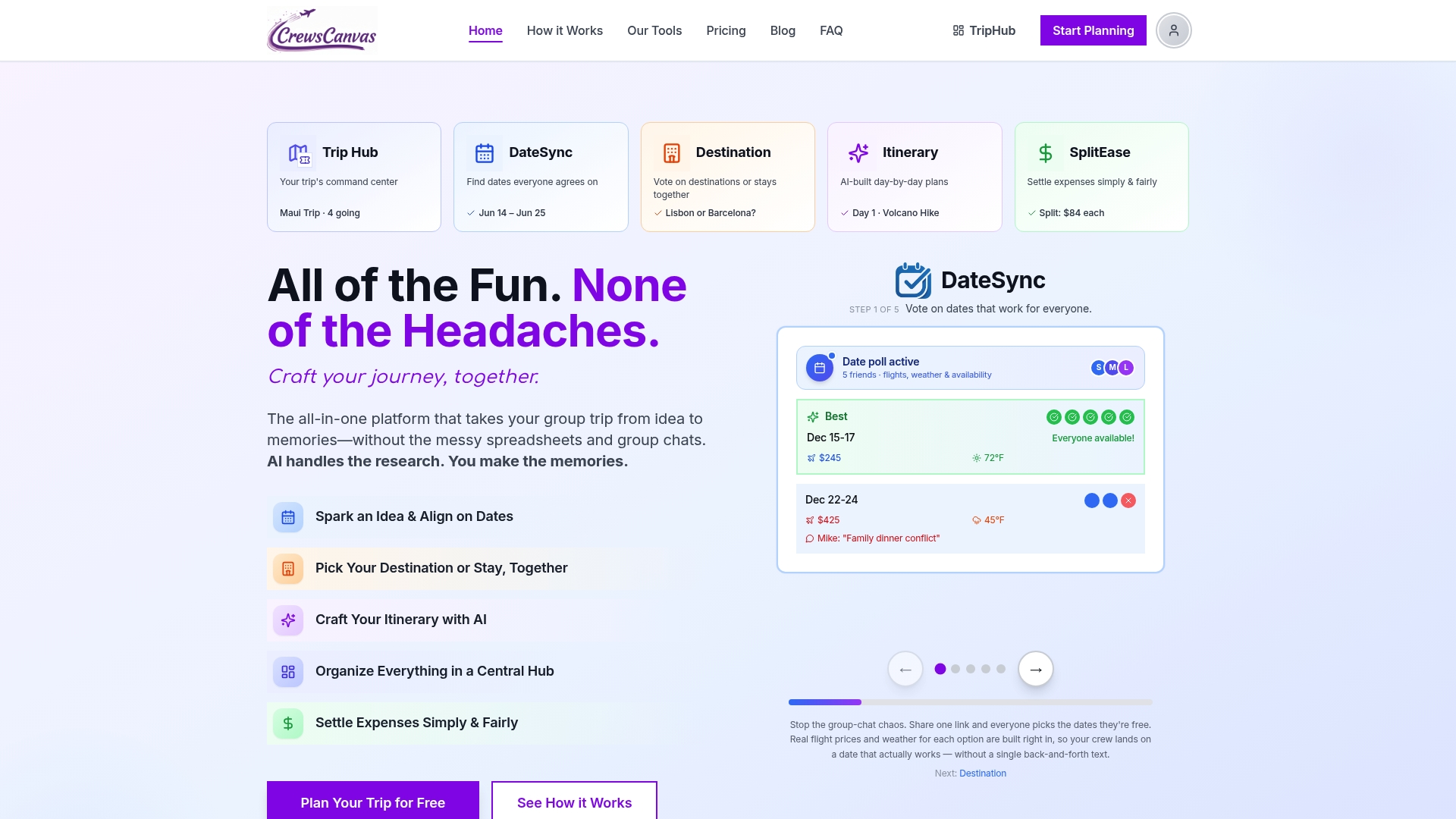
It works well for group trips where costs pile up fast across lodging, meals, and activities, for roommates splitting rent and utilities by income, and for couples who want reimbursements to happen automatically rather than through a running mental tally. Our Free plan covers smaller groups, and our Pro Subscription at $9.99 per month or One-Trip Pro at $14.99 one-off unlock higher participant capacity and advanced features for bigger trips. Head to our pricing page to see which fits your next trip.
FAQ
How do you split expenses equally among a group?
Splitting expenses equally means dividing the total cost by the number of people, regardless of income or usage, as explained in how to avoid vacation rental fees and save more. It works best when everyone in the group earns similarly and benefits equally from the shared cost, like a group dinner or a shared vacation rental booked by all participants together.
What is the 70/20/10 budgeting rule?
The 70/20/10 rule is a personal budgeting guideline where 70% of income covers living expenses, 20% goes to savings, and 10% goes to debt repayment or giving. It's a framework for managing your own money rather than a method for splitting shared costs between multiple people.
What does it mean to split a cost fairly?
Splitting a cost fairly typically means dividing it in a way that feels equitable given each person's circumstances, which often means proportional to income rather than a strict equal division. Research on shared expense fairness shows that perceived fairness, not just mathematical equality, is what predicts satisfaction with the arrangement.
What is the fairest way to split bills between people?
For people with similar incomes, an equal split is usually simplest and feels fair to everyone. When incomes differ meaningfully, a proportional split based on each person's income tends to feel more equitable, since it keeps the financial burden relative to what each person actually earns.
How do you avoid conflict when splitting costs?
Agreeing on a method and a repayment deadline before costs are incurred prevents most disputes before they start. Regular, open conversations about money, sometimes called "money dates," are linked to higher relationship satisfaction and help keep shared expense arrangements running smoothly over time.
Sources
- Financial communication as a mediator between financial values and marital outcomes - Family Relations (Wiley)
- Gendered perceptions of fairness in housework and shared expenses: Implications for relationship satisfaction and sex frequency (PMC)
- A guide to shared expenses with a credit card | Chase