
To plan a Greece trip, settle four things in order: the dates, the length, the islands, and the budget. Pick dates the whole group can make, choose one or two regions instead of five, and agree on a per-person spending range before anyone books a ferry. Do it in that order and most of the arguments never start. Below you'll find the seasons, trip lengths, island choices, transport options, costs and entry rules, plus a way to keep a group of friends or family on the same page.
TL;DR
- Best timing: April–May and September–October usually give pleasant weather, smaller crowds and lower prices. June–August is peak beach season with ferries running in full.
- Best length: About 5 days covers Athens plus one island, a week covers Athens plus two places, and 10 days is the comfortable pace for island-hopping.
- Biggest mistake: Trying to see too much. Stay in one island group and give each stop at least two nights.
- Budget: Published daily figures run from roughly $50–$80 per person for budget travel to well over $400 for luxury, so agree on a tier as a group first.
- Group tip: Lock dates, destinations and a shared expense plan early, in one place everyone can open without creating an account.
Table of Contents
- Why Greece is easy to love and hard to coordinate
- Step 1: Choose the season together
- Step 2: Decide how many days you need
- Step 3: Pick your islands and regions
- Step 4: Work out how you'll get around
- Step 5: Set a budget the whole group agrees on
- Step 6: Check entry rules before you book
- Step 7: Build the itinerary without overscheduling it
- What to pack
- Our perspective: plan the group first, then the country
- Plan your Greece trip in one place
- FAQ
- Sources
Why Greece is easy to love and hard to coordinate
Greece looks simple on a map. Then you start planning. Athens for history, Santorini for the views, Crete for variety, and somebody in the group wants a quiet beach with no crowds. Add ferry timetables that change by season, and a group chat that has already hit 200 messages, and the trip stalls before anyone has bought a ticket.
The fix is not more research. It is making decisions in a sensible order, with a shared place to record them. If your group is still working out how to organize the early stages, our travel planning timeline for small groups shows what to settle at each stage.
Step 1: Choose the season together
The season shapes everything else: prices, ferry frequency, what is open and how hot you will be. Rough Guides recommends summer (June–August) for beach holidays and fully running ferries, and the shoulder seasons (April–May and September–October) for fewer crowds and lower prices. It describes November–March as quiet, with limited ferry service and many smaller islands shutting down.
Rick Steves puts the tourist season at roughly Easter through October and names late spring and fall as the best times to visit, with pleasant weather and smaller crowds, except around holiday weekends.
For a group, here is a practical way to decide:
- Ask everyone for the months they can realistically travel, not a single date.
- Drop any month that excludes a key person, such as a parent, a teacher or a best man.
- Among what is left, favor the shoulder months if budget matters, and summer if swimming is the priority.
This is where polling beats chat. With DateSync, everyone votes on the dates that work for them, so the overlap shows up on its own. If your group has mixed work and school calendars, this guide to syncing group trip dates walks through it.
If you can only go in winter
Off-season trips work, but they are different trips. Condé Nast Traveler's specialists warn of reduced ferry schedules and weather disruptions, and note that many smaller islands close between November and April. Their advice is to focus on the mainland and larger islands such as Crete, Corfu and Santorini.
Step 2: Decide how many days you need
Length is the decision groups most often get wrong, because every person wants to add "just one more island." Rough Guides gives a useful rule of thumb:
| Trip length | What fits comfortably |
|---|---|
| 5 days | Athens plus one island |
| 1 week | Athens plus two destinations |
| 10 days | Island-hopping without feeling rushed |
Its first-trip warning is worth repeating to your group: trying to see too much in too little time is a common mistake. It also suggests spending at least two nights in each location, or three when transfers are long or awkward.
That last point matters more for groups than for solo travelers. Every move means getting six, eight or twelve people and their luggage onto a boat at the same time. Fewer moves means fewer chances for someone to be late.
Step 3: Pick your islands and regions
Lonely Planet's advice is to focus on priorities, homing in on two or three islands or one rich region such as the Peloponnese, rather than trying to cover everything. Rough Guides suggests choosing one island group and staying inside it, because island-hopping eats time and ferry routes depend on the season.
Its quick personality guide for first-timers:
- Santorini: iconic views.
- Naxos: a more local feel.
- Paros: a balance of beaches and villages.
- Crete: variety, from cities to mountains to coastline.
A useful framing for your group: nobody needs to "avoid" an island, but each island suits a different kind of trip. The right question is what the group wants most. If the answer is a mix of history and swimming, Athens plus one or two islands works. If the group includes people who dislike schedule uncertainty, Euroviajar suggests favoring one island with an airport, an easy add-on from Athens, or one large island such as Crete or Rhodes, so the plan doesn't collapse if a ferry shifts.
Let the group vote
Shortlist three or four options, then have everyone vote rather than debate. CrewsCanvas supports voting on destinations and accommodations, so the loudest voice in the chat doesn't decide for the quiet ones. For ideas on keeping a mixed group happy, see our guide to friends trip planning that keeps budgets, dates and peace intact.
Step 4: Work out how you'll get around
Most of Greece's island travel is by ferry. Rough Guides says most ferries leave from Athens' main port, Piraeus, with additional routes from Rafina and Lavrio. It also explains the trade-off: fast ferries are quicker but more expensive and can be rough in windy weather, while slower ferries are cheaper and steadier but take longer.

Athens to Santorini
This is the route readers ask about most. Destination.com describes a morning Blue Star or Highspeed ferry from Piraeus, taking 5 to 8 hours depending on the boat, with SeaJets faster and Blue Star more comfortable. Treat those times as a range, and check current timetables for your travel dates, since schedules change by season.
Ferry or flight?
For a group, the cheapest option is not always the best. A short flight can save half a day on a long route, and a slow ferry can be a pleasant part of the trip on a short one. Compare total group cost and total hours, not just the ticket price. If your route to Greece includes a layover, it helps to understand stopover duration rules before booking, since a planned stop in another city can turn a long connection into a bonus day.
Put every confirmed ticket, booking number and boarding time into one shared place. TripHub, the shared document and reservation hub in CrewsCanvas, is built for exactly this, so no one has to scroll back through a chat to find the ferry confirmation.
Step 5: Set a budget the whole group agrees on
Money is where group trips quietly go wrong. Agree on a daily range first, then plan around it.
Published figures vary by source and by travel style:
- Rough Guides gives daily budget tiers of about $50–$80 for budget travel, $150–$250 for mid-range, and over $400 for luxury.
- Budget Your Trip reports an average of about $246 (€216) per person per day, and around $98 (€86) per day for budget travelers.
- Lonely Planet suggests €100–€150 per day for a budget trip, with examples such as hostel rooms at €25–€65, public bus tickets from €1.50 and a taverna dinner for two from €30–€40.
A small Athens saver from the same Lonely Planet article: a €20 three-day tourist ticket covers unlimited metro rides and airport transfers.
Costs depend mostly on where you sleep, how you eat, and whether you take slow ferries, fast ferries or the occasional domestic flight. Ask your group which of those three they would spend more on, and which they would cut. Two minutes on that question prevents a week of tension later.

Settle shared costs as you go
The awkward part is rarely the big costs. It is the fifth taxi, the group dinner where two people skipped dessert, and the villa deposit one person fronted. SplitEase tracks shared expenses and settlement, including receipt scanning, so the final tally is fair and no one has to be the group's accountant.
Step 6: Check entry rules before you book
Entry rules change, so confirm them on official government pages before you pay for anything. Here is what the sources say as of this writing.
Rough Guides states that U.S. passport holders can visit Greece, as part of the Schengen Area, for up to 90 days without a visa, and that the passport must be valid for at least three months beyond the planned departure from the Schengen zone. Pegasus Airlines adds that the 90 days apply within any 180-day period, and that starting in the last quarter of 2026, visa-exempt travelers will need online ETIAS authorization before boarding a flight to Greece.
Because your group may include people with different passports, ask each person to check their own requirements early. This is a good item to pin at the top of your shared plan.
Step 7: Build the itinerary without overscheduling it
Once you know the dates, length, islands and budget, the itinerary almost writes itself. A sample shape for 10 days, following the Rough Guides guidance on stays:
- Days 1–3: Athens. Settle in, see the major sites, adjust to the time zone.
- Days 4–6: First island, such as Paros or Naxos.
- Days 7–9: Second island, such as Santorini.
- Day 10: Return to Athens for the flight home, with a buffer so a ferry delay doesn't cost anyone a flight.
Leave at least one open afternoon per stop. Groups burn out when every hour is booked. For a deeper look at the method, read how to build a group trip itinerary everyone will love or our guide to a shared travel itinerary your group will use.
What to pack
Packing advice from the sources is practical:
- Shoes: Lonely Planet recommends sturdy walking shoes for cobbled roads and hiking boots for countryside walks, plus smart clothes for urban clubs and bars.
- Churches: cover up before entering.
- Layers: Condé Nast Traveler's specialists suggest lightweight sweaters, linen layers and a rain jacket for windy or off-season periods, since evenings get cooler.
- Summer essentials: PackSmart's guide lists broad-spectrum, water-resistant SPF 50+ sunscreen, UV-protective sunglasses, a sun hat, a quick-dry towel and a dry bag for ferry rides.
Travel insurance deserves a line on the group checklist too. Breezy Routes notes that healthcare availability varies between the mainland and smaller islands, private treatment is not covered without insurance, and medical evacuation from remote islands can be very costly without coverage. Each traveler should speak with their insurer about what their policy covers.
Our perspective: plan the group first, then the country
We have seen the same pattern in group trips to places like Greece: the destination is rarely the problem. The problem is that dates live in one chat, the budget lives in a spreadsheet, the ferry confirmation is in someone's email, and half the group never opens the document.
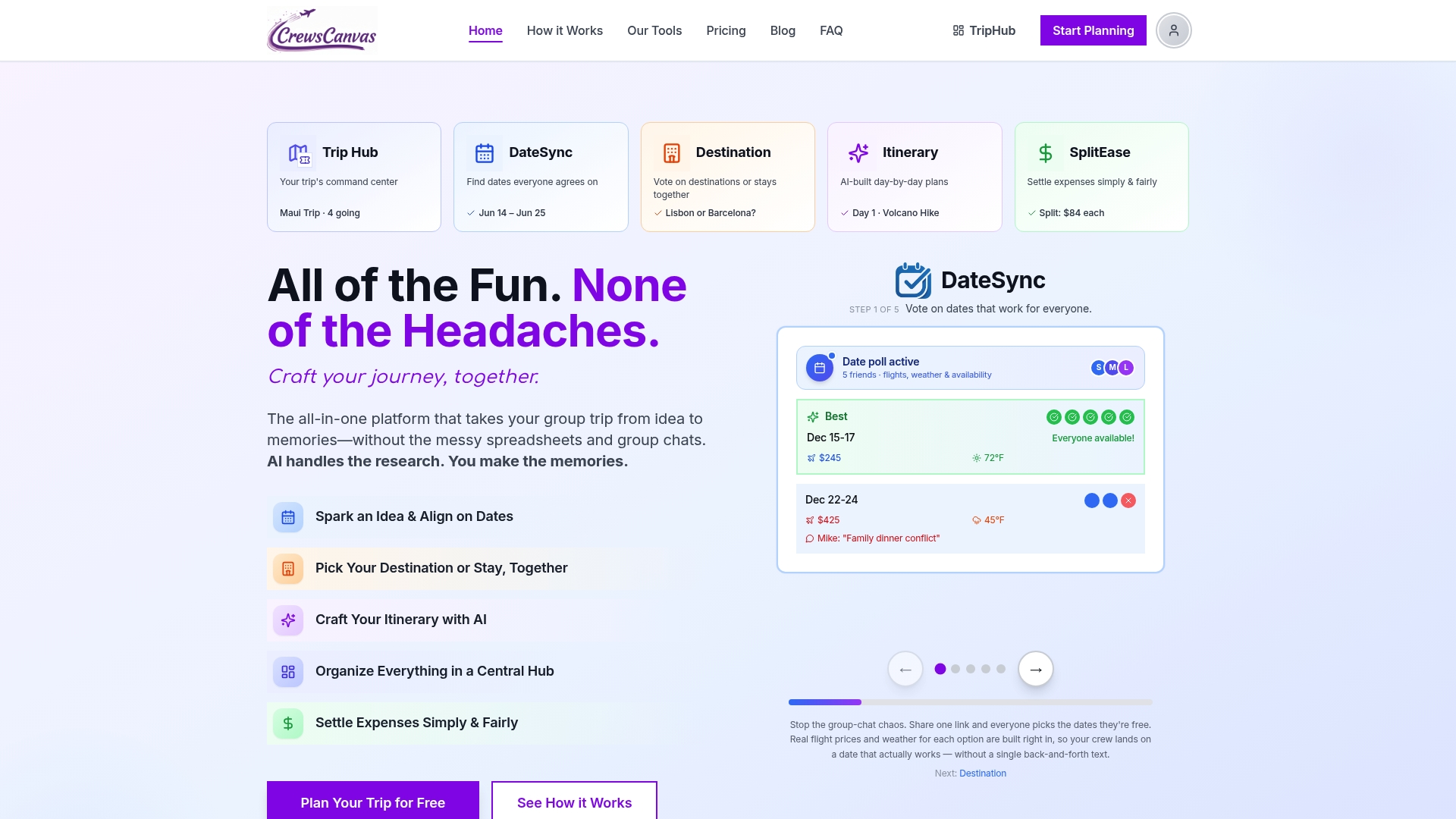
That is why we built CrewsCanvas around the way groups actually behave. DateSync lets everyone vote on dates. Destination and accommodation voting turns "I guess whatever works" into a real answer. Our AI-powered itinerary generator gives you a draft to customize, and TripHub keeps documents and reservations in one place. SplitEase handles expenses so nobody has to chase anyone for money.
Most importantly, participants can join through a shared link on the web. They don't need to download an app or create an account, which means the friend who ignores every sign-up email can still vote, see the plan and log an expense. For a trip as logistics-heavy as an island-hopping route, we believe that is the difference between a plan people use and a plan only the organizer reads.
CrewsCanvas
Plan your Greece trip in one place
If you are the organizer, you don't have to be the group's secretary. CrewsCanvas gives you date polling, destination voting, an itinerary builder, a shared hub for bookings and expense splitting in one place that your travel companions open from a link.
You can start on the Free plan, which is built for small groups. Upgrades are the Pro Subscription at $9.99 per month, or One-Trip Pro at $14.99 one-off if you just need more for a single trip. See the details on the pricing page, or try the itinerary builder to sketch your first draft.
FAQ
What is the best time to plan a Greece trip for a group?
For most groups, April–May and September–October balance weather, crowds and price. Summer is best if swimming and full ferry schedules matter most. Winter is quieter, but many smaller islands close, so stick to the mainland and larger islands.
How many days should we plan for Greece?
Five days works for Athens and one island, a week for Athens and two destinations, and 10 days for relaxed island-hopping. Plan at least two nights per stop to avoid spending the trip in transit.
How do we get from Athens to Santorini?
Most travelers take a ferry from Piraeus, which can take roughly 5 to 8 hours depending on whether the boat is fast or conventional. Check current timetables for your dates, since routes and schedules change with the season.
Do U.S. citizens need a visa for Greece?
U.S. passport holders can stay up to 90 days in any 180-day period without a visa, with a passport valid for at least three months after departure. ETIAS authorization is expected to be required for visa-exempt travelers, so check official government pages before you book.
How can a group split costs without arguments?
Agree on a daily budget range before booking, then log shared costs as they happen. A tool like SplitEase scans receipts and tallies who owes what, so settling up at the end is quick and fair.
Sources
- How to plan a trip to Greece | Rough Guides
- Best Time to Go to Greece by Rick Steves
- How to Make the Most of Greece's Shoulder Season | Condé Nast Traveler
- 13 tips for getting the most out of Greece | Lonely Planet
- Greece on a budget | Lonely Planet
- How much does a trip to Greece cost? | Budget Your Trip
- Greek Islands decision matrix | Euroviajar
- 10 Days in Greece | Destination.com
- Greece visa requirements | Pegasus Airlines
- Greece Travel & Packing Guide 2026 | PackSmart
- Greece Health and Safety | Breezy Routes
- Stopover duration rules | frequentflyer.co.za