
To calculate per person cost, add up every shared expense, add a cushion for surprises, then divide by the number of people paying. The formula is simple: cost per person = total group cost ÷ number of people (Calculator Academy). The hard part is deciding what goes into the total, which costs are really shared, and what happens to everyone's share when someone drops out.
This guide walks through the full process with a worked example, so your group can get a number everyone trusts before anyone pays a deposit.
TL;DR
- The formula: total shared cost ÷ number of paying people. Everything else is deciding what counts as "shared."
- Split two piles: costs that belong to one traveler (like a flight) stay with that traveler, while bundled costs (like a rental house) get divided.
- Fixed costs shrink as the group grows, but food, gas and tickets often scale with headcount, so recalculate when the number changes.
- Build three versions of the budget (lean, expected, comfortable) and add a contingency line instead of trusting one perfect number.
- Agree on the method before booking, not after the trip, so nobody is surprised at settle-up time.
Table of Contents
- The basic formula, and where it goes wrong
- Step-by-step: how to calculate each person's share
- A worked example: six friends, one lake cabin
- How the number changes when the group size changes
- Handle uncertainty with three scenarios
- Equal split or fair split?
- Our perspective: the number is only useful if everyone sees it
- Let the numbers do the work
- Settling up without the awkwardness
- FAQ
- Sources
The basic formula, and where it goes wrong
The math is one line: cost per person (CPP) = total cost (TC) ÷ people (P). If a trip costs $2,400 in total and eight people are going, each share is $300.
Most group arguments don't come from the division. They come from three things that happen before it:
- A missing line item. Parking, tolls, resort fees and tips get forgotten, then someone pays for them out of pocket and feels shortchanged.
- A wrong headcount. Does the total include the couple who might come? The kid who gets in free?
- Mixing personal and shared costs. Dividing one traveler's airfare across the whole group is a quick way to annoy everyone.
So the process below spends most of its time on the total and the headcount, and only the last step on division.
Step-by-step: how to calculate each person's share
1. List every cost category
Start with categories, not prices. AAA's road-trip guidance tells groups to budget for rental cars, gas, lodging, excursions, parking, tolls, food, souvenirs and travel supplies, and to break the budget down to a cost per day (AAA). For trips that involve flying, AAA's planning guide adds airfare, hotels, activities, dining or groceries, transportation at the destination and shopping, and suggests estimating them before you make nonrefundable purchases (AAA Via).
A starter list for most group trips:
- Lodging (plus cleaning fees, taxes, resort fees, deposits)
- Transportation to the destination (flights, train, gas)
- Local transportation (rental car, rideshares, parking, tolls)
- Food (groceries, restaurants, one group dinner)
- Activities and tickets
- Tips and gratuities
- Insurance, travel documents and connectivity
- A contingency reserve
Beyond the core categories, one planning guide recommends including documents, connectivity, insurance and a reserve for unexpected expenses (Wanderlight Guides). If you want a more detailed checklist with formulas for each category, our travel expense categories guide covers it.
2. Sort costs into "individual" and "shared"
This is the step that saves friendships. Travel insurer TravelInsured separates per-person costs, which can be assigned directly to each traveler, from package total costs, which cover a bundled service for the whole group and have to be divided (TravelInsured).
In practice:
| Cost | Usually | Why |
|---|---|---|
| Flights | Individual | Each person pays their own fare from their own city |
| Rental house or cabin | Shared | One price for the whole group |
| Rental car and gas | Shared | Split among riders in that car |
| Group groceries | Shared | Bought once, eaten by everyone |
| A solo spa visit | Individual | Only one person benefits |
| Group boat rental | Shared | One price for the whole group |
Only the shared pile goes into the division. Individual costs get added to each person's own total at the end.
3. Fix the headcount
Decide who is paying before you divide. Count adults, kids who need their own bed or ticket, and anyone who is "probably" coming. If the answer is uncertain, calculate the share for two or three headcounts (more on that below) rather than guessing.
4. Add a contingency
A cushion of roughly 10 percent on shared costs is a common planning habit, though that figure is our rule of thumb, not an official standard. Pick a percentage your group is comfortable with, show it as its own line, and agree upfront that unused money gets refunded or applied to a group dinner.
5. Divide, then add personal costs
Divide the shared total (including the contingency) by the headcount. Then add each person's individual costs to get their full trip price.
A worked example: six friends, one lake cabin
Here is an illustrative example (the numbers are invented for the demonstration). Six friends rent a cabin for three nights.
Shared costs
| Item | Amount |
|---|---|
| Cabin (3 nights, with fees and taxes) | $1,260 |
| Groceries for three days | $390 |
| Gas and tolls for two cars | $150 |
| Boat rental for one day | $300 |
| Shared subtotal | $2,100 |
| Contingency (10%) | $210 |
| Shared total | $2,310 |
Division: $2,310 ÷ 6 = $385 per person for shared costs. Without the contingency, it would be $350.
Individual costs: two friends fly in, paying $340 and $280 for their own tickets. Those amounts are not divided. Their full trip costs are $725 and $665, while the four friends who drive pay $385 each.
The same logic works for any trip. Only the line items change.
How the number changes when the group size changes

Cost per person is not a fixed number. It moves with headcount, but not all costs move the same way. AAA's guidance says group size affects lodging, meals, fuel, travel supplies and potentially attraction fees, with some effects positive and others negative (AAA). The reason is that fixed costs (the cabin, the boat) don't grow when you add people, so adding people lowers each person's share of them (Calculator Academy). Variable costs (groceries, tickets) grow with every person.
Take the cabin trip again. Treat the cabin, boat and gas as fixed ($1,710 total) and groceries as variable ($65 per person):
| Group size | Fixed share | Groceries | Cost per person (no contingency) |
|---|---|---|---|
| 4 people | $427.50 | $65 | $492.50 |
| 6 people | $285.00 | $65 | $350.00 |
| 8 people | $213.75 | $65 | $278.75 |
Going from four to eight people cuts each share by more than $200 in this example. The catch: the cabin only works if it has enough beds, so check capacity and extra-guest fees before you count on that saving. Our guide to group accommodation explains what to verify before paying a deposit.
Watch out for airfare
Adding people doesn't always lower the price. Consumer Reports found that booking multiple airline seats in one transaction can raise the quoted per-person fare, because reservation systems may require every ticket to use the same fare bucket. In its tests, multi-passenger prices were higher in 9 of 16 comparisons, by as much as $103 per person (Consumer Reports). It's another reason to keep flights in the individual pile and let everyone book their own.
Handle uncertainty with three scenarios
A single number looks precise and is usually wrong. A more honest approach is to build three scenarios: lean, expected and comfortable. One planning guide suggests exactly this, as an alternative to relying on one potentially inaccurate figure (Wanderlight Guides).
For the cabin trip, that might look like:
- Lean: cook every meal, skip the boat, share one car. Lowest share.
- Expected: the plan above.
- Comfortable: two restaurant dinners, the boat, and a bigger cushion.
Show all three to the group. People can then say "I'm in for expected, tops" before money is committed, which is far better than discovering budget gaps at the checkout page.
For benchmarks on larger trips, institutions that run group travel publish ranges. Princeton's travel office, for example, suggests budgets of $2,200, $2,700 and $3,200 per student for an 8-day, 7-night group trip at its low, mid and high ranges, and recommends $100 per person per day for meals ($125 in high-cost areas) (Princeton Travel & Expense). That's a student program, so treat it as a model of how to structure ranges, not a price for your trip.

Equal split or fair split?
Dividing by headcount is the fairest method when everyone gets the same thing. It gets shaky when:
- One couple takes the master suite and another person sleeps on a pull-out.
- Someone skips the expensive dinner or the paid excursion.
- Incomes differ a lot and the "even" share is a stretch for some people.
There are a few ways to handle this:
- Equal split on the basics, itemized on the extras. Lodging and groceries are even; optional activities are paid only by those who join.
- Weighted lodging. Price rooms by quality and let people choose.
- Tiered plans. Offer a budget version of the trip alongside the full one.
We go deeper on these in our guides to itemized expense splitting and planning a trip when everyone has different budgets. The overall approach to fair budgeting is in how to budget for a group trip fairly.
Our perspective: the number is only useful if everyone sees it
We built CrewsCanvas because the math is rarely what breaks a group trip. A spreadsheet can divide by six. What it can't do is keep six people looking at the same current number while one person pays for the cabin, another buys groceries, and a third pays for gas.
Our view is that a per-person cost should live in one place that every traveler can open without creating an account or installing anything. It should update when the headcount changes, make clear which costs are shared and which are personal, and settle up at the end without anyone having to chase friends for money. That is why SplitEase sits next to the itinerary and date voting rather than in a separate app: expenses make sense in the context of the plan they belong to.
If you remember one thing from this guide, make it this: agree on the method before the first deposit. Groups fight about fairness far less when the rules were set while everything was still hypothetical.
— CrewsCanvas
Let the numbers do the work
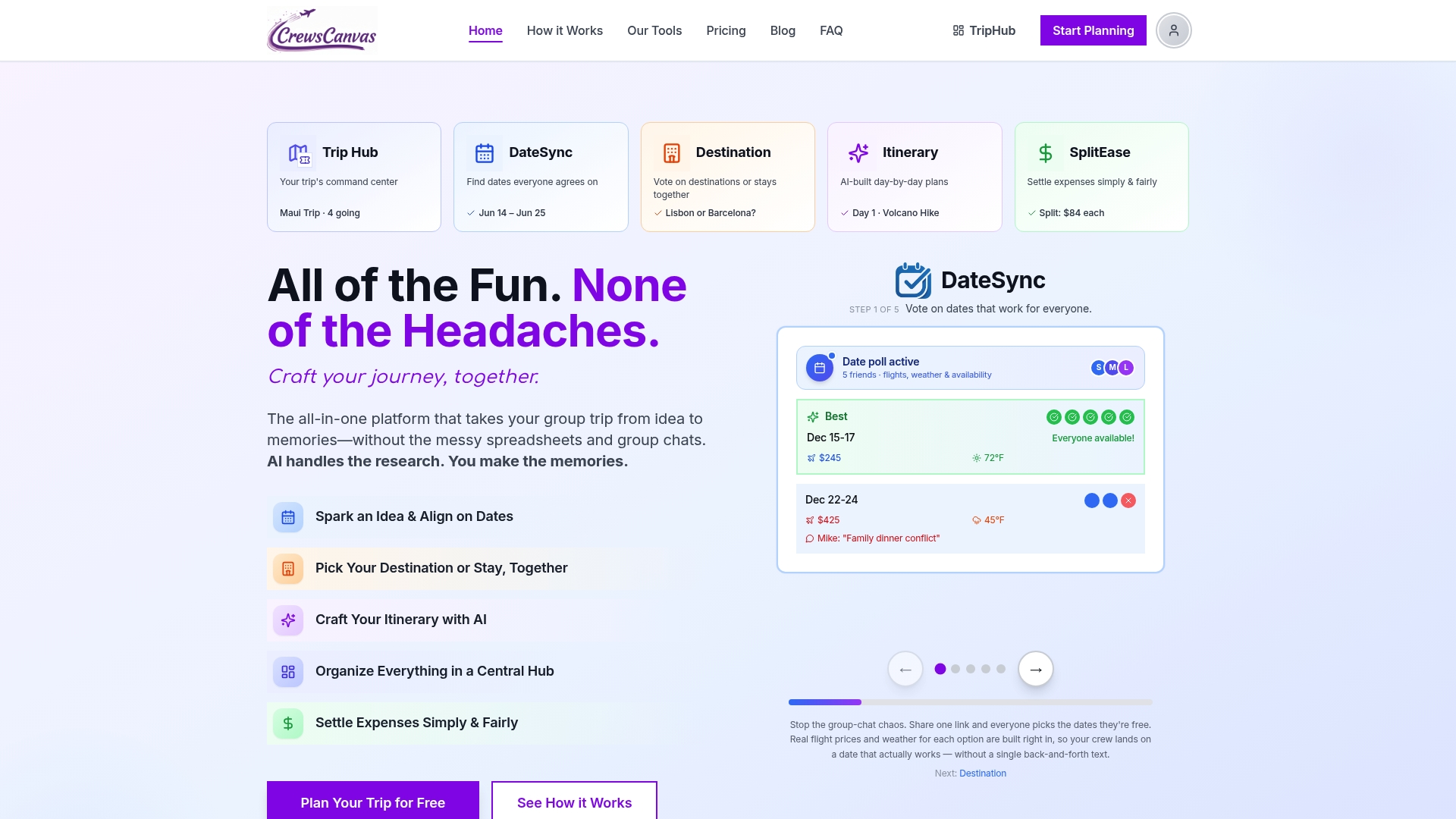
If you'd rather not rebuild the spreadsheet for every trip, CrewsCanvas gives you a free plan for small groups. When your trip outgrows it, Pro Subscription is $9.99 per month, or you can buy One-Trip Pro for a single trip at $14.99 one-off. SplitEase tracks who paid what, scans receipts and settles balances, and your travelers can join from a shared link with no account or app download. See plans and pricing to pick the option that fits your trip.
If you're still at the planning stage, our group trip planning checklist shows what to settle about three months out, and the AI itinerary builder can sketch the days that your costs will be based on.
Settling up without the awkwardness
Once the trip is done, the per-person number becomes a payment request, and that's where social friction shows up. Consumer Reports notes that payment apps are widely used for shared meals, rent and group gifts, but that payment requests can create awkwardness, and it recommends setting the app's privacy settings as private as possible (Consumer Reports).
A few habits make it easier:
- Pick one payer per big expense (the cabin, the car) and have everyone settle with the group ledger instead of with each other.
- Send one clear total per person, with the breakdown attached, not a string of small requests.
- Set a deadline at the start, for example within a week of getting home.
- Keep receipts as you go. Photos on the day beat memory two weeks later.
For the different ways to track this, see our guide on tracking who paid what and our walkthrough on splitting costs without the drama.
FAQ
What is the formula to calculate cost per person?
Divide the total group cost by the number of people: CPP = TC ÷ P. For a group trip, use only the shared costs as the total, add a contingency, and then add each person's individual costs (such as their own flight) to get their final price.
Should I split everything equally?
Not necessarily. Equal splits work well for lodging, shared groceries and shared transportation. Optional activities, pricey dinners or upgraded rooms are often better paid only by the people who use them. What matters is that the group agrees on the rule before booking.
How do I account for people dropping out?
Calculate the share for two or three headcounts in advance, because fixed costs like lodging don't shrink when someone cancels. If a cabin costs $1,260 and six people become five, each share of the cabin rises from $210 to $252. Ask about cancellation terms before paying deposits, and agree on who covers a dropout's share.
How much contingency should I add?
A common approach is around 10 percent of shared costs, though there is no official number. Higher is wiser for trips with rental cars, long itineraries or many variable costs. Show it as a separate line so people know what it's for and when any unused money will be returned.
Is the per-person cost the same as the per-day cost?
No. Per-person cost divides by travelers, while per-day cost divides by the length of the trip. AAA recommends breaking a trip budget down to a cost per day (AAA). Using both helps you spot whether a trip is expensive because of the group or because of the length.
Sources
- Cost Per Person Calculator (Calculator Academy)
- How To Save Money on a Road Trip (AAA)
- How to Plan a Trip: The Complete Trip Planning Guide (AAA Via)
- A Guide to Splitting Travel Costs (TravelInsured)
- Complete Trip Planning Guide (Wanderlight Guides)
- Get Cheapest Airfares When Booking Flights for Several People (Consumer Reports)
- Budgeting for Group Travel (Princeton Travel & Expense)
- Manners and Etiquette for P2P Payments (Consumer Reports)