
A good group trip budget starts with asking, not guessing. Collect each traveler's comfortable range and hard ceiling privately, price the shared costs as a group total, add a buffer, divide by the line item, and track every payment in one place from day one. Do that and the money conversation happens once, calmly, before anyone books. We built CrewsCanvas around that idea: one shared link where the group votes on dates, plans the itinerary and tracks costs, and nobody has to download an app or create an account to take part.
This guide walks you through the whole routine, with a worked example you can copy for your own friends trip, family reunion, team retreat or couples getaway.
TL;DR
- Ask every traveler for a comfortable range and an absolute ceiling, then budget to the lower end so nobody gets priced out.
- Build the total from fixed costs, shared flexible costs and personal costs, and add a 10 to 15 percent buffer.
- Split each cost by how it is charged (per room, per person, per night), not with one rule for everything.
- Pick one person as the group's money contact and log every shared expense as it happens.
- Dates drive the price: the same rental can cost far less midweek, so poll dates before you commit.
Table of Contents
- Why group budgets go wrong
- Step 1: Agree on a range before you pick a place
- Step 2: List every cost the trip will have
- Step 3: Work out the per-person number
- Step 4: Use dates and timing as your biggest lever
- Step 5: Split costs by type, not with one rule
- Step 6: Track every payment as it happens
- Where CrewsCanvas fits
- Our perspective
- FAQ
- Sources
Why group budgets go wrong
Most group trips do not fall apart over the destination. They fall apart over assumptions. One person pictures a beach house with a view, another is counting every dinner, and nobody says so until the deposit is due.
Financial planner Valerie Rivera makes the point well: being able to pay for something does not mean a person wants to. Her advice is to stop guessing what friends can afford and ask them directly, for example with an anonymous form offering three price ranges for the stay and a space for notes on extra costs.
That is the heart of a group trip budget: a number the whole group chose, not a number the loudest person announced.
Step 1: Agree on a range before you pick a place
Budget talk goes best before anyone has fallen in love with a specific house or hotel. Here is a simple order that works.
- Name a money contact. A licensed counselor who specializes in financial therapy suggests the group appoint a treasurer who acts as a sounding board for money questions. Another therapist and financial coach says she usually takes this role herself so everyone knows who to talk to when something is unclear.
- Ask for two numbers. Each person gives a comfortable per-person amount and an absolute ceiling. Collect them privately so nobody anchors on a friend's answer.
- Lean low. The same counselor recommends naming a range that errs on the lower end for inclusivity, or sharing links to options at several price points so people can react to real prices.
- Decide what is shared. A CPA's guidance is to set a maximum budget and decide upfront which expenses are shared (group meals, housing, car rental) and which are individual (airfare, solo outings, souvenirs).
Charles Schwab's group travel guide points the same way: discuss spending styles, set an overall budget for lodging, meals and activities, and choose a trip manager to keep itinerary, reservations and shared costs in one place.
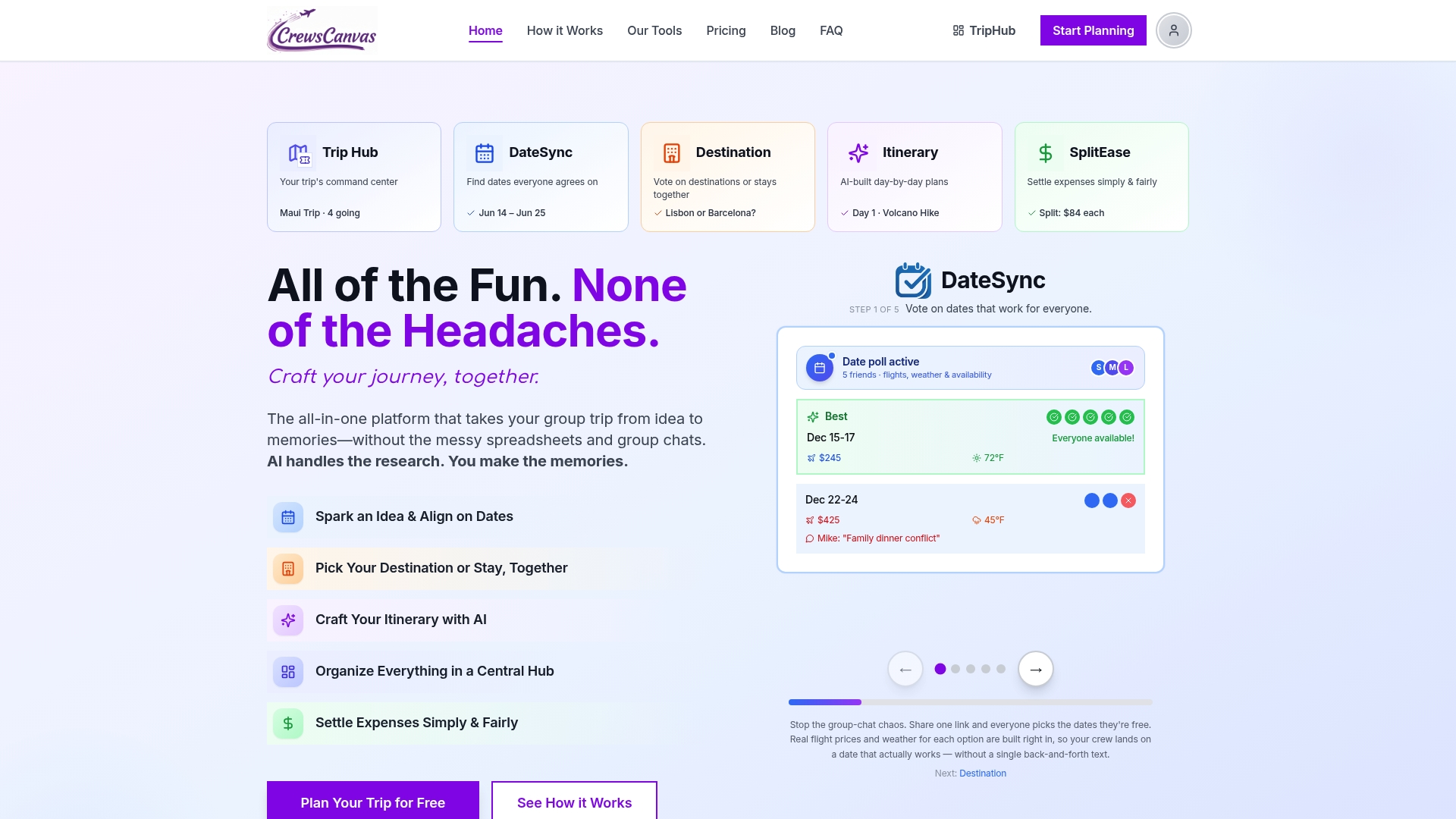
In CrewsCanvas, the organizer can put dates and destination options to a vote, so the group's preferences and price limits surface before anything is booked. Our DateSync tool handles the date vote through a shared link, which matters more for the budget than it sounds, as you will see below.
Step 2: List every cost the trip will have
The most common budget failure is a list that stops at flights and the hotel. Princeton's travel office lists the core costs for group travel as flights, ground transportation, accommodations, meals and activity fees, and says detailed budgets add items such as attraction tickets, guides and gratuities depending on the trip.
Sort your list into three buckets:
| Bucket | What goes in it | When to settle it |
|---|---|---|
| Fixed costs | Lodging, rental car, parking, cleaning fee | Agreed before anyone books |
| Shared flexible costs | Groceries, group dinners, rideshares, shared activities | Tracked as they happen |
| Personal costs | Flights from different cities, souvenirs, solo meals, optional activities | Each person pays their own |
Two costs catch first-time organizers more than any others. One UK group-accommodation company notes that the cleaning fee and the refundable security deposit are often missed, and that someone has to front the deposit even though it comes back. Put both on the list, and decide who fronts the deposit and how they get repaid.
Add a buffer
Build a cushion into the plan. A sample budget from Girl Guides of Canada for a seven-night domestic trip adds a 10 to 15 percent emergency fund on top of a base cost of $1,752 per person, which brings the planned total to $1,932 per person. Baggage fees, taxis and one nicer dinner than planned are exactly the things a buffer absorbs.
Step 3: Work out the per-person number
Calculate the group total first, then divide each line according to how it is charged. Lodging is per room or per house, food is per person per day, a rental car is per vehicle. Dividing everything by head count at the start hides those differences.
Here is a worked example. It is an illustration with round numbers, not a quote for any real trip: six friends, a four-night rental house.
| Line | Basis | Group total |
|---|---|---|
| Rental house, 4 nights at $320 | Per night | $1,280 |
| Cleaning fee | Fixed | $150 |
| Rental car, gas and parking | Fixed | $240 |
| Groceries | Shared | $360 |
| Two group dinners out | Shared | $420 |
| Group activity, $50 each | Per person | $300 |
| Subtotal | $2,750 | |
| 10% buffer | $275 | |
| Total | $3,025 |
$3,025 divided by six is about $504 per person for shared costs. Each traveler then adds their own flight or gas, which in this example might be $300, for roughly $804 all in. The refundable $300 security deposit is not in the total because it comes back, but someone still has to front it.
If your group's lowest ceiling is $600 for the shared part, you know before booking that this house is too expensive, and you can look at a smaller place, fewer nights or other dates instead of finding out at checkout.
Sanity-check against real benchmarks
For scale, Princeton's travel office gives a planning range of $2,200 to $3,200 per student for an eight-day, seven-night international student group trip, with $2,700 as the mid-range figure. Its assumptions include $150 per room per night for mid-range lodging and $100 per person per day for meals. Your trip will differ by destination and style, but a benchmark with stated assumptions beats a guess.

Step 4: Use dates and timing as your biggest lever
Trip length multiplies lodging nights and daily food, transport and activity costs. Dates change the nightly rate itself. The group-accommodation company mentioned above says the same house is often cheaper Monday to Thursday, which for a flexible group can be the biggest single lever in the budget.
That is why date voting belongs in the budget conversation. If five of six people can take a Tuesday off, a midweek stay may cut the lodging line sharply. Guidance on booking a weekend stay and getting the best deal covers the same logic from the lodging side: flexibility on timing is where savings come from.
Getting everyone to and from the airport is another line that groups forget, and a shared transfer often beats several separate rides. These smart ways to save on airport transfers are worth reading before you lock in arrival plans.
On arrival and departure days, do not treat them as ordinary full days. You may eat one meal out and take one ride, so assume less food and transport on those days.
Step 5: Split costs by type, not with one rule
Splitting everything evenly is the simplest method, but CNBC notes it may not work well if people's budgets or activity preferences differ. The same article describes three common approaches: divide everything evenly, pay as you go (each person covers their own meal or ticket), or round robin, where people take turns covering one group activity.
A practical mix looks like this:
- Lodging: by room or by person, depending on who gets which bed. Our guide on how to split an Airbnb cost fairly covers unequal rooms.
- Groceries and shared supplies: equally, as long as everyone eats roughly the same.
- Restaurant dinners: by what each person ordered. One financial coach splits dinners this way so people can order what they want without feeling guilty about paying for others' drinks. Our piece on itemized expense splitting shows how.
- Activities: each person buys their own ticket. The Points Guy also suggests separate checks and individual tour tickets where possible.
- Rideshares: split by who was in the car.
CNBC adds a points tip for groups where one person pays: assign each spending category to the card that earns the most rewards, which can lower the overall cost of the trip.
If budgets differ widely in your group, see our walkthrough on planning a trip when everyone has different budgets. For etiquette questions such as chasing a late payment, read our expense splitting etiquette guide.
Step 6: Track every payment as it happens
The budget only survives the trip if the spending is recorded. A spreadsheet works until the third person forgets to update it. The habit that holds up is simple: put the tracking link in the group chat on day one so everyone logs shared costs as they occur. The Points Guy recommends tracking expenses in the moment, adding receipt photos, and noting who owes what for each payment.
With SplitEase, our expense tool, the group tracks and settles shared costs, and receipts can be scanned rather than typed in. Participants use a shared link, so friends who would never download another app can still add an expense. For more on keeping a clear record, see three ways to track who paid what, and for the settle-up conversation, our guide to splitting costs without the drama.
Where CrewsCanvas fits
The tools covered so far are the ones that answer this keyword: DateSync for the date vote, the itinerary builder for planning days around your budget, TripHub for shared reservations and documents, and SplitEase for the money. They sit in one place instead of across a spreadsheet, a poll and a chat thread.
You can start on the Free plan, which is built for small groups. When you need more capacity or advanced features, Pro Subscription is $9.99 per month, and One-Trip Pro is $14.99 as a one-off payment for a single trip. The organizer pays; participants joining by link do not. See the pricing page for what each plan includes.
If you are ready to try it, open CrewsCanvas and set up your first trip with the budget conversation built in from the start.
Our perspective
Most group budget fights are really information problems. Someone did not know the real price, someone else did not say their limit, and a third person paid and never got repaid. None of that is a character flaw. It is what happens when the plan lives in a chat with 200 messages in it.
That is why we put dates, itinerary, reservations and costs in one shared hub. When the group votes on dates before booking, the price conversation has real numbers behind it. When the itinerary and the expenses sit side by side, the plan and the spending stay connected.
We also think the people joining a trip should not have to sign up for anything to take part. A link is enough to vote, to see the plan and to log a cost. The organizer carries the setup, and everyone else just shows up and contributes.
Our advice: agree on the number first, split each cost the way it is charged, and record every payment the day it happens. Do those three things and the trip stays fun.
CrewsCanvas
FAQ
How do I set a budget for a group trip?
Ask each traveler privately for a comfortable per-person range and an absolute ceiling. Budget to the lower end so nobody is priced out. Then list fixed, shared and personal costs, add a 10 to 15 percent buffer and divide by the line item.
How much should I budget per person per day?
It depends on the destination and style. One reference point is Princeton's student-group assumption of $100 per person per day for meals on an international trip. Price your own lodging and transport from real listings, then add food and activities on top.
Should everyone split costs equally?
Not always. Even splits suit groceries and shared supplies when everyone consumes about the same. Lodging may depend on rooms, restaurant dinners on what each person ordered, and activities are best paid individually.
Who should handle the money on a group trip?
Pick one person as the group's money contact, often the organizer. They answer questions, front shared deposits when needed and keep the expense record. Everyone else logs what they pay so the totals stay accurate.
Sources
- Budgeting for Group Travel, Princeton Travel & Expense
- How Do I Plan a Group Trip That All My Friends Can Afford?, The Cut
- How to Split Expenses With Friends on a Group Trip, The Cut
- Money Planning for Group Trips, Charles Schwab
- Travel Companions: How to Share Expenses, Alan F Burke CPA
- Sample Budget for Domestic Trip, Girl Guides of Canada
- Group Holiday Budget Planner, Group Escape Houses
- Travel Tips: How to Split Expenses on a Group Vacation, CNBC
- How to split travel costs with friends and family, The Points Guy
- How to Book a Weekend Stay and Get the Best Deal
- 7 Smart Ways to Save on Airport Transfers