
Travel booking management for a group trip comes down to four jobs: agreeing on dates and budget before anyone books, deciding who books what, recording every deadline and cancellation term, and keeping confirmations and costs in one place everyone can see. Do those four things and the trip stops living in a 200-message group chat. We built CrewsCanvas around exactly that routine: DateSync for dates, TripHub for reservations and documents, and SplitEase for costs, all through a shared link that participants can open without an account or an app.
TL;DR
- Lock dates, headcount and a budget cap before you book anything, so every reservation rests on a decision the whole group already made.
- Name one organizer, give each person a clear job, and attach a mini-deadline to every decision.
- Before paying a deposit, write down the total price, payment dates, the point where money becomes nonrefundable, and what happens if someone drops out.
- Keep confirmations, rooming lists and receipts in one shared hub, and reconfirm every booking after it is made.
- Pay with a credit card where you can: US billing-error rights run on a 60-day clock.
Table of Contents
- What travel booking management means for a group
- Step 1: Agree on dates, destination and budget first
- Step 2: Choose an organizer and split the jobs
- Step 3: Pick your booking model
- Step 4: Read the terms before the first payment
- Step 5: Set mini-deadlines and a payment strategy
- Step 6: Reconfirm every booking and keep it in one place
- Step 7: Split costs without the awkward conversation
- Where group bookings go wrong
- Promo: one hub for dates, bookings and costs
- Our perspective
- FAQ
- Sources
What travel booking management means for a group
Search this phrase and most results are business-travel tools or software for travel agencies. If you are a friend group, a family planning a reunion or a team organizing a retreat, you need something simpler: a way to turn "we should totally go" into confirmed flights, rooms and a fair bill.
The work is a chain. Each link depends on the one before it. A group that books flights before agreeing on dates ends up paying change fees. A group that books a house before confirming headcount ends up with empty beds to pay for. Trip.com's group booking guide lists the same sequence: confirm headcount, settle dates and flexibility, set a budget, sort out rooming and preferences, collect legal names and passport details, and nominate an organizer. Then agree on how people pay and share the booking essentials.

This guide walks that chain in order, then shows where a shared workspace takes the busywork off the organizer.
Step 1: Agree on dates, destination and budget first
This is the step where most group trips stall, and it is cheaper to fix here than anywhere later.
Dates. Polling the chat is the common approach, and it works for a group of four. A Charlotte Observer travel piece suggests polling the chat for availability and having an honest budget conversation early to avoid awkwardness later. Past about six people, chat polls get buried under replies. A dedicated date poll fixes that: everyone marks the days that work, and the overlap is visible at a glance. That is what DateSync does, and participants vote from a link. Our guide on coordinating travel dates for a group covers the details.
Destination and priorities. Before anyone pins dream destinations, agree on the kind of trip: beach or city, packed or slow, splurge or save. A destination vote works best when the options already fit the dates and the budget range.
Budget. Ask for a per-person ceiling, not a vague "around what?". Someone will quietly be stretching, and an early number lets them say so without embarrassment. Our walkthrough on budgeting for a group trip fairly shows how to set one.

Step 2: Choose an organizer and split the jobs
Every source on group booking lands on the same point: one person must be accountable. Trip.com recommends nominating an organizer or two to keep track of everything. One person can handle all the bookings, with the group reimbursing later.
A simple division that scales to large groups:
- Organizer: books, holds the deadlines, and chases payments.
- Itinerary owner: builds the day-by-day plan and collects activity ideas.
- Rooming and needs owner: keeps the rooming list, dietary needs and mobility notes.
One caution applies to the organizer. Putting every booking on one card makes the booker financially exposed until everyone pays them back. That is the reason to settle the payment method and deadlines before the first booking, not after.
Step 3: Pick your booking model
There are three common ways to book:
| Model | How it works | Best for |
|---|---|---|
| One master booking | One person books and pays for everything, then collects shares | Rental houses, small groups with a trusted organizer |
| Room block or group rate | A supplier holds a set of rooms or seats for the group, often with a deposit and a rooming-list deadline | Reunions, weddings, retreats with 10 or more people |
| Individual bookings, shared plan | Each person books their own flight or room against a common itinerary | Groups flying from different cities |
For flights, the numbers matter. Airlines commonly treat 10 or more passengers on a shared segment as a group booking, with pricing held for a limited time, and falling below the minimum headcount can void the deal, according to this group flight pricing explainer. With a smaller group, individual bookings against a shared plan are usually simpler. Whichever you pick, put it in writing so nobody assumes a different arrangement.
For lodging, check beds, fees and policies before sending a deposit. Our guide to choosing group accommodation lists what to look at: bed types, cleaning and occupancy fees, and the cancellation window.
Step 4: Read the terms before the first payment
This is the step that saves real money. Before anyone pays a deposit, get answers to these questions in writing:
- What is the total price, including taxes and fees?
- When is each payment due, and when does money become nonrefundable?
- Does the rate depend on a minimum number of travelers? What happens if the group shrinks?
- Are deposits refundable, and can they move to new dates or a replacement guest?
- Can names be changed, and by when?
- What happens if the supplier changes the schedule or cancels?
The K&S Travel Crusaders contract guide frames the first test as identifying the total financial commitment, the payment deadlines and the date money turns nonrefundable. Note the time zone on every cancellation deadline too: a cutoff at midnight local time at the destination can arrive earlier than you think.
Names must match IDs
For flights, collect each traveler's legal name exactly as it appears on their passport or ID. Fixing a typo is usually possible, but airlines do not allow ticket transfers to a different person, and corrections on multi-airline trips can force a new reservation, as Group Travel Network's name-change guide explains. Ask everyone for names on day one, not the week before departure.
Know your rights if a flight is canceled
For US travel, the Department of Transportation's rule requires automatic refunds when an airline cancels or significantly changes a flight and the traveler declines the alternative. Refunds are due within 7 business days for credit card payments and 20 calendar days for other payment types, per the Federal Register. If you booked everyone's flights on one card, that refund returns to you, the organizer, so repay each traveler promptly.
Protect yourself on card charges
If a charge is wrong, such as a service you never received, the FTC explains that credit card billing errors must be disputed in writing within 60 days. Keep the date each charge appeared, and have the organizer check statements soon after booking.
This is also why a deposit plan matters. A shared written schedule that matches your supplier's due dates, with a few days of buffer, keeps the organizer from fronting cash for late payers.
Step 5: Set mini-deadlines and a payment strategy
Open-ended decisions are how prices rise while a group debates. Trip.com's advice is to set mini-deadlines such as "Confirm by Friday" or "Pay by the 10th" to lock in prices before availability changes. Add one more line to your group plan: what happens if someone cancels, joins late or stays fewer nights?
Group Escape Houses recommends three rules for group holiday costs: one payment channel, deposits landing before the house is booked, and a dropout clause agreed in the group chat before anyone pays. These work for any group trip. A dropout clause is awkward to write but far less awkward than negotiating it after someone pulls out.
A deadline chain for a typical trip:
- 10 to 12 weeks out: dates and budget agreed.
- 8 to 10 weeks out: lodging and flights chosen; headcount confirmed.
- Booking day: deposits collected before the organizer pays.
- Each supplier deadline minus one week: group payment due.
- Two weeks out: rooming list, names and special requests finalized.
Adjust to your supplier's calendar, since peak seasons and room blocks have their own cutoffs. If your group is hiring ground transport, a group transfer booking timeline shows how far ahead organizers typically start arranging it.
Step 6: Reconfirm every booking and keep it in one place
A booking is not finished when you pay. Open each confirmation and check names, dates, occupancy and special requests against your plan. Mistakes caught in week one cost a phone call. Caught at the front desk, they cost a night. A hotel booking confirmation checklist explains which details to check and keep.
Then put everything where everyone can see it. A shared document with flight numbers, hotel details, airport transfer info and emergency contacts is Trip.com's recommendation. In CrewsCanvas, that is TripHub: reservations and documents sit beside the itinerary, and participants reach them through the shared link without creating an account. The AI itinerary builder drafts a day-by-day plan the group can then edit, so the plan and the bookings stay together.
Step 7: Split costs without the awkward conversation
Money is where friendships strain, and the cause is usually vagueness, not greed. A few principles from the research:
- Pick a split method before spending. Spark's guide names six: equal per person, usage-based, shares-based, by room or nights, income-based, and reimbursement after approval. Equal shares suit similar rooms and shared meals. When rooms differ widely, Group Escape Houses advises adjusting the bedroom allocation instead of running two per-person rates.
- Mark costs as shared, personal or optional. Keep personal spending, such as drinks or solo activities, out of the shared pot.
- Handle refunds first. You-owe-me.com recommends applying any real refund or credit before deciding how to treat the unrecovered amount, which the remaining travelers re-split.
SplitEase tracks who paid for what, supports itemized splits, scans receipts, and shows who owes whom at the end. For a deeper look, see our guides on itemized expense splitting, tracking who paid what and splitting costs on a group trip.
Where group bookings go wrong
Most disruptions are predictable:
- Headcount drops below a group-rate minimum, voiding the deal. Confirm numbers before the hold expires.
- Names do not match IDs, leaving tickets needing reissue.
- One person fronts everything and waits weeks for repayment. Collect first.
- A flight is canceled or rescheduled. Know your refund rights, and reconfirm schedules a week before departure.
- Nobody remembers the cancellation deadline. Put it in the shared plan with the time zone.
- Different people think different things were agreed. Send a written summary after each decision.
Promo: one hub for dates, bookings and costs
If your group is tired of spreadsheets and scattered chats, CrewsCanvas keeps date voting, itinerary, reservations and expenses in one place, and your travel companions join from a link with no app to install. The Free plan covers small groups. Pro Subscription costs $9.99 per month, and One-Trip Pro costs $14.99 one-off for a single trip. See the pricing page for what each plan unlocks.
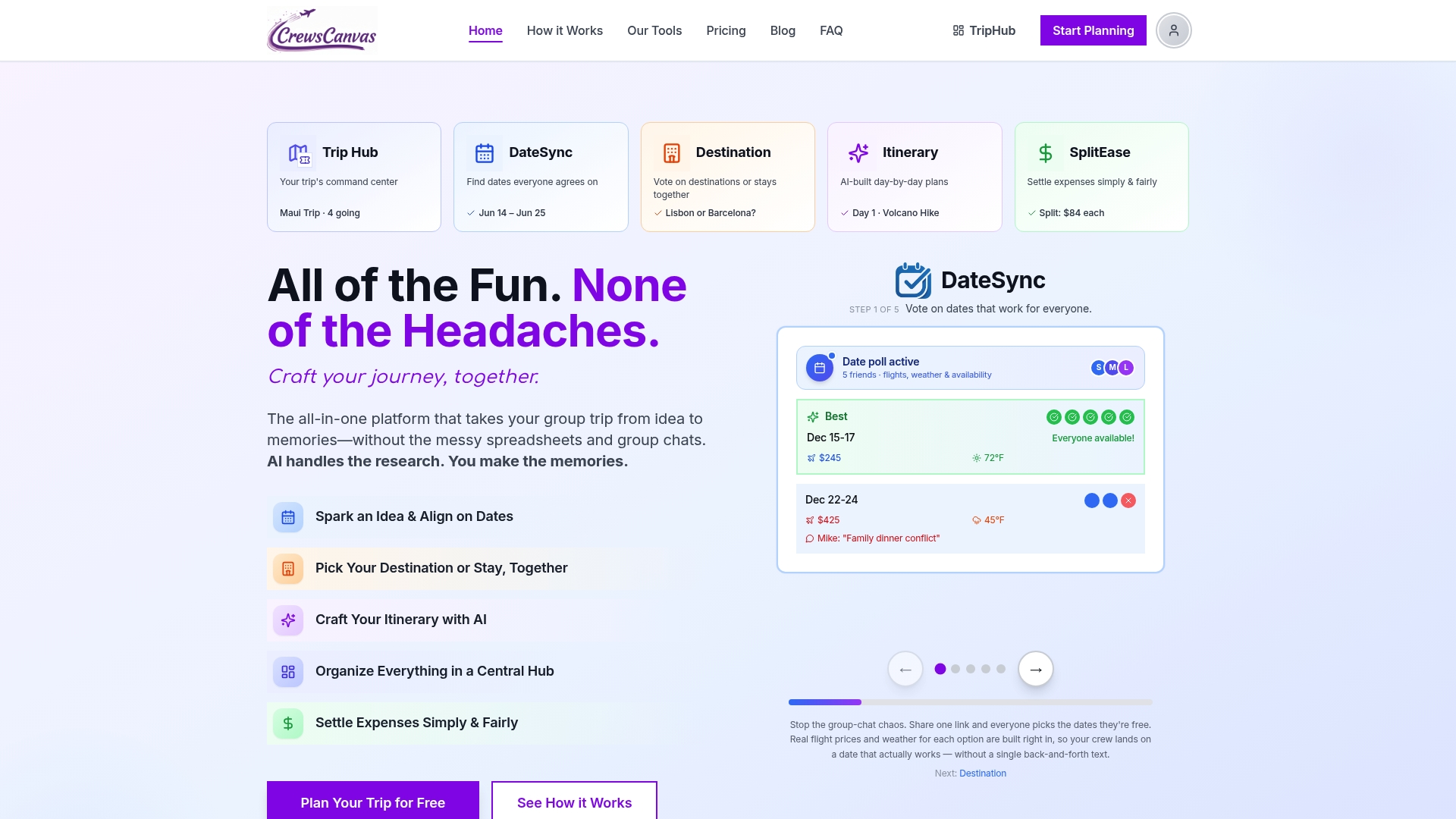
You can explore the full group trip planning toolkit or start with our group travel planner guide.
Our perspective
Group booking fails less from bad suppliers than from missing agreements. People book before the dates are settled, pay before the terms are written down, and argue about money after the trip because nobody tracked it as they went.
That is why we built CrewsCanvas as one flow instead of separate tools. DateSync settles when. The itinerary builder and TripHub hold what and where. SplitEase records who paid and who owes. Because participants use a shared link and do not need an account or an app, the organizer is no longer the only person who can see the plan.
Our aim is a trip where the organizer enjoys the vacation too, and where nobody has to send an awkward payment reminder.
CrewsCanvas
FAQ
What is the best way to manage bookings for a group trip?
Name one organizer, agree on dates and budget before booking, and write down every deadline and cancellation term. Keep confirmations in one shared place, and track costs as they happen. A tool such as CrewsCanvas keeps all of this in a single hub that participants open from a link.
Do we need a group booking for flights?
Usually only at around 10 or more travelers on a shared flight segment. Smaller groups often book individually against a common itinerary. Group fares are typically held for a limited time, so confirm your headcount before the hold expires.
Who should pay for the bookings up front?
Collecting deposits before the organizer pays is the safest approach. If the organizer does front the cost, use a credit card, since billing errors must be disputed in writing within 60 days under US rules. Agree on a repayment date in advance.
How do we handle someone dropping out?
Write a dropout clause before anyone pays: who covers nonrefundable costs, whether the share is re-split, and whether the spot can transfer to someone else. Apply any refund or credit first, then divide what remains.
Sources
- How Do I Book Group Travel? (Trip.com)
- How to plan a fun girls trip that actually comes together (Charlotte Observer)
- Group Flight Bookings (10+) in 2026
- Group Travel Contract Terms Explained
- Airline Name Change Policy for Groups
- Refunds and Other Consumer Protections (Federal Register)
- What To Do if You're Billed for Things You Never Got (FTC)
- How to Split Group Holiday Costs
- Group Holiday Budget Planner
- How to Split Group Trip Costs Fairly With a Spreadsheet
- Should Friends Pay You Back Before a Group Trip?
- Group Transfer Booking Timeline for Organizers
- Hotel Booking Confirmation: What to Check and Keep