
The easiest way to track group expenses is to keep one shared record that everyone can see, agree on the split rules before anyone pays, and log each cost as it happens. With our SplitEase tool, that record lives at one link: your group can open it in a browser, with no app to install and no account to create, and see who paid what and who owes whom. The rest of this guide shows how to set it up, whether you are a group of friends, a family reunion, a team retreat or a couple sharing a getaway.
TL;DR
- Agree on a rough budget range and the split rules (equal, per room, or itemized) before you book anything.
- Separate shared essentials, like lodging and groceries, from personal extras that only the people who choose them pay for.
- Log every expense the moment it happens, with the same few details each time, and keep the receipt photo.
- Settle up within a few days of getting home, and decide in advance how to treat tiny leftover amounts.
- Use one shared, always-visible record instead of a spreadsheet and a 200-message group chat.
Table of Contents
- Why group expense tracking goes wrong
- Step 1: Set the shared trip budget before you book
- Step 2: Decide what is shared and what is personal
- Step 3: Choose equal or itemized splitting
- Step 4: Log every expense as it happens
- Step 5: Keep the record transparent and handle corrections
- Step 6: Prevent overruns while you travel
- Step 7: Settle up quickly and fairly
- A worked example: six friends, one weekend house
- Where CrewsCanvas fits
- Our perspective
- FAQ
- Sources
Why group expense tracking goes wrong
Most group money friction does not come from the money. It comes from not knowing. Someone put the rental car on a card, someone else covered the first dinner, and three days later nobody remembers whether the grocery run was already counted.
The Guardian, quoting a Skyscanner travel expert, treats unclear shared costs as a leading source of resentment on trips with friends and advises deciding in advance whether restaurant bills will be split equally or itemized. The pattern is easy to see in practice:
- Costs live in different places: one person's notes app, another's memory, a photo of a receipt buried in a chat.
- Nobody knows the rules, so each person quietly assumes a different one.
- The organizer ends up doing the math at the airport, and the group feels like a debt collector is on the trip.
A good tracking system fixes all three: one place, agreed rules, and a running balance anyone can check.
Step 1: Set the shared trip budget before you book
A shared trip budget is not a number the organizer picks. It is a range the whole group can live with. Financial planner Valerie Rivera, quoted in The Cut, recommends asking each traveler what budget feels comfortable before booking, for example with an anonymous form offering ranges for accommodation and add-ons. Her key point is that being able to afford something is not the same as being willing to spend on it, so ask rather than assume.
Charles Schwab's guidance for group trips says much the same: agree on spending styles and a rough range for lodging, meals and activities up front, and make the big choices openly as a group. For a team retreat, the same logic explains why teams should talk about spending limits before reservations are made: once a deposit is down, the budget conversation is much harder.
A quick way to run it:
- Ask everyone privately for a comfortable total, or a range per category.
- Take the lowest comfortable number that still works as the baseline.
- List what is in the baseline (lodging, shared transport, a few group meals) and what is optional.
- Share the draft and let people react before anything is booked.
If your group has very different budgets, our guide on planning a group trip when everyone has different budgets goes deeper, and how to budget for a group trip fairly walks through the numbers.
Step 2: Decide what is shared and what is personal
This is the decision that prevents most arguments. Phoenix's tourism bureau recommends a shared baseline everyone can afford, with optional extras paid by the people who choose them. It also suggests a 15 to 20 percent buffer on shared costs so a surprise fee does not blow up the plan.
A simple split of categories:
| Category | Usually shared | Usually personal |
|---|---|---|
| Lodging | The base house or rooms | Room upgrades, a private room |
| Transport | Rental car, fuel, parking | Individual flights, solo rides |
| Food | Groceries, group dinners | Drinks, extra courses, solo meals |
| Activities | Group tours everyone joins | Optional add-ons |
Then pick how lodging is divided. Vrbo's group travel guide suggests agreeing on a per-person budget and deciding whether lodging is split per person, per bedroom or per night. Per night matters when people arrive or leave on different days. Per bedroom matters when one room has a private bath and another does not.
Our travel expense categories checklist lists eight categories and the split formula that fits each one, so you do not have to invent rules from scratch.
Step 3: Choose equal or itemized splitting
Equal splitting is fast and works when everyone eats, drinks and does roughly the same things. Itemized splitting is fairer when spending differs: one person skips alcohol, another joins only half the activities.
The Guardian's advice is to decide this ahead of time, not at the table when the bill arrives. A workable default for most groups:
- Equal for shared essentials everyone uses: the house, groceries, the car.
- Itemized for restaurant bills, drinks and optional activities.
- Per person who joined for anything only part of the group attended.
We cover the itemized approach in more detail in our post on itemized expense splitting, and our piece on splitting costs without the drama shows how to word the rules so no one feels singled out.
Step 4: Log every expense as it happens
Tracking shared travel expenses accurately comes down to recording the same few details every time. Memory fades fast on a trip, so enter the cost the same day, ideally at the moment you pay.
For each expense, record:
- What it was, in a few words ("Airport shuttle", "Dinner at the harbor").
- The amount and currency, exactly as charged.
- Who paid.
- Who it covers, meaning everyone or only specific people.
- The category, so you can compare against your budget later.
- A photo of the receipt, taken before it ends up crumpled in a pocket.
Skipping item 4 is the most common mistake. If the record only says who paid, the math defaults to an equal split, and the person who skipped the cocktails ends up covering them.
In SplitEase, anyone with the trip link can add an expense, and receipts can be scanned in rather than typed by hand. Because the link works without an account, the person who is least interested in apps still logs their share, which is usually what makes a shared record complete. You can see how it works on the SplitEase page.

Step 5: Keep the record transparent and handle corrections
A shared record only works if everyone trusts it. Three habits help:
- Everyone sees everything. A ledger only the organizer can see invites suspicion, even when the organizer is fair.
- Correct, do not delete. If an amount was wrong or someone was added to a split by mistake, fix the entry and mention it in the chat. A visible fix is better than a quiet one.
- Name the currency. If you travel abroad, log each expense in the currency you were charged and agree on one currency for settlement before you leave, so nobody argues about which exchange rate to use.
For the unpaid items that tend to slip through, such as the tip someone covered or the museum tickets bought in advance, our guide to tracking unpaid trip expenses includes scripts for the follow-up message and a simple spreadsheet layout.
Step 6: Prevent overruns while you travel
Budgets slip when nobody can see the running total. Two small habits keep it visible:
- Check the total at the halfway point. A two-minute look at the shared balance, compared with the budget you set in step 1, tells you whether the second half needs lighter plans.
- Raise concerns early and directly. Financial therapist Amanda Clayman, quoted in The Cut, says the goal is not to avoid conflict but to raise concerns directly and repair disagreements rather than suppress them.
Schwab frames the best prevention as early transparency: agree on trip style, budget range and responsibilities before spending starts. When that groundwork is done, a mid-trip "we are over on dinners" is a normal adjustment, not an accusation.
The buffer from step 2 helps here too. If a shared essential goes over, the buffer absorbs it instead of forcing a new round of asking people for money.
Step 7: Settle up quickly and fairly
The best time to settle is right after the trip, while everyone remembers what happened. Schwab recommends a post-trip summary, using technology to calculate balances and settling before the trip ends or within a few days. It also suggests agreeing in advance how to handle very small differences, such as $2.37, so nobody chases pocket change.
A clean settlement looks like this:
- Freeze the record. Set a date after which new expenses are not added.
- Calculate net balances. Each person's total paid minus their total share. Positive means they are owed money; negative means they owe.
- Reduce the number of payments. Instead of everyone paying everyone, pair up the biggest debtors with the biggest creditors. A group of six can often settle with three or four transfers.
- Round small amounts. Agree on a rule, such as rounding to the nearest dollar, and stick to it.
- Set a deadline. A few days is reasonable, and a gentle reminder at that point is normal.
Doing this by hand across a dozen shared expenses is where spreadsheets fall apart. SplitEase tracks the collaborative expenses and handles the settlement, so the final balances are ready when the trip ends instead of being reconstructed later. For other approaches, see our rundown of three ways to track who paid what.
A worked example: six friends, one weekend house
Say six friends rent a lake house for three nights. They agreed beforehand on a baseline: lodging and groceries split equally, restaurant meals itemized, and the kayak rental paid only by the four who went.
- Lodging: $1,500 paid by Maya. Shared equally, $250 each.
- Groceries: $240 paid by Dev. Shared equally, $40 each.
- Dinner out: $210 paid by Sam. Itemized: two people skipped dessert and drinks, so their shares are lower.
- Kayaks: $120 paid by Lena for four people, $30 each.
Without a record, Maya would be out $1,250 and nobody would be sure how to handle dessert. With every expense logged as it happened, along with who it covered, the final balances are a matter of arithmetic, and the group can settle in a handful of transfers instead of a long thread of messages.
Where CrewsCanvas fits
The steps above work with any record you can keep consistent. What makes them stick is having the trip's dates, plans and money in one place the whole group can open. CrewsCanvas is a group trip planning platform: DateSync lets participants vote on dates, our AI itinerary builder drafts a plan the group can customize, TripHub keeps shared documents and reservations together, and SplitEase handles expenses and settlement with receipt scanning. All of it runs in the browser through a shared link, and participants do not need an account.
There is a Free plan for small groups. Pro Subscription is $9.99 per month, and One-Trip Pro is a $14.99 one-off payment for a single trip, which unlocks advanced features and more capacity. You can compare them on the pricing page, or see the full set on our tools page.
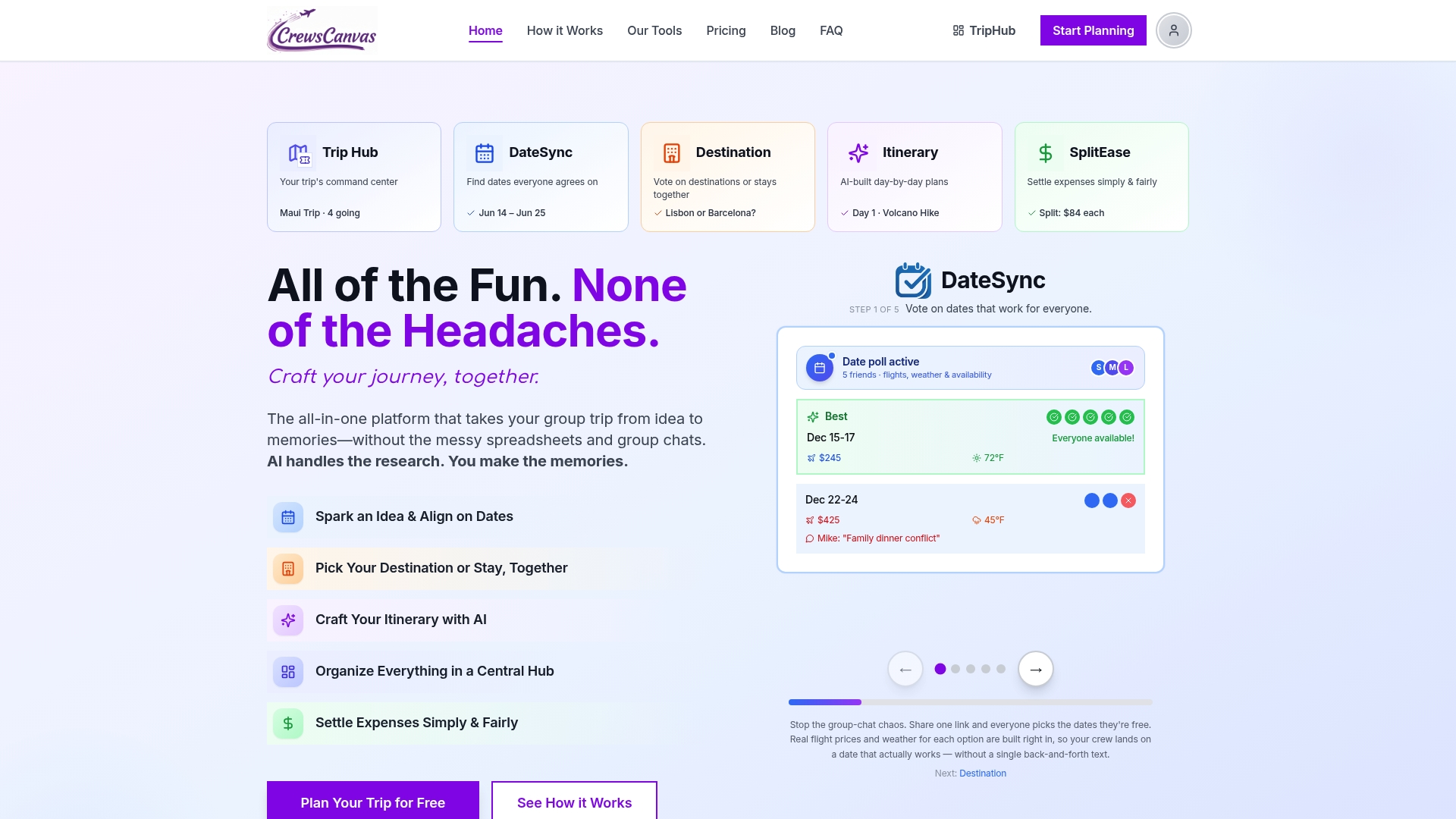
If you are the organizer, start the trip in CrewsCanvas, send the link to the group, and let the expenses build up in one place from the first booking.
Our perspective
Group trips rarely fall apart because of the destination. They fall apart in the gap between "we will figure out the money later" and "later" arriving with six different memories of who paid for what.
We built CrewsCanvas around the idea that the organizer should not have to be the group's accountant. Dates, destination votes, the itinerary and the expenses all belong in one shared hub, so decisions are visible and nobody has to ask what was agreed.
That is also why SplitEase works through a link rather than an app download. A tracker is only as accurate as the least engaged person on the trip, and asking everyone to create an account is the quickest way to end up with a half-empty ledger. When anyone can open the link and add what they paid, the record stays complete and the split stays fair.
Our aim is simple: transparency about the money, so the group can spend its energy on the trip.
CrewsCanvas
FAQ
What is the best way to track shared travel expenses?
Keep one shared record that everyone can see, and log each expense the same day with the amount, currency, who paid, who it covers and a receipt photo. A purpose-built tool beats a spreadsheet because everyone can add entries from their phone and the balances update automatically. SplitEase does this through a shared link with no account required.
How do we set a shared trip budget when everyone has different budgets?
Ask each person privately for a comfortable range, then build the plan around the baseline everyone can afford. Treat extras, such as upgraded rooms or optional activities, as personal costs paid by the people who choose them. Valerie Rivera's advice in The Cut is to ask about comfort rather than assume it from income.
Should we split everything equally?
Only the costs everyone uses, such as the house, groceries and the shared car. Restaurant bills, drinks and optional activities are usually fairer when itemized or limited to the people who took part. Agree on this before the first bill arrives, not at the table.
When should we settle up after the trip?
Within a few days of getting home, or before the trip ends if the balances are already clear. Waiting weeks makes receipts harder to match and reminders more awkward. Decide in advance how to round small leftovers so the last transfers stay simple.
How do we handle receipts and different currencies?
Photograph each receipt when you pay, log the expense in the currency you were charged, and agree on a single currency for the final settlement before you leave. That removes the debate over exchange rates at the end.
Sources
- How to Split Expenses With Friends on a Group Trip, The Cut
- Money Planning for Group Trips, Charles Schwab
- Snoring, slobs and splitting the bills: 19 ways to holiday with friends, The Guardian
- Group Travel Made Easy: Vrbo's Guide, Expedia Newsroom
- How to Plan a Trip With Friends Who Have Different Budgets, Phoenix CVB
- Corporate Retreat Planning: A Practical Guide