
The simplest way to collect money for a group trip is to agree on the numbers before anyone pays, pick one payment method for everyone, and keep a single shared record of who has paid and who still owes. Most of the awkwardness comes from skipping one of those three steps. This guide walks through each, including how to pay safely, handle late payers, and keep reservations and documents where everyone can find them.
TL;DR
- Settle the budget, each person's share, and what counts as shared versus personal before anyone books or pays.
- Choose one collection method for the whole group, and treat payment-app transfers like handing over cash: they can be hard to reverse.
- Write down deposit, cancellation, and late-joiner rules up front so nobody has to improvise a confrontation later.
- Keep one shared link for the itinerary, reservations, and the running tally, so nobody has to dig through a 200-message group chat.
- Use a tool that tracks who owes what, so the organizer is not the group's accountant.
Table of Contents
- Why collecting money feels so awkward
- Step 1: Agree on the numbers before anyone pays
- Step 2: Set deadlines from the real booking terms
- Step 3: Choose how the money moves
- Step 4: Keep a single record of who owes what
- Step 5: Decide the hard cases in advance
- Step 6: Put the trip details in one place
- Perspective: what we have learned about group trip money
- How CrewsCanvas helps
- A simple timeline you can copy
- FAQ
- Sources
Why collecting money feels so awkward
Nobody minds paying their share. What people mind is the uncertainty: how much, by when, to whom, and whether anyone else has paid yet. The organizer ends up fronting a deposit on a card, then sending reminders that sound like nagging.
The fix is not a better reminder message. It is removing the ambiguity that makes reminders necessary. When the amount, the deadline, and the method are all written down and visible to everyone, a nudge becomes a neutral fact ("the balance shows two people outstanding") rather than a personal request.
If you are also working out how to divide the bill itself, our guide on how to split costs on a group trip without the drama covers the math. This article is about the step after that: actually getting the money in.
Step 1: Agree on the numbers before anyone pays
Money conversations go worst when they happen after a deposit is already down. Have them first.
- Ask what everyone is comfortable spending. The Points Guy, citing a Bankrate analyst, recommends discussing money openly and checking what each traveler can comfortably spend before anyone commits. Let people push back or opt out without it being a big moment.
- Estimate by category. Flights, lodging, local transport, food, and activities. A rough number per category is enough to start. Our checklist of eight travel expense categories gives you a ready list with split formulas.
- Label each cost shared, personal, or optional. The group house is shared. One person's spa day is personal. A boat tour only half the group wants is optional. Decide on tips and booking fees in advance too, since they are the items that surprise people.
- Set a per-person figure and a cap. Give people one number to plan around, not a spreadsheet to decode.
If your group has a wide range of incomes, do not skip this step. Our piece on planning a group trip when everyone has different budgets shows how to choose lodging and activities that keep everyone in.
A quick worked example
Say six friends are renting a cabin for a long weekend. The cabin is $1,800 total, groceries are estimated at $360, and a shared activity is $240. That is $2,400 for the shared costs, or $400 each. Flights and any personal extras are tracked separately, since each person pays for their own. Everyone sees the $400 figure and the date it is due before they say yes. That single number does most of the work.

Step 2: Set deadlines from the real booking terms
An arbitrary deadline invites arguments. A deadline tied to a real constraint does not.
Look at when the cabin, hotel, or tour operator actually requires a deposit and the balance, and work backward. Build in a cushion: if the deposit is due on the 15th, ask for payment by the 8th, so a late transfer does not put the organizer in a bind. Say plainly whether the deposit is refundable, and who holds it.
For the lodging side specifically, read the terms before committing. Our guide to checking beds and fees before paying a deposit lists what to confirm so the number you ask people to pay is the real one.
Step 3: Choose how the money moves
There are four common ways groups collect, and each has a trade-off.
| Method | Works well for | Watch out for |
|---|---|---|
| Organizer pays on a personal card, group reimburses | Small groups of close friends | The organizer carries the risk and the float |
| Peer-to-peer payment apps | Quick, informal transfers | Limited recourse if something goes wrong; scams |
| Bank transfer | Larger amounts between people who trust each other | Slower, and details must be entered correctly |
| A shared pool or dedicated account | Bigger groups, multiple shared bookings | Fees on some funding sources; someone must manage it |
Whichever you choose, use the same one for everybody. Mixed methods are how payments get lost.
Understand what protections you do and do not have
This is where groups tend to get casual and shouldn't.
- The FTC describes payment-app transfers as similar to sending cash, and advises sending money only to people you know and verifying requests through a trusted contact method.
- The FTC also notes that mobile-app payments can be hard to recover, and recommends double-checking recipient details before you send. Typing the wrong username on a $400 transfer is a real risk.
- On the FTC's list of basics for these apps: turn on multifactor authentication, a PIN, or biometric authentication, and review who can see your transactions on social media.
- One major payment provider says personal payments to friends and family are free when funded by a bank account or balance, but personal payments are not covered by its purchase protection, and card-funded personal payments carry a fee. Fees and coverage differ by provider, so read your chosen app's current terms.
The practical takeaway: for a trip with real money involved, send to the organizer's confirmed account, verify the recipient name before you hit send, and add the security settings your app may not turn on by default.
And a scam note for organizers: if someone in the group suddenly asks you to pay a "new" account, call or text them on a number you already have before you do. Federal regulators have also been paying attention to this space; the CFPB finalized federal oversight of larger nonbank payment apps handling more than 50 million transactions a year, citing risks around privacy, fraud, errors, and account access. Its enforcement order against one payments company pointed to failures in fraud prevention and in handling disputes over unauthorized transfers. The lesson is not to avoid these apps. It is to use them carefully and keep a record.
Step 4: Keep a single record of who owes what
The moment two or three payments arrive by different routes, memory fails. A running tally everyone can see fixes this.
A good tally shows:
- Each person's share and what they have paid so far
- Deposits tracked separately from day-to-day expenses
- Who fronted what, so reimbursements net out correctly
- A clear "settled" status at the end
A spreadsheet can do this, but it needs someone to maintain it and everyone to trust it. That is exactly the job a tool should take over. For disputes over shared meals and uneven orders, see our guide to itemized expense splitting, and for the social side, expense splitting etiquette.
Step 5: Decide the hard cases in advance
Late payments, dropouts, and late joiners are not rare. They are the norm on any trip with more than a handful of people. Write the rules before the first dollar moves, and post them where everyone can see them.
Late payers. State the deadline, then what happens after it. A common approach is a short grace period, then the organizer can release the spot. Make this a group rule, not a personal judgment.
Cancellations. Spell out whether a deposit is refundable, based on the vendor's actual policy. If someone drops out and the booking cannot be refunded, decide whether they can find a replacement or whether the group splits the loss.
Late joiners. Decide what they owe, including any costs already paid. Someone joining after the deposit should still cover an equal share of it, so the others are not subsidizing them.
Shortened stays. If one person leaves a day early, decide whether lodging is split by nights or equally. Either works if it was agreed ahead of time.
Changes in cost. If the total rises, the organizer announces the new per-person amount with the reason and a new date. Surprises sent as a quiet chat message are what turn into resentment.
The common thread is that every one of these rules is easy to follow when written down and painful to invent on the spot. Our guide to budgeting for a group trip fairly includes a template for stating them.

Step 6: Put the trip details in one place
Money is only half the confusion. If your group is also asking "which flight is Maya on?" and "where is the booking confirmation?", you have the same problem in another form.
Centralizing the details means:
- One shared link that anyone can open without a login. If people have to create an account before they can see the plan, some never will.
- The itinerary, dates, and lodging in the same place as the payments, so the cost and the thing it pays for are visible together.
- Reservations and confirmations uploaded once, so no one needs to forward the same email five times.
- Clear permissions. Everyone can view; only the organizer, or a couple of co-organizers, can edit key items such as dates and amounts.
Sharing reservations and documents safely
A trip folder can hold sensitive material. A sensible rule: share what the group needs and keep the rest private.
- Share confirmation numbers, addresses, check-in times, and booking names.
- Keep passport numbers, full card numbers, and personal ID out of a group-visible space. If the group needs, say, names as they appear on a passport for a booking, collect only that, from each person, directly.
- Remember a shareable link works for whoever holds it. Pass it only to the group, and ask people not to post it publicly.
For more on keeping a trip plan limited to the right people, see our guide to private group trip planning.
Perspective: what we have learned about group trip money
We built CrewsCanvas because the same pattern kept showing up: the trip itself was easy to get excited about, and the money, dates, and scattered details were what wore people down.
Our view is that collecting money should not be a job one person does alone, in private messages, from memory. It should be visible, shared, and boring. When everyone can see the plan, the share, and the status, nobody has to be the bad guy.
That is why we put expense tracking, date voting, the itinerary, and shared reservations in one hub, and why participants can open the shared link without downloading an app or creating an account. The fewer hurdles between a person and the plan, the fewer "I never saw that" moments later.
Our goal is simple: the organizer plans the trip, and the tool handles the bookkeeping.
CrewsCanvas
How CrewsCanvas helps
Here is how the pieces above map to what we offer:
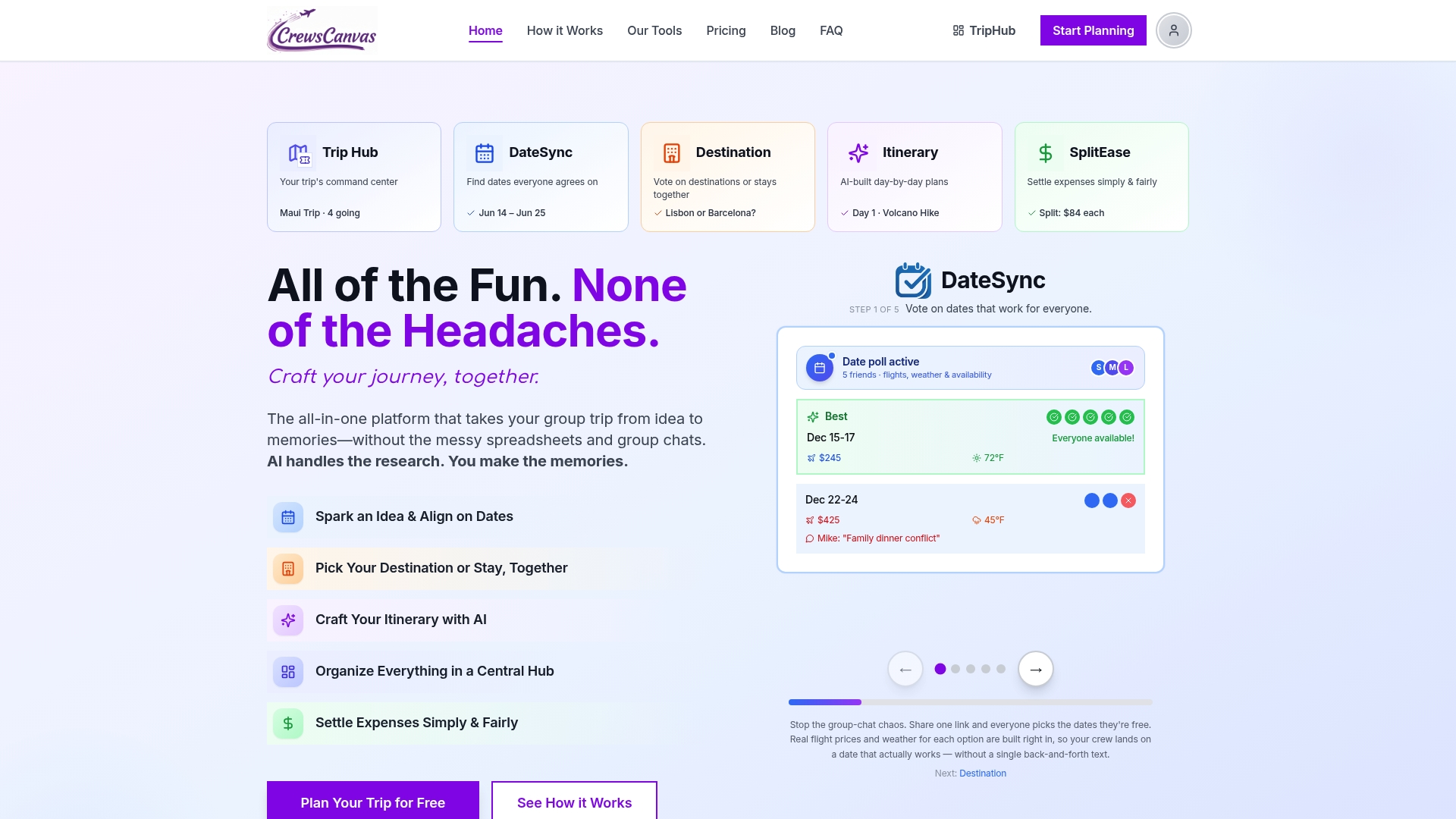
- SplitEase tracks shared expenses and settlement, with receipt scanning, so the group can see who owes what without a spreadsheet. Money is still paid through the method your group chooses; SplitEase keeps the record straight.
- DateSync lets participants vote on dates, so deadlines and deposits are tied to a date everyone agreed to.
- TripHub keeps documents and reservations in one shared place, and the itinerary builder turns your plans into a day-by-day schedule you can customize.
The free plan suits small groups. If you need more capacity or advanced features, Pro Subscription is $9.99 per month, and One-Trip Pro is a $14.99 one-off payment for a single trip. See the plans on our pricing page to compare, or start from the CrewsCanvas home page.
Not sure which fits? One-Trip Pro is built for the organizer who plans one big trip a year and does not want a recurring subscription.
A simple timeline you can copy
Here is a sequence that works for most groups, from first idea to final settlement:
- Weeks 1 to 2: Float the idea, ask about budgets, and poll dates.
- Weeks 2 to 3: Confirm the headcount and set the per-person estimate. Post the cancellation and late-joiner rules.
- Before the first booking: Collect deposit shares by your internal deadline, ahead of the vendor's own.
- Between deposit and balance: Upload confirmations to the shared hub and keep the tally current.
- Before departure: Collect the remaining balance, then confirm every person is marked paid.
- During the trip: Log shared purchases as they happen, and scan receipts rather than saving them for later.
- After the trip: Settle the differences in one round, so nobody is owed $18 for months.
For more on planning with friends in particular, our guide to friends trip planning that keeps budgets, dates, and peace intact goes through the social dynamics.
FAQ
What is the easiest way to collect money for a group trip?
Agree on a per-person amount and a deadline first, then choose one payment method for everyone. Keep a shared tally so each person can see their own status. The method matters less than the clarity: visible numbers prevent most chasing.
Should the organizer pay upfront and get reimbursed?
It works for small groups of close friends, but it puts the risk on one person. For larger groups or bigger deposits, ask for shares before booking, using your internal deadline ahead of the vendor's. If the organizer does front money, track it in a shared record so the reimbursement is clear.
Are payment apps safe for collecting trip money?
They are convenient, but the FTC says transfers work much like sending cash and can be hard to recover if you send them to the wrong person or to a scammer. Turn on multifactor authentication, double-check the recipient, and only send to people you know. Review your app's current fees and protections before you start.
What should I do about someone who has not paid?
Point to the rule the group already agreed on rather than making it personal. Send one neutral reminder with the amount and the date, then follow the grace period you set. Having the status visible to everyone usually resolves it before you need to escalate.
Can everyone see the trip details without making an account?
With CrewsCanvas, participants can use a shared link to collaborate on planning and expense tracking without creating an account or installing an app. Organizers decide who they share the link with, so it is worth sending it only to the group.
Sources
- How to split travel costs with friends and family, The Points Guy
- Do you use payment apps? FTC consumer alert, August 2023
- Mobile Payment Apps: How To Avoid a Scam, FTC
- Tips for using peer-to-peer payment systems and apps, FTC
- PayPal Payment Types: Personal Payments vs Goods
- CFPB finalizes rule on federal oversight of digital payment apps
- Block, Inc. enforcement action, CFPB