
The way to manage a group travel budget is to agree on a spending range before anyone books, decide in advance how each cost gets split, record every expense in one shared place as it happens, and settle balances right after the trip. Money gets awkward in groups when those four things are left to chance. When they are settled early, the budget becomes a plan instead of a source of tension. With CrewsCanvas, the whole group can vote, see the numbers and split costs from one shared link, with no one required to create an account or download an app.
This guide walks through each step for friends, families, couples and teams, with a worked example you can copy.
TL;DR
- Ask first, book second. Find out what each person is comfortable spending, then plan around the lowest comfortable number, not the average.
- Budget by category. Transportation, lodging, meals, activities and a 10 to 15 percent cushion for surprises.
- Pick split rules before the trip. Equal splits for shared basics, itemized splits for anything people use differently.
- Track as you go. One shared record, receipts saved, one person acting as treasurer.
- Settle fast. Share a summary and square up during the trip or within a few days afterward.
Table of Contents
- Why group trip budgets go wrong
- Step 1: Find out what everyone can comfortably spend
- Step 2: Build the budget by category
- Step 3: Agree on how costs get split
- Step 4: Choose a treasurer and a collection method
- Step 5: Track every expense in one shared place
- Step 6: Handle changes and overruns together
- Step 7: Settle up quickly
- Budgeting for different kinds of groups
- What we believe about group trip money
- Put the budget in one place
- Quick budgeting checklist
- FAQ
- Sources
Why group trip budgets go wrong
Most group budget problems are not math problems. They are conversation problems. One person assumes a beach house is a splurge worth sharing, another assumed a hostel, and nobody said so until the deposit was due. Then the receipts pile up in a 200-message group chat and someone ends up paying for things they never wanted.
Three patterns cause nearly all of it:
- No agreed range. People commit to a trip before they know what it costs them.
- No agreed rules. Nobody decided whether the group splits everything evenly or pays for what they use.
- No shared record. Expenses live in memory, photos and scattered messages, so settling up becomes an argument about who remembers what.
The steps below fix each one in order.
Step 1: Find out what everyone can comfortably spend
Do this before dates, destinations or deposits. Financial guidance for group trips consistently starts here: Charles Schwab's group-trip guide recommends talking through spending styles and agreeing on a rough overall range for lodging, meals and activities before booking.
People rarely say their real limit in a group chat. An anonymous form works better. The Cut quotes certified financial planner Valerie Rivera recommending that organizers ask travelers early what they are comfortable spending, including through an anonymous form with accommodation ranges and optional activity costs. A few good questions:
- What is the most you would comfortably spend on the whole trip, not counting flights?
- Which nightly lodging range feels right: budget, mid-range or splurge?
- Which paid activities do you definitely want, and which would you skip?
Then use the answer that protects everyone. The same article advises planning around the lowest common budget instead of guessing what friends can afford or want to spend. If one person's ceiling is $900 and everyone else would pay $1,500, a $1,500 trip excludes someone or quietly strains them. A $900 core plan with optional add-ons keeps everyone in.
If your group's budgets differ widely, our guide on planning a group trip when everyone has different budgets goes deeper, and setting a group trip budget everyone can afford covers the conversation itself.
Step 2: Build the budget by category
A single total hides where the money goes. Categories show it. Princeton University's group travel budgeting guide names flights, ground transportation, accommodation, meals and activity fees as the core cost categories, with items like event tickets, guides and venue costs as possible additions.
For a typical friends or family trip, use this skeleton:
| Category | What to include | How to estimate |
|---|---|---|
| Transportation | Flights, gas, rental cars, transfers, parking | Real quotes, plus tolls and baggage fees |
| Lodging | Rental, hotel rooms, cleaning fees, taxes | Actual listing totals after fees |
| Meals | Groceries, group dinners, drinks | Daily per-person target times days |
| Activities | Tours, tickets, rentals | Published prices for the ones you want |
| Cushion | Tips, supplies, surprises | 10 to 15 percent of the total |
Two details save the most money. First, use the final price, not the headline price. CIT Bank's group travel guide recommends researching costs ahead of time and accounting for the fees and taxes that are often left out of listed airfare, hotel and rental-property prices. Second, build in the cushion. The same guide suggests adding 10 to 15 percent for surprises.
A worked example
Say six friends plan a three-night cabin weekend.
- Lodging: $1,200 total after cleaning fee and taxes
- Gas and parking: $240 total
- Groceries and two group dinners: $600 total
- One paid activity (a guided hike): $35 per person, or $210
- Subtotal: $2,250
- Cushion at 12 percent: $270
- Planning total: $2,520, or $420 per person
Now you can ask the real question: is $420 inside everyone's comfortable range? If it is not, adjust before booking, perhaps by cooking more meals or making the hike optional, rather than after.
For the lodging line, it helps to compare options the whole group can actually afford. This breakdown of how to choose group accommodation covers the trade-offs of staying together. And if you are weighing transport costs in a destination with organized tours, a comparison of private guides and group tours in Iceland shows how that single choice shifts a budget.
When the group decides on lodging and destination together, CrewsCanvas lets everyone vote on destination and accommodation options in one place, and DateSync lets participants vote on dates, so cost and availability are settled before money changes hands.

Step 3: Agree on how costs get split
Before booking, define which expenses are shared, how they will be split, and how optional choices are handled. CIT Bank's guide also recommends agreeing on how people will reimburse each other and whether balances settle during or after the trip, then telling everyone the rules clearly.
There are three common methods, and most trips use a mix.
Equal split
Everyone pays the same. This is simplest and fits when spending styles and incomes are similar. It works well for shared basics: a rental car everyone rides in, a house everyone sleeps in, groceries everyone eats. Financial coach Jasmine Ramirez, quoted in The Cut, suggests setting shared-cost standards in advance and splitting common transportation evenly when the whole group uses it.
Itemized split
People pay for what they ordered or used. CIT Bank notes that equal splitting is less suitable when spending styles differ substantially. Ramirez favors itemizing restaurant costs so non-drinkers or lighter eaters do not subsidize other people's orders. Itemizing takes more bookkeeping, which is exactly why a shared tool helps. Our guide to itemized expense splitting shows how it works in practice.
Split by room
When rooms differ in size or quality, splitting lodging by person is not always fair. CIT Bank suggests considering a split by room instead. A couple in the primary suite with a private bath may reasonably pay more than two friends sharing a smaller room.

Write the rules down
A short message to the group is enough:
- Shared: lodging, rental car, gas, groceries, group dinners.
- Individual: personal drinks, souvenirs, optional activities.
- Optional activities are opt-in, and nobody is expected to join every paid one.
- We settle up within a few days of getting home.
That last point about opting out matters. A NerdWallet podcast discussion on group vacations emphasizes flexibility: people need not join every paid activity, and changes should be discussed with group buy-in rather than imposed afterward. For more on the social side, see our expense splitting etiquette guide and how to split costs on a group trip without the drama.
Step 4: Choose a treasurer and a collection method
Someone has to be the point person. Metro Credit Union's guide recommends appointing a trip manager or treasurer to track expenses, manage payments and coordinate the budget. It also suggests considering a shared fund for large shared costs.
In practice, that means two choices:
- Who fronts big bookings? Usually the organizer puts the lodging deposit on a card. Collect each person's share quickly so one person is not carrying the group's money for months.
- How do people pay in? Decide on a single method and a single deadline for each payment, and put both in writing.
The treasurer should not also be the person who absorbs every awkward conversation. A shared, visible record takes that pressure off, because the numbers speak for themselves.
Step 5: Track every expense in one shared place
Metro Credit Union's guide recommends keeping a shared expense record updated as purchases occur and recording who paid, along with receipts and confirmations. CIT Bank says groups should keep the shared budget in an accessible spreadsheet or expense-sharing app and keep it updated in real time. Charles Schwab's guide adds that people should label receipts when they incur different costs for activities, drinks or services.
A few habits make tracking painless:
- Log it the same day. Memory fades by dinner the next night.
- Photograph receipts. CIT Bank recommends saving receipts, including photos.
- Note who it covers. "Dinner, all six" and "Drinks, three people" settle very differently.
- Hold a short money check-in on longer trips. CIT Bank suggests brief check-ins so nobody is surprised at the end.
Spreadsheets can do this, but they depend on everyone remembering to open and edit them. Our walkthrough of group expense tracking lays out a simple system either way.
This is the step where we built SplitEase. It handles collaborative expense tracking and settlement with receipt scanning, so the person who paid snaps the receipt, and the shared record updates for the whole group. Participants use a shared link and may never need to create an account, which matters when your group includes a parent who does not want another app.
Step 6: Handle changes and overruns together
Budgets move. A rental price jumps, a tour sells out, someone adds a day. One survey reported by The Herald Business found that Korean respondents said group trips cost an average of 15.6 percent more than originally budgeted. That survey covers South Korea, not the US, but it shows why a cushion belongs in every plan.
When costs change:
- Tell the group right away. Surprises about money feel worse than the amount itself.
- Get buy-in on the fix. The NerdWallet discussion recommends communicating and getting group agreement when budgets or expenses change, rather than imposing the change afterward.
- Offer options. Cut an activity, cook one more dinner, shorten a night, or let people opt out of the extra cost.
- Draw from the cushion first. That is what it is for.
If the overrun is your fault as organizer, say so plainly. Groups forgive a clear correction far more readily than a mystery.
Step 7: Settle up quickly
The longer a balance sits, the harder it is to collect. Charles Schwab's guide recommends sharing a post-trip expense summary and settling balances before the trip ends or within a few days afterward. Metro Credit Union's guide likewise advises settling promptly at the end of the trip.
A clean close-out looks like this:
- Confirm the last expenses are logged.
- Share one summary showing totals, who paid what and who owes whom.
- Set a settle-by date, a few days out.
- Send one friendly reminder to anyone outstanding.
A summary that nets everything out means fewer payments. If three people each owe one another small amounts, the math can often collapse into one or two transfers. If balances do slip, tracking unpaid trip expenses includes message scripts for asking without friction.
Budgeting for different kinds of groups
Friends. Budgets and spending habits vary most here. Lean on the anonymous range question and opt-in activities.
Families and reunions. Several households, different ages, different incomes. Split lodging by room or household, and consider letting people cover their own meals on days they do their own thing.
Coworkers and team retreats. Decide up front what the company covers and what individuals pay. Keep a clean record of who paid what for reimbursement.
Couples. With two people the question is less about splitting and more about agreeing on a total and on what is worth splurging on. A category budget still helps.
What we believe about group trip money
We built CrewsCanvas around one idea: the trip is easier to enjoy when the money part is boring.
In our view, most budget fights start before the trip, when people agree to a plan without seeing what it costs them. That is why we put decisions in one place. DateSync lets a group vote on dates, destination and accommodation can be voted on too, and SplitEase keeps shared costs and settlements in the same hub as the plan. When everyone sees the same numbers at the same time, nobody has to play accountant or collector.
We also think the people who join a trip should not need homework. Participants use a shared link, and they do not need to download an app or create an account to take part. The organizer does the setup, and everyone else just contributes.
Our approach is simple: agree early, record as you go, settle fast. Our tools are designed to make each of those three steps the easy default.
CrewsCanvas
Put the budget in one place
If you want the voting, planning and splitting in one hub, CrewsCanvas has a free plan for small groups. Pro is $9.99 per month, and One-Trip Pro is a $14.99 one-time purchase if you only need extra capacity and features for a single trip. You can compare them on the pricing page.
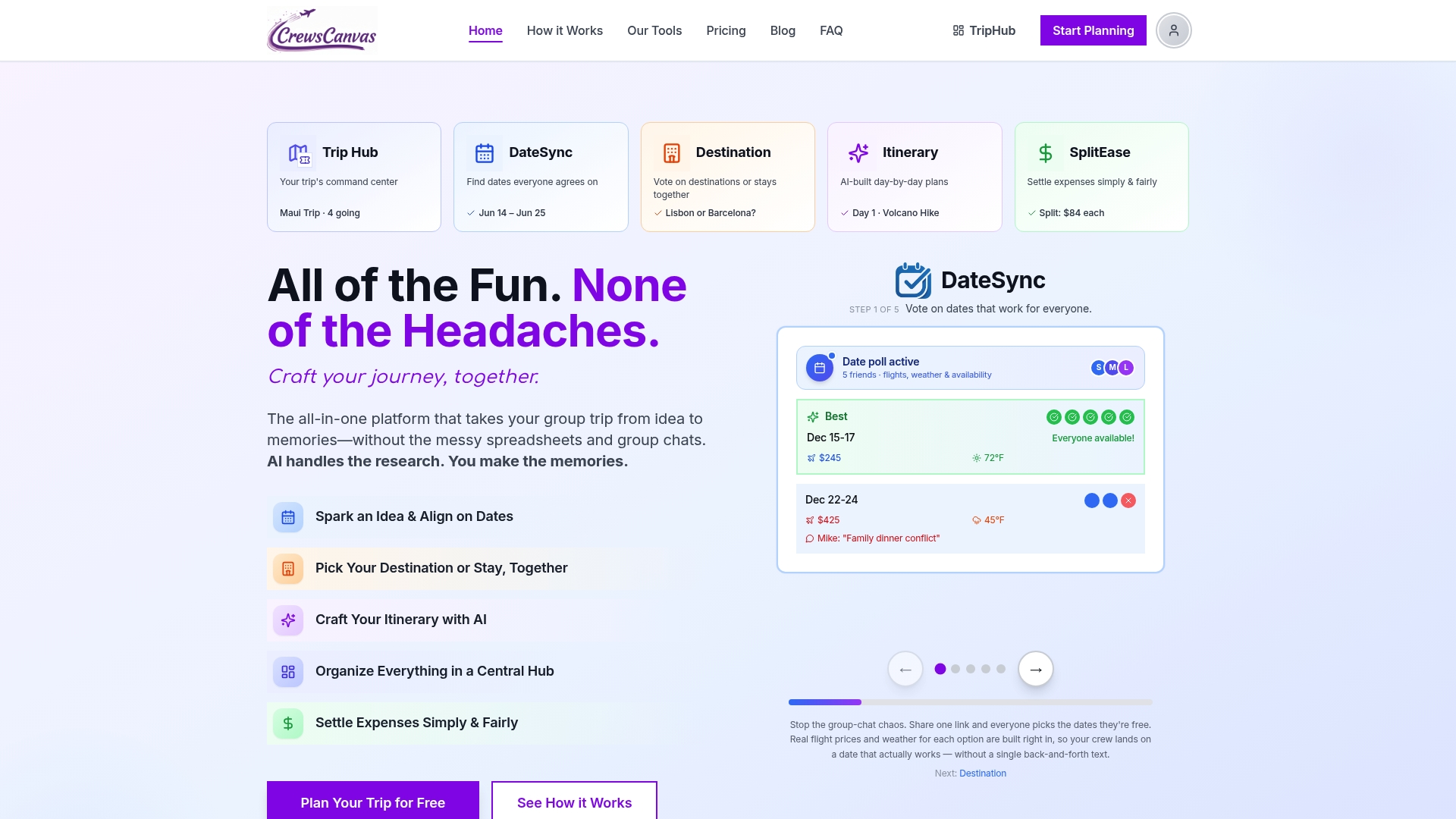
You can also see how the pieces fit in the CrewsCanvas toolkit, including the itinerary builder, so the budget and the plan stay in step.
Quick budgeting checklist
Before you book anything, run through this list:
- Everyone has shared a comfortable spending range, privately if needed.
- The plan fits the lowest comfortable number.
- Costs are listed by category using final prices with fees and taxes.
- A 10 to 15 percent cushion is included.
- Shared and individual expenses are defined in writing.
- A treasurer is named and a payment method and deadline are set.
- There is one shared place to log expenses and save receipts.
- A settle-up date is agreed.
If you would like help on the booking side too, see our travel booking management guide and our guide to building a shared travel itinerary.
FAQ
How much should we add as a buffer to a group travel budget?
A cushion of 10 to 15 percent is a common recommendation, according to CIT Bank's group travel guide. Apply it to the full subtotal, not just one category. Use it for tips, small supplies and price changes, and tell the group when you dip into it.
Should we split everything equally?
Equal splits work for shared basics like lodging, a rental car and group groceries, especially when spending styles are similar. For restaurant meals, drinks and optional activities, itemizing is fairer when people order or do different things. Most groups combine both and write the rules down before the trip.
Who should manage the money on a group trip?
Name one trip manager or treasurer to track expenses, coordinate payments and share the summary. Keep the record in a shared place so everyone can see it. That keeps the treasurer from being the bad guy and keeps the numbers transparent.
What if one person can't afford the trip we planned?
Plan around the lowest comfortable budget in the group instead of the average. Make add-ons optional so people can join only what suits them. If it still does not fit, adjusting the lodging or the length of stay is better than letting someone quietly overspend.
When should we settle up after the trip?
Settle before the trip ends or within a few days afterward, as Charles Schwab's guide recommends. Share one summary, set a settle-by date and send a single reminder to anyone outstanding.
Sources
- How to manage money on a group trip | CIT Bank
- How to Split Expenses With Friends on a Group Trip | The Cut
- Money Planning for Group Trips | Charles Schwab
- Budgeting for Group Travel | Princeton Travel & Expense
- Splitting Expenses on a Group Trip | Metro Credit Union
- Korean survey on group trip costs | The Herald Business
- Group Accommodation: How to Choose Where to Stay Together
- Private Guide Versus Group Tour in Iceland