
A travel expense receipt only does its job if it shows the date, the vendor, what was bought, the amount and how it was paid, and if you can find it again weeks later. The simplest habit is this: photograph every receipt the moment you pay, attach it to an expense entry that says who paid and who shares the cost, and settle up from that one log after the trip. This guide covers what a good receipt contains, how to scan and file receipts while you travel, and how a group can turn a pile of paper into a fair, argument-free settlement.
TL;DR
- A usable receipt shows the transaction date, vendor, itemized purchase, amount and proof of payment. Hotels, flights and rental cars are the ones you can least afford to lose.
- Capture every receipt with your phone on the spot. A photo taken at the counter beats a crumpled paper slip found in a jacket pocket.
- For a group, a receipt is only half the record. Pair it with who paid, who shares the cost and the currency.
- If you travel for work, the IRS expects records of your expenses, and employers often require itemized receipts over a set amount.
- Settle from one shared log within a week or two of getting home, while everyone still remembers what the charges were.
Table of Contents
- Why receipts matter on a trip, even a casual one
- What a valid travel receipt should show
- Which shared trip expenses to document
- How to scan receipts while you travel
- How to organize receipts so you can find them later
- Tying receipts to an expense log: who paid, who shares
- When a receipt is missing, refunded or in another currency
- How long to keep travel receipts
- Our perspective
- Put your receipts where the expenses are
- A five-step plan for the whole trip
- FAQ
- Sources
Why receipts matter on a trip, even a casual one
On a solo business trip, receipts are proof for your employer or your tax return. On a trip with friends or family, they do something just as valuable: they settle the question "wait, what was that charge?" before it turns into an awkward group-chat thread.
There are three common reasons to keep them:
- Reimbursement. An employer, a client or a team budget owner wants proof of what you spent.
- Taxes. If any part of the trip is a business expense, you need records that back it up.
- Fair splitting. When one person puts the villa deposit, the groceries and the rental car on their card, the receipts are the evidence of what everyone owes.
The third reason is the one most trip guides skip, and it is the one we see most often in group travel. If your group has ever tried to rebuild a week of spending from memory and card statements, you already know why.
What a valid travel receipt should show
The exact rules depend on who is asking, but the major requirements overlap a lot. Here is what several US institutions that publish their travel policies ask for.
The University of Pennsylvania says an acceptable receipt includes the transaction date, merchant, purchase details, payment method, amount, and an indication that it was paid. It also requires itemized receipts for expenses of $75 or more, and for certain categories whatever the amount, according to its travel receipt requirements policy.

Indiana University lists four essentials: date, amount, proof of funds tendered (typically the last four digits of the card) and vendor name. It requires receipts regardless of amount for airfare, lodging, rental vehicles and student group travel meals, per its receipt requirements page.
MIT asks for itemized receipts on purchases over $75, on meals that include alcohol, and on business meetings regardless of amount, and wants them submitted within 60 days of the trip's end, according to its procurement guidance on saving receipts.
These are university policies, not universal law, but they give you a realistic standard to aim for. If your receipt would pass these checks, it will almost certainly satisfy a casual group or a typical employer.
Restaurant and hotel receipts
The details that matter differ by type of purchase. The University of Connecticut's itemized receipt guidelines spell them out:
| Purchase | What the receipt should show |
|---|---|
| Restaurant | Restaurant name, date, number of guests, itemized food and drinks with prices, total charges, amount paid |
| Hotel | Hotel name and address, check-in and check-out dates, number of guests or rooms, room rate, taxes and fees per night, total charges, amount paid |
Two practical lessons follow. First, a card slip with only a total is not an itemized receipt. Ask for the full itemized copy, or photograph the check before you sign. Second, the itemized restaurant bill is also what lets a group split fairly when some people ordered drinks and others did not. Penn notes that itemization is what makes it possible to separate costs such as alcohol from other charges, a point that applies to personal splitting as much as to institutional accounting.
If you are planning business meals on the road, a business travel meal planning guide can help you pick where to eat ahead of time, which makes it easier to ask for an itemized bill when the check arrives.
Which shared trip expenses to document
Not every dollar needs the same level of care. A sensible rule for a group: document anything that is shared, anything over a modest threshold, and anything paid by one person on behalf of others.
Typical shared costs worth a receipt or a screenshot:
- Lodging: deposits, final balances, cleaning fees, resort fees and taxes.
- Transportation: flights, train tickets, rental car, fuel, parking, tolls, airport transfers.
- Food: group dinners, grocery runs for a shared kitchen, a bulk alcohol purchase.
- Activities: tours, tickets, equipment rentals, guides and tips.
- Miscellaneous shared supplies: beach gear, firewood, ice, a first-aid kit.
For a fuller list of categories and the formulas that go with them, see our travel expense categories checklist. If you have a car in the mix, our walk-through on how to split a rental car covers the charges that tend to surprise people.
Personal purchases such as souvenirs and solo snacks usually do not belong in the shared log. Agree at the start which categories are shared and which are individual, and you will skip most of the later arguments.
How to scan receipts while you travel
Paper receipts get lost, fade (thermal paper is notorious for it) and pile up in bags. Scanning with your phone solves all three problems.
A simple capture routine
- Photograph it right away. Lay the receipt flat on a dark surface, make sure all four corners are in frame and the text is readable.
- Check legibility before you toss it. Zoom in on the total and the date. If either is blurry, retake it now.
- Name or tag it immediately. A consistent format such as date, vendor, amount makes later searching painless.
- Attach it to an expense entry. A photo floating in your camera roll next to 400 sunset pictures is not an organized record.
- Keep the paper until you are home for anything over your threshold, especially lodging, flights and car rentals.
Most receipt-scanning tools today read the vendor, date and total from a photo automatically, and some handle foreign-language receipts or work offline and sync later. Tools like that are widely available, so choose one that fits how your group actually shares information. For a group, the key question is not how clever the scanner is. It is whether the scanned receipt ends up attached to a shared expense that everyone can see.
Digital receipts count too
Many receipts never touch paper: booking confirmations, ride-share emails, app purchase summaries. Save them as PDFs or screenshots in the same place as your scanned ones. If you share booking confirmations with the group, be careful about what is visible on them. Our guide to sharing booking screenshots without exposing payment details explains what to crop or hide.
The IRS says that when you travel away from home on business, you must keep records of your expenses, and that a log, diary, notebook or any other written record can serve to track them. Supporting documentation is described in Table 5-1 of IRS Publication 463. For personal or tax questions about your own situation, a tax professional or the IRS itself is the right place to confirm what applies to you.
How to organize receipts so you can find them later
Capturing is the easy part. Organizing is what saves you in month three, when someone asks about the cleaning fee.
Use one home per trip. Create a single folder or shared space for each trip. Everything goes there: scans, confirmations, screenshots, PDFs.
Sort by category and date. Lodging, transport, food, activities. Within each, order by date. Our guide to organizing trip documents goes deeper on folder structure for groups.
Use a consistent file name. For example: 2026-11-08 Harbor Inn lodging 412.50. Anyone can scan a list of names like that in seconds.
Back up in two places. A phone can be lost or stolen on a trip. Keep copies in cloud storage plus one other location.
Reconcile as you go. Once a day, spend two minutes matching the day's receipts to entries. Do it at breakfast or on the way to the airport. Reconciling a day's worth is trivial. Reconciling ten days at the airport gate is not.

Tying receipts to an expense log: who paid, who shares
A receipt tells you what was bought. It does not tell you who fronted the money or who benefits. For group trips, every entry should carry five fields:
| Field | Example |
|---|---|
| What | Dinner at the harbor restaurant |
| Amount and currency | 186.40 EUR |
| Who paid | Maya |
| Who shares it | Maya, Dev, Sam, Lee (Priya skipped) |
| Receipt | Photo attached |
That one table row answers nearly every dispute: the charge is real, the amount is documented, and the people who share it are named. The next step is splitting. Equal splits work for rooms and shared transport. Itemized splits work when people ordered differently. Our article on itemized expense splitting shows how to handle both without a calculator marathon, and the piece on three ways to track who paid what compares the common approaches.
A worked example
Four friends spend a long weekend away. Maya pays $620 for a cabin, Dev pays $148.30 for groceries, and Sam pays $96 for a rental kayak session for three of the four people.
- Cabin: $620 split four ways is $155 each.
- Groceries: $148.30 split four ways is $37.075 each, so round to $37.08 and let the rounding settle in the final tally.
- Kayaks: $96 split three ways is $32 each, only for the three who went.
Without receipts and a clear "who shares" column, the kayak charge is exactly the kind that gets forgotten or argued about. With them, the math takes minutes.
When a receipt is missing, refunded or in another currency
Things go wrong. Here is how to handle the usual problems.
Missing receipts
First, ask the vendor for a duplicate. Hotels and airlines can almost always email one. If that fails, combine other records. Texas A&M's disbursement rules say a booking confirmation showing the detailed itinerary, plus a card statement showing the transaction as proof of payment, can replace a missing receipt, according to its receipt requirements. Penn adds that a missing-receipt declaration may not be used for lodging, airfare and airline fees, conference registration, rental cars or rail, so those are the ones to guard most carefully.
For a friends' trip, the standard is much simpler: a card statement line or a payment-app record, plus a note of what it covered, is usually enough to agree on an amount.
Refunds and cancellations
Keep the original receipt and add the refund as a separate negative entry linked to it. Then the log shows the true net cost, and everyone who shared the original charge shares the refund.
Foreign currencies
Record the amount in the currency you paid, and note the converted figure too. Penn requires that a foreign-currency receipt come with its U.S. dollar equivalent, and Texas A&M tells travelers to convert using the rate on the date shown on the receipt. For group splits, agree on one method early, for example the rate your card actually charged, as shown on the statement. The charge on the statement includes any bank fees, so it is often the fairest figure to share. Whichever you choose, apply it to everyone.
How long to keep travel receipts
For personal trips, keep receipts until the group is fully settled and any refunds have cleared. For business travel, keep them longer. A US tax-preparation firm notes that routine business expense records are generally kept for three years from the filing date, with longer periods in specific situations, in its guide to organizing receipts for taxes. Retention rules differ by country and by situation, so confirm the period that applies to you with an accountant or your tax authority. Legible digital copies are generally what most people rely on today, which is one more reason to scan.
Our perspective
We built CrewsCanvas around a simple observation: the receipt is rarely the problem. The problem is that the receipt lives in one person's pocket, the expense lives in a spreadsheet, and the conversation about who owes what lives in a 200-message group chat.
That is why we put receipt scanning inside SplitEase, next to the expense itself. When a receipt is attached to an entry that already says who paid and who shares the cost, nobody has to reconstruct anything at the end of the trip.
We also believe the people on your trip should not need to create accounts or install an app just to see a charge. Our platform works on the web through a shared link, so everyone in the group can follow the numbers. Our goal is transparency without the awkward conversation.
CrewsCanvas
Put your receipts where the expenses are
If you are tired of piecing together receipts, card statements and chat messages, SplitEase is our expense tool for group trips. You log an expense, scan the receipt, choose who shares it, and the app keeps track of what each person owes, all through a web link your group can open without downloading anything.
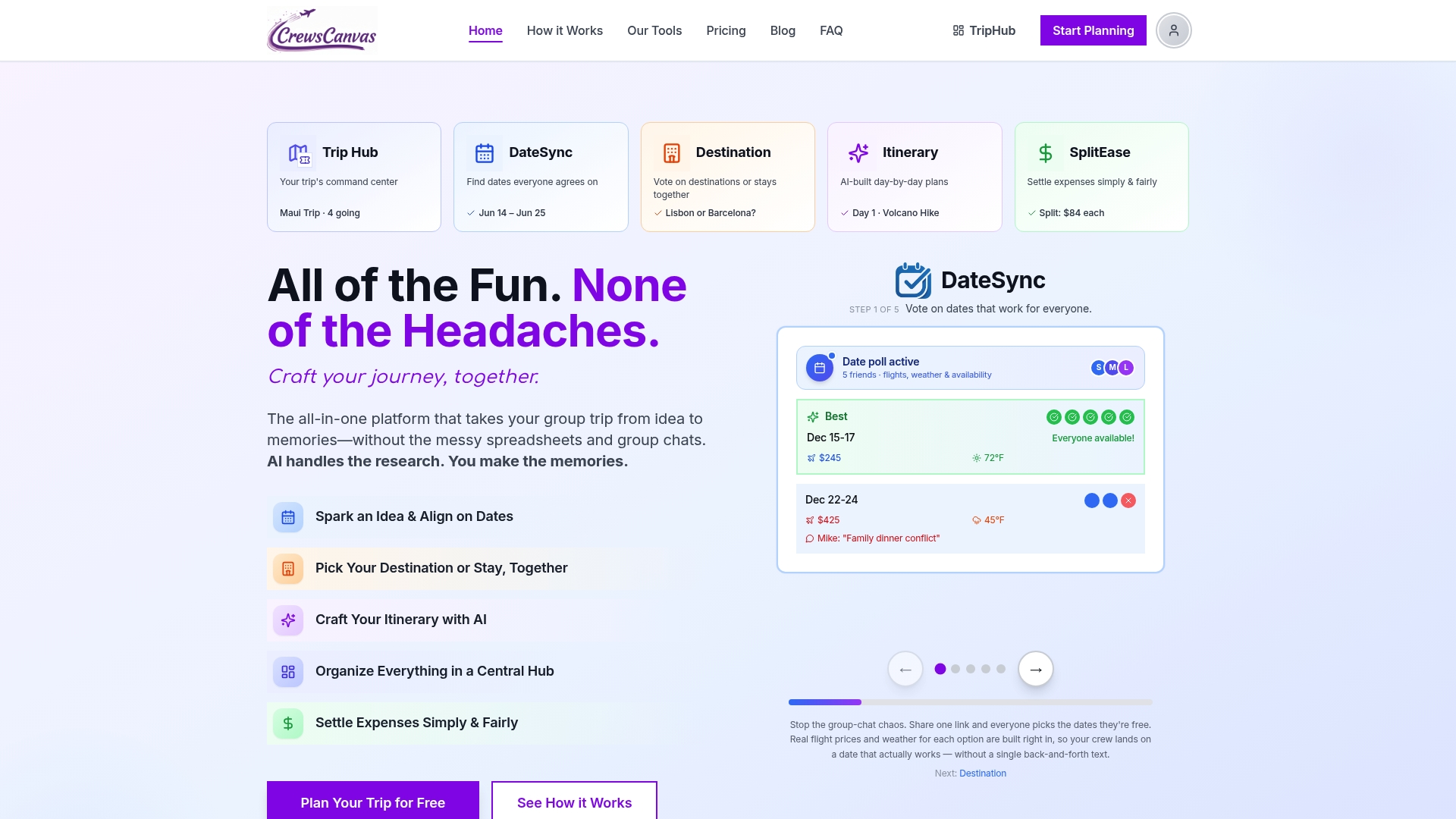
You can start on the free plan. Pro Subscription is $9.99 per month, and One-Trip Pro is a one-time $14.99 for a single trip. See the details on our pricing page, or browse the whole planning toolkit if you also want date polling and itinerary building in the same place.
A five-step plan for the whole trip
Here is the routine in one place.
- Before you go: agree which categories are shared, which are personal, and which currency or method you will use for conversions. Decide who will be the main record keeper, if anyone.
- At every purchase: ask for an itemized receipt and photograph it before leaving the counter.
- Each evening: attach the day's receipts to expense entries, naming who paid and who shares.
- Before you fly home: check that lodging, transport and any large charges each have a receipt or a confirmation.
- Within a week or two of returning: tally the log, settle up, and file the folder. If someone is slow to pay, our scripts for chasing unpaid trip expenses keep it friendly, and the expense splitting etiquette guide covers the rest.
If you are still choosing where to stay, it helps to check beds and fees before paying a deposit, since the deposit is often the largest receipt in the whole log.
FAQ
What should a travel expense receipt include?
At minimum: the date, the vendor name, the amount and proof of payment such as the last four digits of the card. For meals and lodging, an itemized version is better, listing each item or nightly charge, taxes and fees. Institutions such as Penn and Indiana University publish these requirements, and following them is a safe standard for most situations.
Do I need to keep receipts for small purchases?
For a personal trip, small purchases matter only if they are shared. For business travel, many employers set a threshold. Penn and MIT, for example, require itemized receipts at $75 and above, with exceptions for some categories at any amount. Check your own employer's policy, and when in doubt, photograph it.
Is a photo of a receipt good enough?
For most group splitting and employer reimbursement, yes, as long as the photo is clear and shows the whole receipt. The IRS accepts a range of written records for business travel, though your employer or tax professional can tell you what applies to your case. Keep the paper for big items like lodging until you are fully settled.
How do I split a receipt when people ordered different things?
Use the itemized bill. Assign each line to the people who had it, then divide shared items such as appetizers, tax and tip proportionally or equally, whichever your group agrees on. Doing this inside an expense tool beats doing it on a napkin.
What if I lose a receipt?
Ask the vendor to email a duplicate. If that is not possible, a booking confirmation plus a card statement line can stand in for it in many institutional policies. For friends' trips, a card statement and a short note are usually enough.
Sources
- University of Pennsylvania: Travel and Entertainment Receipt Requirements
- Indiana University: Receipt Requirements
- University of Connecticut: Itemized Expense Receipt Guidelines
- MIT Procurement: Saving Your Receipts
- Texas A&M Disbursement Manual: Receipt Requirements
- IRS Publication 463 (2024)
- Tax Experts of OC: How to Organize Receipts for Taxes
- Business Travel Meal Planning Guide for 2026